About the Author:

Kamal Uddin is an experienced tech career mentor and former software engineer with over a decade of industry experience. Having successfully transitioned from a non-traditional background himself, Kamal specializes in guiding aspiring developers through the complex landscape of coding education, helping them make informed decisions to land rewarding roles in software engineering.

The Quiet Struggle of Chasing a Career in Software Engineering

You wake up every single morning feeling completely exhausted by your current job. The daily routine feels heavy, the pay is barely enough to cover your basic bills, and your hard work goes unnoticed. You look at the tech industry with a sense of hope, wishing you could build real software and earn a great living.

The idea of becoming a developer sounds amazing, but you do not know where to start. You see endless ads for coding schools making big promises, but you worry about making a huge mistake.

Many people fall into dangerous traps when trying to switch careers because they lack clear guidance:

  • Falling into the tutorial trap: You spend hours watching free video playlists without actually writing any real code yourself.
  • Buying outdated courses: You spend your hard-earned money on cheap, outdated classes that do not teach modern development tools.
  • Believing flashy marketing: You trust schools that guarantee a high-paying job in twelve weeks without doing your own research first.
  • Learning without a system: You try to learn too many programming languages at once and end up feeling deeply confused.

This constant confusion quickly turns into a heavy mental burden. You start to doubt your own intelligence and wonder if you are simply not smart enough to code.

The fear of wasting your life savings on a bad program keeps you awake at night. You feel stuck in a loop of wanting a better future but feeling too scared to take the first step.

The Ultimate Blueprint to Choosing a High-Quality Coding Academy

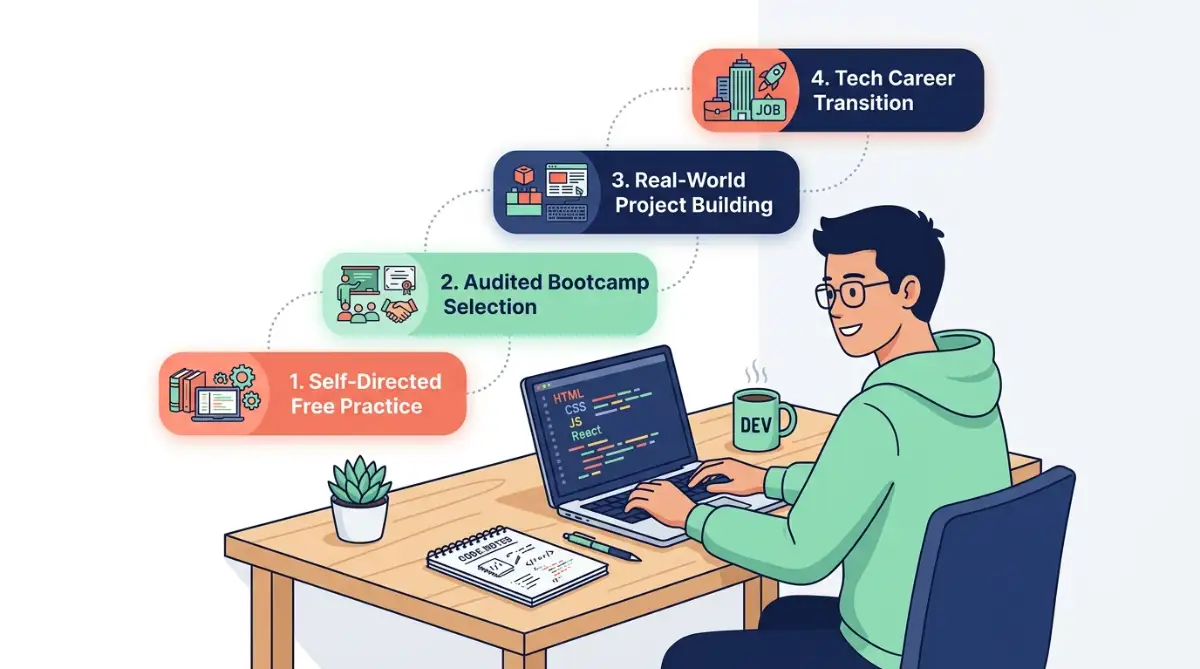
Making the transition into tech is a massive life shift. Letโ€™s bypass the flashy marketing fluff and look at a practical, step-by-step roadmap designed to help you separate high-quality coding academies from expensive traps.
1. Identify Your Ideal Learning Style and Daily Routine

Before you look at any coding program, you must understand how you learn best. Some people need a quiet room and a strict schedule, while others need total flexibility.

Understand the Full-Time Versus Part-Time Choice

If you have a family to feed or bills to pay, quitting your job to study full-time is incredibly risky. A full-time schedule requires forty to sixty hours of intense work every single week.

On the other hand, part-time programs let you keep your current job while you study in the evenings. This path takes longer, but it protects your financial health and reduces stress.

Weighing In-Person Classes Against Online Classrooms

In-person programs give you direct access to teachers and classmates in a physical room. This format is wonderful if you struggle with self-discipline or get distracted easily at home.

Online programs offer the ultimate convenience of learning from your own living room. However, they require you to be highly organized and self-motivated every day.

Full-Time Online

  • Weekly Time Commitment: 40 - 60 Hours
  • Best Suited For: People with savings who want fast results
  • Risk Level: High

Part-Time Online

  • Weekly Time Commitment: 15 - 25 Hours
  • Best Suited For: Working professionals and busy parents
  • Risk Level: Low

In-Person Local

  • Weekly Time Commitment: 50+ Hours
  • Best Suited For: Learners who need face-to-face help
  • Risk Level: Medium

***A Note for International and Remote Learners:***

If you plan to attend a US-based coding academy from outside North America, consider the practical hurdles. Live online immersive sessions require real-time attendance, meaning you might find yourself coding late into the night depending on your local timezone. Additionally, remember that job placement guarantees and career coaching networks are often regionally restricted; double-check if their partnerships apply to your local job market before committing.

2. Spot the Red Flags in Program Marketing

Many schools use clever words to make themselves look much better than they actually are. You must learn to look past the shiny advertisements and check the real data.


+-----------------------------------------------------------------+
|                       MYTH VS. REALITY                          |
+-----------------------------------------------------------------+
| MYTH: "Our program will make you a senior developer in ninety   |
| days with zero previous experience."                            |
|                                                                 |
| REALITY: Coding is a complex skill that takes time. A bootcamp  |
| can only teach you the basic skills to secure an entry-level   |
| role. Becoming a senior developer takes years of work.          |
+-----------------------------------------------------------------+

Search for Independently Audited Graduation Rates

Do not simply believe a website that claims a ninety-nine percent employment rate. Look for programs that share their data with the Council on Integrity in Results Reporting (CIRR).

This group checks the data to make sure schools are not lying about their graduation numbers. If a school refuses to share their audited statistics, you should probably walk away.

Talk to Real Graduates on Social Media

One of the smartest things you can do is find older students on social platforms like LinkedIn. Search for the name of the school and filter by past students who now work as developers.

Send them a polite, friendly message asking about their honest experience at the school. Most graduates will gladly tell you the truth about the teachers, the work, and the job hunt.

3. Build a Strong Coding Foundation Before You Pay Anything

You should never pay thousands of dollars for a coding school before you know if you actually enjoy writing code. This is a common mistake that leads to regret and wasted money.

Start with High-Quality Free Resources

Spend at least one month using free websites to learn the absolute basics of HTML, CSS, and simple JavaScript. Platforms like freeCodeCamp or the Odin Project offer wonderful lessons for beginners.

This practice helps your brain get used to the logic of programming without any financial pressure. If you hate solving these early puzzles, a coding school is not the right choice for you.

The Magic of the One-Hundred-Hour Rule

Try to complete at least one hundred hours of self-directed coding before applying anywhere. This simple rule ensures that you do not feel completely lost during the first week of a fast program.

It also shows the admissions team that you are highly serious about your new career path.

Expert Insight: "Students who spend time learning the basics on their own before day one have a much higher rate of finishing the program. They do not get overwhelmed by simple syntax errors."


4. Decode the Financial Options and Avoid Debt Traps

Understanding how you will pay for your education is just as important as the coding lessons themselves. You must study the payment options carefully to avoid long-term financial pain.

The Reality of Upfront Tuition

Paying the full amount before the classes begin is often the cheapest option because it avoids interest. However, this choice requires you to have thousands of dollars sitting in your bank account.

Only choose this option if you have a healthy emergency fund left over for your daily living costs.

How Income Share Agreements Really Work

An Income Share Agreement (ISA) means you do not pay tuition until you land a job making a certain salary. Once you get hired, you agree to pay a percentage of your monthly income back to the school for a set time.

While this sounds perfect, some ISAs have high payment caps that end up costing much more than normal tuition. Read the fine print to make sure the percentage and the maximum payment limit are fair.

5. Check the Quality of the Job Placement Assistance

A school can have the best coding lessons in the world, but it is useless if they do not help you find a job. You need to know exactly how they support you after graduation day.

Look for Dedicated Career Coaches

Ask the admissions team if you will get a personal career coach to guide your search. A great coach helps you write a clean resume, teaches you how to present your skills, and runs practice interviews with you.

Avoid schools that only send you a list of job links and expect you to do everything else alone.

Ask About Active Hiring Partnerships

Some schools have strong relationships with local tech companies that hire their graduates regularly. Ask for a list of businesses that have hired students from the program in the last year.

This information tells you if local companies actually respect the school's certificate.


Quick Assessment: Is a Coding Bootcamp Right for You?
[ ] Have you coded for at least 100 hours for free?
[ ] Do you have a stable plan to cover your bills during the program?
[ ] Have you spoken directly with at least three past graduates?
[ ] Do you enjoy solving complex problems even when it feels frustrating?

6. Examine the Curriculum for Modern Tech Stack Relevance

The technology market changes quickly, and some schools fail to keep their lessons updated. You must make sure you are learning skills that companies are actively looking for today.

Focus on One Main Stack First

As a beginner, you should focus on programs that teach a popular, highly demanded stack. For web development, this usually means learning JavaScript, React, Node.js, and SQL.

Avoid schools that try to teach you three different languages in three months, as this approach prevents you from mastering any of them.

The Value of Learning Version Control and Testing

A great program does not just teach you how to write code; it teaches you how to work like a professional. Make sure the curriculum includes Git, GitHub, and basic software testing.

These practical tools are essential for working on a modern team, and knowing them will help you stand out during interviews.

## Top-Rated Coding Bootcamps: A Closer Look

To help you kickstart your research and align with the "bootcamp reviews" goal, we have highlighted a few highly-regarded coding bootcamps based on their transparency, curriculum depth, and track record.

### 1. Codesmith

***Best For:** Rigorous full-stack preparation and advanced software engineering concepts.

***Format:** Online & In-Person (Los Angeles, New York).

***Tuition:** Approximately $22,500.

***Key Feature:** Codesmith is an active member of CIRR. Rather than focusing just on entry-level syntax, their flagship Software Engineering Immersive has recently expanded to include robust AI/ML engineering concepts alongside system design, React, Node.js, and computer science fundamentals.

***Why Choose Them:** If you want a highly immersive, collaborative environment with a strong focus on mid-to-senior level transition strategies and modern AI-driven software development.

### 2. Springboard

***Best For:** Working professionals needing flexible, part-time schedules.

***Format:** 100% Online (Self-paced with weekly mentor calls).

***Tuition:** Approximately $9,900 to $14,000 (offers job guarantee models).

***Key Feature:** Springboard pairs you with a 1-on-1 industry mentor who reviews your code weekly and keeps you accountable.

***Why Choose Them:** Outstanding career coaching and a curriculum structured around real-world projects that allows you to study while keeping your day job.

### 3. Hack Reactor (by Galvanize)

***Best For:** Fast-paced, structured, high-intensity remote learning.

***Format:** 100% Online.

***Tuition:** Approximately $17,980 (12-Week Intermediate Program) to $19,480 (19-Week Beginner Program).

***Key Feature:** Post-pandemic, Hack Reactor runs its immersive programs entirely online. They offer structured pathways depending on your experience level: a standard 12-week immersive for intermediate coders and an extended 19-week program that covers coding foundations in JavaScript and Python before diving into advanced full-stack systems.

***Why Choose Them:** An alumni network of thousands of working developers and a highly structured, collaborative pair-programming methodology that closely mimics real-world engineering teams.

### 4. Code Platoon (For Veterans)

***Best For:** Military veterans and military spouses.

***Format:** In-person (Chicago) or Online.

***Tuition:** Significantly subsidized (often $0 through VET TEC or GI Bill).

***Key Feature:** Code Platoon is a non-profit bootcamp and a dedicated CIRR member, focusing entirely on preparing military family members for tech careers.

***Why Choose Them:** Specialized support, community, and career services tailored specifically to veterans transitioning into civilian tech roles.

7. How to Make Your Final Decision with Confidence

Choosing your school is a major life step, and you should not rush the process. Take your time, compare your options, and listen to your gut feeling.

Visit the School if Possible

If you are planning to attend an in-person program, ask to visit the campus during a regular class day. Watch how the students interact with the teachers and look at the overall energy in the room.

If the environment feels cold, tense, or disorganized, it might not be the best place for you to learn.

Take a Free Prep Course First

Many of the top-tier programs offer free, short prep courses to help you get ready for their entry tests. Sign up for these free classes to experience their online portal and teaching style firsthand.

This test drive is the best way to see if you like the school's platform before signing a contract.

A Practical Scenario: Sarah's Journey to Success

Let us look at a simple story to see how these steps work in the real world. Sarah was a retail manager who worked long hours on her feet and wanted a change.

She did not have a computer science degree, and she could not afford to quit her job. Instead of rushing into a high-cost program, she spent six months studying Python and JavaScript on her own using free online tools.

Once she knew she loved programming, she applied to a respected part-time online program with a transparent CIRR report. She chose a program that offered weekly calls with a mentor and a dedicated career coach.

It took her a year of hard work, but she built three great projects and practiced her interview skills every weekend. Two months after graduation, she landed her first job as an associate developer at a local logistics company.

Sarah's story shows that you do not need a fancy background to enter the tech industry. What you need is a careful plan, a lot of patience, and a school that truly supports your goals.

Advanced Strategies for Mastering Your Coding Education

Learning how to write code is only the first step of your transition into the technology field. To truly stand out, you must learn how to study smarter and prepare for the actual workplace.

We will now look at advanced strategies that will help you get the absolute most value out of your study hours. These techniques are used by successful self-taught developers and top bootcamp graduates to land jobs quickly.

Transforming Your Practice Projects into Real-World Software

Many students make the mistake of building the exact same projects as everyone else in their class. If your portfolio only has a simple calculator or a basic weather app, hiring managers will quickly pass over your resume.

To catch the eye of a recruiter, you need to build software that solves actual, real-life problems.


+-----------------------------------------------------------------+
|               HOW TO CHOOSE A UNIQUE PROJECT VALUE              |
+-----------------------------------------------------------------+
| 1. Identify a small business in your local neighborhood.        |
| 2. Find a manual process they do on paper or in spreadsheets.   |
| 3. Build a simple web application to automate that process.    |
| 4. Deploy the app online and let them use it for free.          |
+-----------------------------------------------------------------+


This method gives you a fantastic story to tell during your job interviews. You can explain how you gathered requirements, designed the database, and helped a real business save time.

This shows that you think like a professional software engineer rather than just a student.

Mastering Git and the Art of Continuous Code Commits

When you work at a real company, you will never write code in a vacuum. You will work with a team of developers using version control tools to manage the codebase.

Because of this, mastering GitHub is just as important as learning the programming language itself.

Create a Professional Profile Layout

Your profile on code hosting platforms acts as your modern digital resume. Make sure each of your main repositories has a clear, well-written description file that explains what the project does.

Include a live link to the running application, a list of technologies used, and instructions on how to run the code locally.

Write Clean and Meaningful Commit Messages

Avoid writing lazy commit messages like "fixed stuff" or "updated code." Instead, write clear, brief messages that explain exactly what changed in the software.

This habit shows hiring teams that you are organized and understand professional workflow standards.

Developing a Powerful Problem-Solving Framework

When your program inevitably breaks, your first reaction might be to panic or immediately ask for help. However, the best engineers are those who know how to debug problems systematically.

Learning how to fix your own errors is the most valuable skill you can develop.

The Magic of the Rubber Duck Debugging Method

When you get stuck on a difficult error, try explaining your code line-by-line to an imaginary object on your desk. This practice forces you to slow down and think about what the code is actually doing versus what you think it should do.

Many times, you will spot your own mistake halfway through your explanation.

Read and Understand Error Messages

Beginners often close their terminal the moment they see bright red error text. Do not run away from errors; they are clues designed to help you solve the puzzle.

Copy the error message and search for it on developer communities like Stack Overflow to see how others solved the same problem.

Building Your Professional Network Without Feeling Fake

Many people dread the word "networking" because it sounds like shaking hands and passing out business cards to strangers. In the tech community, true networking is simply about building friendly, helpful relationships with other developers.

You can start doing this today from the comfort of your own home.

Engage with the Open Source Community

One of the best ways to meet experienced developers is by contributing to open-source software. Start by looking for small issues labeled "good first issue" on popular repository platforms.

Helping to fix minor bugs or improving documentation is a fantastic way to learn from code reviews written by senior engineers.

Attend Local Tech Meetups and Online Events

Look for local programming groups or tech gatherings in your city through online community boards. If you live in an area without local events, join online technical webinars or virtual coding challenges.

Listening to industry professionals talk about their daily work will help you understand the current expectations of the job market.

Maintaining Your Mental Well-being and Motivation

Learning to code is a long journey that can easily lead to physical and mental exhaustion. If you try to study ten hours a day without taking breaks, you will likely burn out before you finish.

You must protect your health to ensure long-term success.

Establish a Sustainable Study Routine

It is much better to study for two hours every day than to study for ten hours only on weekends. Consistency helps your brain retain new information and builds strong muscle memory.

Set a simple daily goal and stick to it, but give yourself permission to rest when you feel completely stuck.

Focus on Your Personal Progress

It is incredibly easy to compare your progress to other students who seem to learn much faster than you. Remember that everyone comes from different backgrounds, and some people may have studied before joining the program.

Your only goal is to be a slightly better developer today than you were yesterday.

Crucial Errors That Stop Aspiring Developers from Landing Jobs

Even with the best intentions, many students make critical mistakes that destroy their chances of getting hired. By understanding these common traps, you can protect your time, money, and energy.

1. Falling into the Trap of Tutorial Addiction

Some students spend months watching endless video guides without ever writing a single line of original code. This creates a false sense of progress because you feel like you understand the instructor.

However, when you open a blank editor to build something on your own, your mind suddenly goes completely blank.

To break this habit, you must write your own code immediately after watching a short lesson. If a video shows you how to build a basic list, stop the video and try to build a different version of that list from memory.

True learning only happens when your brain is actively struggling to solve a problem without a guide.

2. Prioritizing Code Quantity Over Basic Fundamentals

Many beginners try to learn three different frameworks and databases at the same time to make their resumes look impressive. This approach usually backfires because they end up with a superficial understanding of everything.

Companies would much rather hire someone who deeply understands coding basics than someone who knows a little bit of ten different tools.

Spend your early months mastering core concepts like variables, loops, conditional logic, and data structures. Once you have a rock-solid foundation, learning new frameworks and tools becomes incredibly easy.

You can find excellent fundamental learning paths on platforms like Codecademy to build your core coding logic.

3. Underestimating the Importance of Professional Communication

Many students assume that software engineering is purely about writing lines of code on a computer screen. In reality, modern developers spend a massive portion of their day communicating with team members, clients, and managers.

If you cannot explain your technical ideas clearly, you will struggle to pass your initial interviews.


+-----------------------------------------------------------------+
|                  DO'S AND DON'TS OF TECH COMS                   |
+-----------------------------------------------------------------+
| DO: Explain your technical decisions using simple, clear        |
| terms that a non-technical manager can easily understand.       |
|                                                                 |
| DON'T: Hide your problems from your team until the deadline;     |
| ask for clarification as soon as you get genuinely stuck.       |
+-----------------------------------------------------------------+


During your study period, practice writing down your thought process when solving difficult coding challenges. Being able to explain how you solved a problem step-by-step is a key skill that hiring managers look for.

4. Relying Completely on Artificial Intelligence to Write Your Code

Using modern automated tools to write code for you is highly tempting when you are struggling with a difficult assignment. However, relying on these tools too much during your learning phase is a dangerous mistake.

If you do not write the code yourself, your brain never builds the logical pathways needed to solve problems independently.

Use these tools only as an assistant to explain difficult concepts or spot minor syntax errors. When it comes to writing the actual logic of your projects, do the hard work yourself so you can actually pass technical tests during job interviews.

5. Starting Your Job Hunt Far Too Late

Many students wait until they feel one hundred percent ready before they start applying for open positions. The truth is that you will probably never feel completely ready to apply for your first developer job.

If you wait until you feel perfect, you will end up waiting forever.

Begin applying for entry-level positions as soon as you have built two or three solid, unique projects. The actual process of interviewing is a skill that takes practice, and early rejections will teach you exactly what areas you need to improve.

Your Practical Step-by-Step Blueprint for Tomorrow

To help you take immediate action, we have put together a simple checklist to guide your journey. You do not need to do everything at once; just focus on taking one step at a time.


  • Audit your current coding schedule: Dedicate a specific, quiet block of time every single day for hands-on practice.
  • Review your active projects: Ensure you have at least one unique project that solves a real problem for a real user.
  • Clean up your code repositories: Write clear, professional description files for all your public work on your code hosting profiles.
  • Connect with fellow learners: Join an active community of developers on platforms like freeCodeCamp to share your progress.
  • Practice verbalizing your logic: Explain your code out loud to build your professional communication skills.

A Final Message of Encouragement

Transitioning into the technology field is a challenging path, but it is entirely possible with patience and a structured plan. Every single expert developer you look up to today started exactly where you are sitting right now. They struggled with the exact same error messages, felt the same self-doubt, and had to learn the basics step-by-step.

The difference between those who succeed and those who do not is simply the determination to keep going when things get difficult. Do not let temporary frustration stop you from building a better, more rewarding future.

Put in the work, trust your learning system, and keep moving forward.

Helpful Resources for Aspiring Developers

If you want to read more about the current job market and tech salaries, check out the official reports from the US Bureau of Labor Statistics. For high-quality, free educational lectures on computer science fundamentals, look at the famous CS50 course catalog on the Harvard University Class Portal.

To read about career changes and professional growth stories, check out some helpful articles on Forbes. You can also visit W3Schools for quick, clean programming references and interactive practice sessions.

Finally, to build your professional profile and search for open junior-level developer jobs, make sure to keep your profile updated on LinkedIn. If you want to check if a specific bootcamp is sharing real, honest student outcome statistics, examine their data on the official Council on Integrity in Results Reporting web directory.

Disclaimer:

The information provided in this guide is for general educational and informational purposes only. Transitioning into a software engineering career requires significant personal effort, time, and persistent practice. While attending a coding bootcamp can provide valuable structure and resources, graduation does not guarantee immediate employment or a specific salary level. Individual career outcomes depend on a wide variety of personal factors, including prior experience, local job market conditions, networking efforts, and overall technical performance during job interviews.