
Why Making Money Online Feels So Hard (Even When Everyone Says It's Easy)
A few years ago, I sat in front of my old laptop at 2 AM, staring at an empty bank account. I had just lost 100 USD on an online training program that promised I would wake up rich by Friday. Instead of waking up rich, I woke up broke, stressed out, and deeply embarrassed. I looked at social media screenshots of people making thousands of dollars from their bedrooms, and I felt like an absolute failure. I almost closed my laptop forever and accepted that making an income on the internet was only for lucky folks or scammers.
That night was my turning point. I stopped chasing push-button tricks and decided to look at online work the same way someone learns carpentry or cooking: by doing the simple, boring work step by step. I made mistakes, pitched clumsy proposals to clients, and got ignored dozens of times. But slowly, those small efforts started paying off. In this guide, I want to cut out all the internet noise and show you what actually works. No fake promises, no guru nonsense—just the exact steps we can take together to build your first reliable income stream from home.
📌 Quick Takeaways: What You Need to Know First
- Start With What You Know: You do not need five fancy degrees; pick one simple skill you already understand and offer it to people who need it.
- Stick to One Single Platform: Spreading your energy across six platforms burns you out. Pick one place like Upwork or Fiverr and focus there for at least 30 days.
- Treat Month One as School: Your first month is for learning client habits and collecting solid reviews, not chasing a jackpot.
- Get Paid Safely: Avoid sketchy direct payment links, gift cards, or crypto shortcuts—stick to protected systems like Payoneer, direct bank transfer, or PayPal.
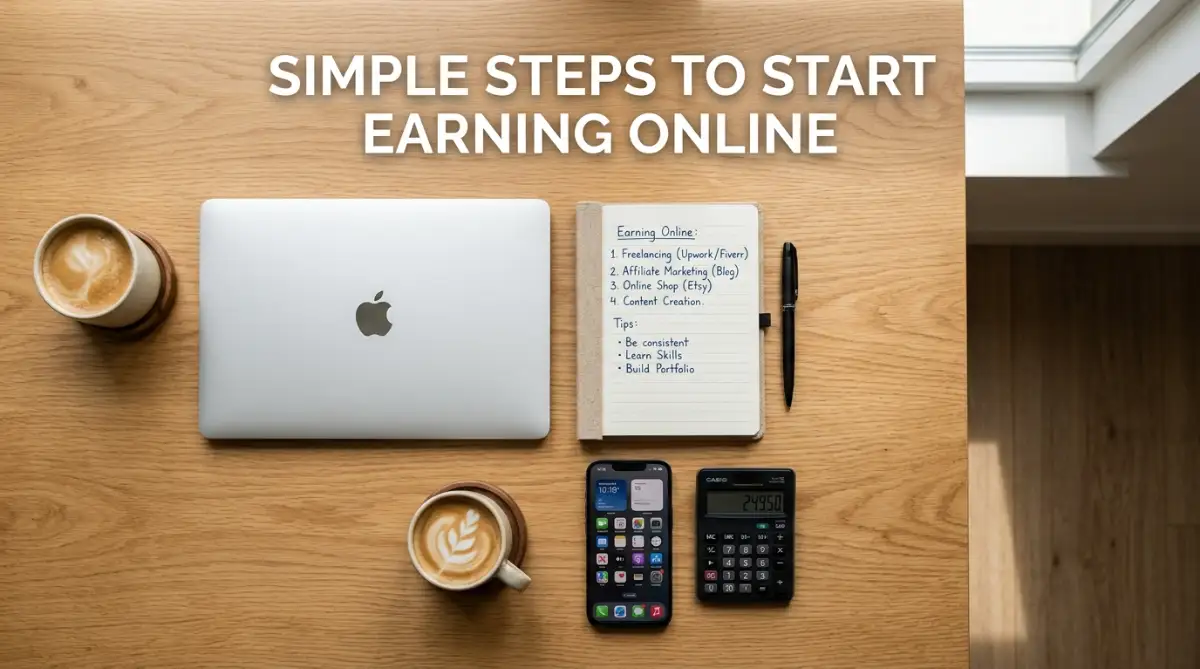
A Step-by-Step Online Income Guide for Beginners
Let's get into the part that actually matters: what to do, in what order, and why it works.
Step 1: Pick One Skill You Already Have (Or Can Learn Fast)
Most people overthink this step. They spend weeks researching "the best way to make money online" instead of just starting with something they already know how to do.
Ask yourself these three questions:
- What do friends or coworkers already ask me for help with?
- What could I explain to someone else in five minutes without looking it up?
- What have I done for free that other people would pay for?
Writing, editing, basic graphic design, data entry, customer support, social media posting, translation, voiceover work, and simple video editing are all in demand right now.
You do not need to be an expert. You need to be slightly better than someone who has never tried it, and willing to keep improving.
Pro Tip: Instead of trying to master a skill before you start, learn just enough to complete one small paying task. You will learn the rest faster once real money and real feedback are involved.
My biggest mistake when I started was spending three months trying to make my writing perfect before applying for a single job. Once I finally pitched my first client with basic skills, I learned more in two weeks of real work than in months of endless practice. Action always beats overthinking.
Step 2: Choose One Platform and Ignore the Rest
Want to see how this step-by-step process actually works in real life? Watch this complete beginner guide to pick up practical tips and stay motivated on your path!
Here is where a lot of people slow themselves down. They sign up for ten platforms, half-finish their profile on each one, and then wonder why nothing is working.
Instead, do this:
- Pick one freelancing platform, one content platform, or one marketplace based on your chosen skill
- Build a complete, honest profile with real examples of your work, even small ones
- Apply, post, or pitch consistently for at least two to three weeks before judging results
- Track what gets a response and what does not, then adjust your approach
To make this process easier for you, I’ve listed a few highly reputable platforms we often recommend depending on the path you choose to take:
- For Freelance Services (Writing, Design, Admin, etc.): You can start by building a complete profile on Upwork or Fiverr. If you prefer local or highly specialized hands-on tasks, TaskRabbit is also a solid option to explore.
- For Teaching & Tutoring: If you love sharing your knowledge, we suggest listing your tutoring services on Preply or packaging your expertise into a simple course on Udemy.
Getting Paid Safely: How to Bring Your Hard-Earned Money Home
Once you start pitching and landing clients, a big question is bound to pop up in your head: How do I actually get this money into my local bank account without getting ripped off?
If you are working outside the US or Europe, international transfers can sometimes feel like a puzzle. But don't worry, we have highly reliable systems in place today to make this seamless for you.
Our Go-To Bridge: For a huge part of my own freelance journey, I’ve relied on [Payoneer](https://www.payoneer.com/).
It essentially gives you a virtual US or EU bank account, allowing you to withdraw directly to your local bank account in your local currency with very reasonable fees.
Direct Platform Transfers: Reputable platforms like Upwork and Fiverr allow direct local bank deposits or transfers to verified [PayPal](https://www.paypal.com/) accounts or your Payoneer balance.
The Golden Rule: Never, ever agree to receive payments through sketchy, untraceable methods—like random gift cards, direct western union transfers from a stranger, or crypto—just because they promise to "bypass platform fees."
Keep it official. If a client refuses to use a secure, verified payment gateway, that’s your cue to walk away. We want to build a real, sustainable business, not chase risky shortcuts that leave us empty-handed.
A simple comparison can help you decide where to start:

Your First Profile Checklist: How We Look Like a Pro (Even on Day One)
I know exactly how intimidating it feels to look at a blank profile on Upwork or Fiverr. You stare at the screen, feeling like an imposter, wondering why anyone would hire you over someone with hundreds of reviews.
But remember: every single top-rated expert earning six figures today started with a brand-new profile and zero reviews on their dashboard. I did, and you will too.
To help you get over that initial hurdle, here is a simple, actionable checklist we can use to make your profile stand out from the crowd:
Ditch the Casual Selfies: Use a clear, well-lit headshot where you’re smiling and looking at the camera. We want to show clients a warm, professional human being they can trust, not a dark avatar or a cropped vacation photo.
Write a Headline That Solves a Specific Problem: Instead of writing a generic title like "Freelance Writer," try something more focused, such as Clear, SEO-Optimized Blog Writer for E-commerce Brands. Show the client exactly how you can help their business.
Keep Your Bio Reader-Focused: Believe it or not, your profile bio isn't actually about you—it's about what you can do for the client.
Instead of writing, I have been studying design for two years,write, I help small local businesses build a clean, modern brand identity that attracts more customers.
Create Your Own Samples: Don’t have previous client work to showcase? No problem at all! Write two mock blog posts or design three sample logos for fictional brands.
Put them in your portfolio. Clients care about what you can do, not just who paid you to do it in the past.
Step 3: Treat Your First Month Like a Learning Investment, Not a Payday
This is the step most guides skip, and it is the most important one.
Your first month online will probably not make you rich. It might not even cover a full day's expenses. That does not mean it failed.
In your first month, you are:
- Learning how clients or audiences actually think
- Building a small portfolio of real, finished work
- Figuring out what tasks you enjoy and which ones drain you
- Making mistakes that are cheap now and expensive later
Myth vs Reality:
Myth: "If it were a good method, I would see money in the first week."
Reality: Most sustainable online income takes four to twelve weeks of consistent effort before it becomes steady. The people who quit in week two never find out what week eight would have looked like.
Building Momentum: Small Wins Add Up Faster Than You Think
Once you land your first paid task, review, or sale, something shifts. It stops being theory. It becomes proof that this works for you specifically, not just for people in YouTube videos.
From there, the pattern repeats and grows:
- One client turns into a review, and a review turns into two more clients
- One blog post that ranks well brings in readers for months without extra effort
- One small digital product, once made, can be sold again without remaking it each time
- One skill, once learned, opens doors to slightly bigger and better-paid projects
This is the quiet part nobody talks about enough. Online income rarely arrives as one big breakthrough. It builds in layers, and each layer makes the next one a little easier.
A few honest reminders as you get started:
- Expect slow weeks. They are normal, not a sign of failure.
- Keep a simple record of what you tried and what happened. Patterns show up faster than you expect.
- Protect your time from "opportunities" that promise big returns for little effort. If it sounds too easy, look closer before committing.
- Ask for feedback early and often. It is the fastest way to improve.
You already have what most successful online earners started with: a willingness to try, and enough curiosity to read a guide like this one all the way through.
The method matters less than the habit of showing up and doing the work, one small, honest step at a time.
A Real-Life Scenario: How This Actually Plays Out
Picture someone named Rahim. He works a regular office job and wants extra income without quitting.
Week one: He picks writing, since he already writes clear emails at work. He sets up one profile on a freelance platform and writes three sample pieces in his free evenings.
Week two: He applies to small jobs, low pressure, low pay. Most go unanswered. One client replies and asks for a short trial piece.
Week three: He delivers the trial piece on time, with a short, polite note asking for feedback. The client likes it and offers a second, slightly bigger project.
Week six: He has three regular clients, a small but growing portfolio, and a clearer sense of what kind of writing he enjoys and what pays best for his time.
Nothing about Rahim's path was dramatic. No viral post. No lucky break. Just one small step after another, repeated until it became a habit, and then a routine, and then a real source of income.
The same pattern shows up again and again, no matter the skill:
- A graphic designer starts with free logo redesigns for local shop owners, then charges for the next ten
- A tutor starts with one free trial lesson, then fills a weekly schedule through word of mouth
- A photographer sells five small digital presets before building a full course around them
- A voice artist records a handful of free demo clips before landing a paid script
Common Mistakes That Slow People Down
Even with a clear plan, a few habits quietly stall progress. Knowing them in advance can save you weeks of frustration.
Watch out for these patterns:
- Switching methods too fast. Trying writing for a week, then design the next, never gives either one a fair chance to work.
- Underpricing out of fear. Charging too little at the start can attract clients who expect endless free extras and never value your time.
- Ignoring feedback. A client's honest note about your work is often the fastest, cheapest lesson you will ever get.
- Skipping the boring parts. Invoicing, following up, and organizing files are not exciting, but they are what turns one job into a repeat client.
- Comparing day one to someone else's year three. Every online earner you admire had a slow, unremarkable start that you simply never saw.
Setting Realistic Expectations for Your First Ninety Days
It helps to know, roughly, what a normal timeline looks like. This is not a guarantee, since results depend on your skill, effort, and a bit of luck along the way.
But it gives you a fair, honest benchmark instead of a fantasy one.
Your Actionable 90-Day Step-by-Step Roadmap
To keep you focused and stop you from feeling overwhelmed, I've mapped out exactly what your first three months should look like. Treat this as your realistic operating guide.

Phase 1 (Days 1–30) — The Foundation: Your only goal here is to get comfortable with the environment. Do not stress about making thousands of dollars yet.
Build your profile, create 1–2 stellar mock samples, and send a few highly customized proposals every week. We are quietly laying the bricks here.
Phase 2 (Days 31–60) — The Momentum: This is where we chase that sweet first win. When you land a client—even if it’s a tiny $15 job—treat them like they’re paying you $1,500.
Deliver early, communicate politely, and ask for an honest review. That first 5-star rating on your profile is worth far more than the paycheck because it acts as your social proof.
Phase 3 (Days 61–90) — The Scaling: Now that you have a little proof of concept, we raise the stakes. Bump your rates up slightly.
Start looking for clients who need ongoing monthly help rather than one-off tasks. This is the exact phase where a side hustle slowly transforms into a predictable, rewarding stream of income.
Expert Insight: The biggest difference between people who succeed online and people who give up is rarely talent.
It is almost always patience combined with a willingness to keep showing up during the quiet, unglamorous middle stretch, when nothing feels like it is working yet.
Bringing It All Together
Making money online is not about finding a secret shortcut. It is about picking one honest method, learning it properly, and giving it enough time to actually work.
Before you move on, keep these core ideas close:
- Start with a skill you already have or can learn quickly
- Choose one platform and commit to it fully before adding another
- Treat your first month as practice, not a payday
- Track small wins, since they build into something bigger over time
- Expect a slow, quiet start, because that is what a real, sustainable path usually looks like
You do not need permission to start. You do not need perfect conditions either. You just need one small task, done today, and then another one tomorrow.
That is how every online income story, including the ones that look impressive from the outside, actually began.
How to Scale Your Freelance Work From Home Into a Lasting Business
Once you have landed a few paying projects, a new question shows up: how do you keep this going without burning out or plateauing?
This is the part most beginner guides skip. They tell you how to start, then leave you alone once the money starts trickling in.
But the gap between "made $50 online" and "built a real income stream" is where most people quietly stall.
Let's close that gap.
Raise Your Rates Before You Feel Ready
Here's something almost nobody tells beginners: you will feel underqualified to raise your prices for a lot longer than you actually are underqualified.
That gap between confidence and skill is normal. The trick is not waiting for the confidence to catch up before you act.
A simple way to think about pricing:
- After your first 3–5 completed projects, raise your rate by 10–20%
- After your first repeat client, raise it again
- Every time a client says yes almost instantly, that's a signal your price is too low, not a compliment
Think of pricing like a thermostat, not a fixed setting. You adjust it based on feedback, not fear.
Quick Q&A:
What if I raise my rate and lose clients?
Some clients may leave. That's normal, and it's usually fine, since the ones who leave are often the ones paying the least for the most demands.
The clients who value your work will usually stay, or you'll replace the ones who left with better-paying ones faster than you expect.
"What if I'm still a beginner and don't deserve higher rates yet?"
Rates are not a reward for years of experience. They reflect the value a client gets from the result, not how long you've been doing the work.
Build One Small System So You're Not Starting From Zero Every Time
Beginners often treat every new project like it's the first one they've ever done. That's exhausting, and it's unnecessary.
A few small systems save huge amounts of time later:
- A saved template for how you introduce yourself to new clients
- A simple checklist you run through before delivering any project
- A folder of your best past work you can share instantly, instead of digging through old files
- A short list of your standard rates and what's included at each level
None of this needs to be fancy. A basic document on your computer works fine. The point is not building a perfect system. It's not rebuilding the wheel every single time you get a new project.
Pro Tip: Spend 30 minutes this week creating just one of these. Pick the one that would have saved you the most time last month.
Diversify Slowly, Not All at Once
Once your first income stream feels stable, it's tempting to chase five new ideas at once. Resist that.
Instead, think of your first skill as the trunk of a tree. Everything else grows as a branch from that trunk, not as a separate tree planted somewhere else.
Examples of natural, low-risk branches:
- A writer starts offering light editing as an add-on service
- A designer starts selling simple templates alongside custom work
- A tutor starts recording short lessons that can be sold repeatedly, instead of only live sessions
- A social media manager starts offering a one-time strategy session for smaller clients who can't afford full management
This approach lets you add income streams that support each other, instead of competing for your time and attention in random directions.
Protect Your Time Like It's Part of Your Income
Here's a mindset shift that changes everything: your time is not free just because you work for yourself.
A few boundaries that protect long-term earnings:
- Set clear working hours, even if they're flexible, so work doesn't quietly expand into every free hour
- Decide in advance how many free "sample" tasks you'll do before asking for payment
- Say no to projects that pay poorly and take a lot of energy, even if you're tempted by "just this once"
- Build in short breaks between projects instead of jumping straight from one deadline to the next
According to the U.S. Bureau of Labor Statistics' overview of gig work, many people who succeed long-term in flexible or independent work treat it with the same structure and discipline as a traditional job,
even while enjoying more control over their schedule. That structure is often what separates a short-lived side hustle from a lasting income source.
Keep Your Finances Organized From Day One
This part feels boring. It matters anyway.
A few simple habits go a long way:
- Open a separate space, even a basic savings account, just for your online income
- Set aside a portion of every payment for taxes, since online income is usually still taxable income
- Track what you earn and spend on tools, subscriptions, or software related to your work
- Review your numbers monthly, not just at the end of the year
If you are working with US clients or platforms, the IRS Gig Economy Tax Center explains how earnings from freelance and online work are generally treated for tax purposes, and it is worth a slow read once your income becomes consistent.
Getting this right early saves a lot of stress later, and a simple monthly budgeting habit makes the whole process far less overwhelming.

Traps That Quietly Drain Time, Money, and Motivation
Even careful, hardworking people fall into a few common traps. Knowing them ahead of time is often enough to avoid them completely.
Chasing "Guaranteed" Income Programs
If something promises a fixed, guaranteed income with little to no effort, treat that as a warning sign, not an opportunity.
Real online income almost always depends on:
- The effort and consistency you put in
- The quality of the work or product
- Market demand, which changes over time
- Your ability to adjust when something isn't working
No legitimate method can guarantee a fixed dollar amount regardless of effort or market conditions. According to a public awareness guide from the Federal Trade Commission on job scams, offers built around big,
guaranteed earnings with little explanation of how the money is actually made are one of the clearest warning signs of a scam.
If you ever want to check whether a company or opportunity has a pattern of complaints, the Better Business Bureau's guide to spotting scams is a simple, free place to look before you commit any money.
Buying Courses Instead of Doing the Work
There is nothing wrong with paid education. The trap is using it as a substitute for action.
A simple rule that helps: for every hour you spend learning, spend at least two hours applying what you learned, even imperfectly. Learning without application creates knowledge that never turns into income.
Ignoring Contracts and Clear Agreements, Even for Small Projects
Skipping a simple written agreement, even a short email confirming scope, price, and deadline, causes more disputes than almost anything else in freelance and online work.
Do's and Don'ts for every project, no matter how small:
- Do confirm the price, deadline, and deliverables in writing before starting
- Do ask for partial payment upfront on larger projects
- Don't rely on verbal agreements alone, even with people you trust
- Don't start major work without some form of confirmation from the client
Comparing Your Income to Curated Success Stories
Social media is full of people showcasing their best month, not their average one. Comparing your real, ongoing numbers to someone else's highlight reel is a guaranteed way to feel like you're failing, even when you're actually on track.
A healthier comparison: look at your own numbers from three months ago versus today. That comparison is honest, and it's the only one that actually tells you if you're improving.
Neglecting Skills That Don't Feel "Billable"
Communication, negotiation, and basic bookkeeping don't feel like the skill you're being paid for, so many people ignore them completely.
In practice, these supporting skills often determine whether a talented person earns steadily or struggles despite being good at their craft.
A quick look at how independent work is trending can help set realistic expectations here too. Recent data from the Federal Reserve's report on the economic well-being of U.S. households shows that many people doing gig and short-term work value the flexibility it offers,
even though pay can be less predictable than a traditional job. Going in with realistic expectations, rather than assuming instant financial stability, makes it far easier to stick with the process long enough to succeed.
Your Next Move, Starting Today
You have now walked through the full picture: why this feels hard at first, exactly how to begin, how to grow what you start, and which traps to sidestep along the way.
Here is a simple checklist to carry with you as you move forward:
- Pick one skill and one platform, and give it real, focused effort for at least a month
- Treat your first few weeks as learning time, not proof that the method failed
- Raise your rates as soon as clients say yes without hesitation
- Build one small system this week to save yourself time later
- Set aside part of every payment for taxes and savings from your very first dollar earned
- Walk away from anything that promises guaranteed income with no real explanation of how it works
- Compare your progress only to your own past self
If you found this guide considering starting your own small business rather than freelancing, the Small Business Administration's step-by-step business guide is a solid, free next stop once you're ready to formalize what you're building.
And if you're simply curious about how independent work is shaping the wider economy, the Pew Research Center's ongoing coverage of the gig and sharing economy offers a grounded, research-based view beyond the hype.
Making money online was never about finding the one perfect method. It was always about picking something honest, learning it properly,
and giving it enough time and attention to actually grow. You already have everything you need to take the next small step. Take it today.
You do not need permission or perfect timing to start changing your financial life today. Pick one skill, set up your profile, and commit to taking just one small action before you go to sleep tonight. Trust me, your future self will thank you for having the courage to begin right now.
Disclaimer:
This article is for general educational and informational purposes only. It does not constitute financial, tax, legal, or professional business advice. Income results from freelance work, online business, or gig platforms vary widely and are not guaranteed. Please consult a qualified financial advisor, accountant, or tax professional regarding your specific situation before making financial decisions.

