
The True Worry of Setting Up a Business on Your Own
Starting a new company is an amazing journey, but it often brings a lot of hidden stress. Many new owners stay awake at night worrying about legal mistakes. They wonder if a simple error in their paperwork could ruin their personal life and savings later on.
This fear is real because the law feels like a secret language. You want to build your dream, but the dread of lawsuits holds you back. Let us look at why this happens and how you can find the right path.
- Confusing search results: If you search for help online, you get millions of pages telling you different things. Some say you will go to jail if you miss a form, while others say legal help is a waste of money.
- The trap of free forms: Downloading a free document template online feels easy and smart. However, these templates are often outdated, generic, or meant for a different state entirely.
- Lack of clear guides: Most official government websites are hard to read and use heavy legal words. This leaves normal people feeling completely lost and unable to make a clear decision.
- Loss of sleep and focus: When you worry about legal traps, you cannot focus on growing your actual business. You spend your days reading forums instead of talking to customers.
- Fear of losing personal wealth: The main reason we set up formal companies is to protect our homes and savings. Without clear guidance, you might set up a structure that leaves your personal assets completely exposed.
- Doubt in your own decisions: Starting a business requires bold moves and high confidence. But constantly second-guessing your legal foundation makes you act slow and afraid.

How to Navigate Your Business Setup Step-by-Step
Step 1: Figure Out if Your Business is Simple or Complex
Before you spend thousands of dollars on an attorney, you must look at what you are selling. Not every business needs the same level of legal protection. If you understand your actual risk level, you can save a lot of money and stress.
If you are starting a small service business alone, your path is usually very straightforward. Think of businesses like freelance writing, home cleaning, or basic online consulting. These businesses do not carry high physical risks or complex financial setups.
For these simple businesses, a Single-Member LLC is often the most popular choice. Setting up an LLC in this situation is like registering a new car. You fill out a few basic forms with your state government and pay a small fee.
Many states have online portals that make this process as simple as buying shoes online. You do not need to pay a lawyer $300 an hour just to type your name into a state form. If your business has only one owner and no complex debt, going solo is highly practical.
On the other hand, some business plans are like building a skyscraper. If you have partners, high risks, or plan to raise outside money, you need professional help. Skipping a lawyer in these cases is like trying to perform surgery on yourself.
Let us look at a few examples where you definitely need a corporate lawyer:
- Starting with partners: When two or more people own a company, things can get messy quickly. You need clear rules on who does the work, how money is shared, and what happens if someone wants to quit.
- Raising money from investors: If you plan to get money from venture capitalists or angel investors, you cannot use a simple LLC. You will need a C-Corporation with clear share systems that only an attorney should set up.
- High-risk industries: If your business deals with medical advice, heavy machinery, child care, or complex food production, your risk is high. One mistake could lead to a major lawsuit, so you want your legal shield to be perfectly built.
Consider the story of Mark and David, who started a software company together. They decided to save money by using a free online template for their partnership agreement. They did not hire a lawyer because they trusted each other completely.
Two years later, their software became highly successful, but they disagreed on how to run the company. Mark wanted to sell the business, while David wanted to keep growing it. Because their cheap template did not have a proper dispute clause, they ended up in court.
They spent over $40,000 in court fees just to resolve the argument. If they had paid a corporate lawyer $2,000 at the start, they would have saved two years of stress and a fortune in fees.
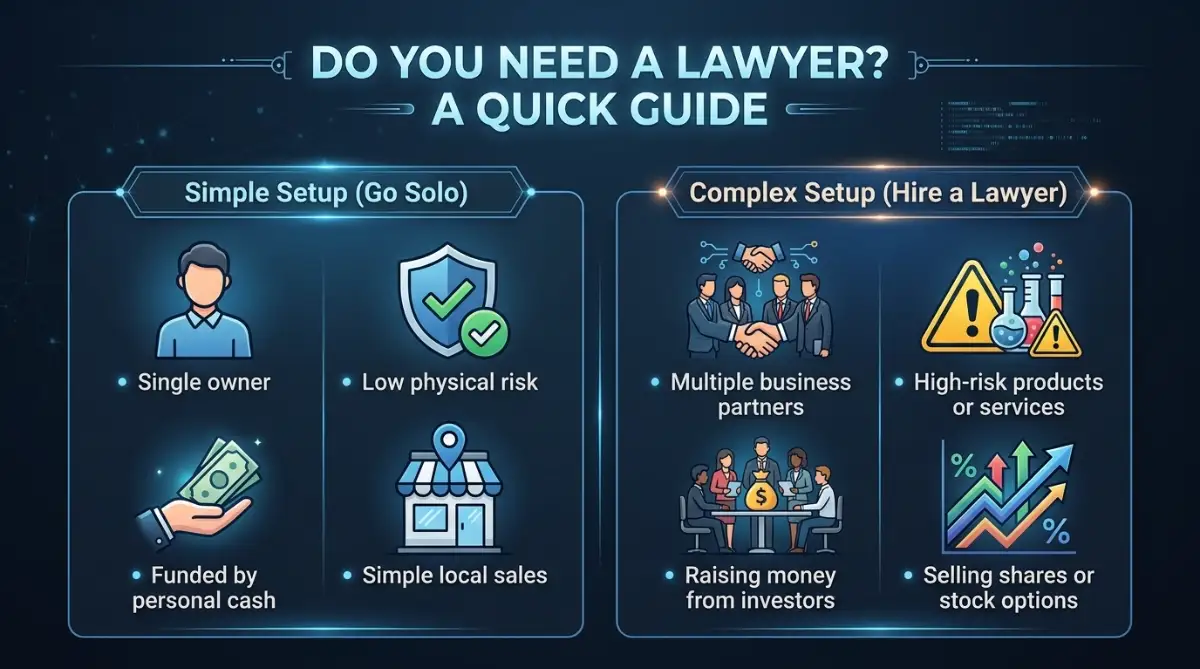
+------------------------------------------------------------+ | DO YOU NEED A LAWYER? A QUICK GUIDE | +--------------------------+---------------------------------+ | Simple Setup (Go Solo) | Complex Setup (Hire a Lawyer) | +--------------------------+---------------------------------+ | โข Single owner | โข Multiple business partners | | โข Low physical risk | โข High-risk products or services| | โข Funded by personal cash| โข Raising money from investors | | โข Simple local sales | โข Selling shares or stock options| +--------------------------+---------------------------------+
Step 2: Choose and Setup the Right Legal Entity
Once you know your business complexity, you must choose the actual legal structure. The structure you select dictates your taxes, your paperwork, and your personal liability. Let us look at the three most common structures in simple terms.
A sole proprietorship is the default state for any business run by one person. If you start selling handmade soap today without registering anywhere, you are a sole proprietor. There is zero paperwork to start, which makes it highly tempting.
However, this structure offers absolutely no personal asset protection. If someone gets sick from your soap and sues you, they can go after your house, your personal bank account, and your car.
We always advise moving away from a sole proprietorship as soon as possible. It is simply not worth the risk of losing everything you own just to avoid a little paperwork.
For most everyday entrepreneurs, the LLC is the absolute sweet spot. It creates a protective wall between your personal wealth and your business debts. If your LLC goes bankrupt or gets sued, only the money inside the business is at risk.
Setting up an LLC requires filing a document called the Articles of Organization with your state. You also need to pay a filing fee, which ranges from $50 to $500 depending on where you live.
Here is a simple checklist of what you need to form an LLC yourself:
- Choose a unique name: Your name must end with "LLC" and cannot be used by any other business in your state.
- Appoint a Registered Agent: This is the person or service that receives official legal mail for your business.
- File your paperwork: Submit your Articles of Organization to your state's business division.
- Get an EIN: Apply for a free Employer Identification Number from the IRS website to open a business bank account.
[ Personal Assets: House, Car, Savings ]
||
================== <-- The LLC Shield
||
[ Business Liabilities: Debts, Lawsuits ]
A corporation is a much more complex animal than an LLC. It is owned by shareholders, managed by directors, and run by officers. It also has strict rules about holding annual meetings and keeping detailed notes of every decision.
If you are a local store owner or a consultant, a corporation is usually too much work. The extra tax rules and paperwork will make your head spin.
However, if you plan to go public on the stock market or offer stock options to employees, a corporation is required. In this situation, you must hire a corporate lawyer to ensure everything matches state and federal laws.
Step 3: Write Your Internal Rules (Operating Agreements & Bylaws)
Many people think that getting a certificate from the state means their business is complete. This is a big mistake that often leads to major legal problems later. You must also create the internal rules for how your company runs.
If you choose to form an LLC, your most important document is the Operating Agreement. This document acts like the constitution of your business. It outlines who owns what percentage of the company and how decisions are made.
Even if you are a single-member LLC, you still need this document. Banks, investors, and state courts will often ask to see it. It proves that your LLC is a serious, separate legal entity and not just a personal bank account.
If you are going solo, you can use a high-quality online template to write your operating agreement. Just make sure the template matches the laws of your specific state.
If you have partners, please do not use a generic agreement you found on the web. A cookie-cutter agreement cannot understand the unique relationship between you and your partners.
For example, what happens if one partner works 80 hours a week and the other only works 10? What happens if one partner wants to buy out the other, but you cannot agree on the price? A custom agreement written by an attorney covers all of these scenarios clearly.
An attorney will ask you questions you never even thought about. They will help you plan for the worst-case scenarios while you are still on good terms. This upfront planning is the best insurance policy your business can have.
Once your legal structures and agreements are ready, you must practice good hygiene. The fastest way to lose your personal liability protection is by mixing your money.
If you pay for your personal groceries using your business debit card, you are doing something called "piercing the corporate veil." If a court sees this, they can decide your LLC is fake and let creditors take your home.
Always follow these simple financial rules:
- Open a dedicated business bank account: Never let personal and business money touch the same account.
- Pay yourself properly: Write a check or transfer money from your business account to your personal account as an official owner's draw.
- Sign documents correctly: When signing contracts, always sign as "Your Name, Manager of [Your LLC Name]" instead of just your personal name.
Understanding the Real Costs of Legal Help
Now that you know the steps, let us talk about the financial side of things. How much does a corporate lawyer actually cost, and how can you budget for it?
The Traditional Hourly Rate Model
Most corporate attorneys charge by the hour. Depending on where you live and the experience of the lawyer, this can range from $150 to over $600 per hour.
If you use this model, the costs can add up very quickly. A simple phone call or email exchange can cost you $100. This hourly rate model makes many new business owners afraid to call their attorney when they have a question.
The Modern Flat-Fee Model
Thankfully, many modern business lawyers now offer flat-fee packages for startups. This means you pay one set price for a bundle of services.
For example, a lawyer might charge a flat fee of $1,500 to set up your LLC. This package usually includes checking your business name, filing the state forms, writing your operating agreement, and getting your tax ID.
This flat-fee model is wonderful for budgeting because there are no surprises. You know exactly what you will pay before the work even begins. When shopping for a lawyer, always ask if they offer flat-fee packages.
+--------------------------------------------------------------+ | LEGAL SERVICES COST COMPARISON | +---------------------+--------------------+-------------------+ | Setup Method | Estimated Cost | Safety Level | +---------------------+--------------------+-------------------+ | Do It Yourself | State Fee Only | Low to Medium | | (Solo filing) | ($50 - $500) | | +---------------------+--------------------+-------------------+ | Online Document | State Fee + | Medium | | Filing Service | ($100 - $300) | | +---------------------+--------------------+-------------------+ | Flat-Fee Corporate | Flat Package Fee | High | | Attorney | ($1,000 - $3,000) | | +---------------------+--------------------+-------------------+ | Hourly Corporate | $150 - $600 / Hour | Extremely High | | Attorney | (Varies widely) | | +---------------------+--------------------+-------------------+
How to Find and Choose the Right Attorney
If you decide that your business needs a lawyer, you should not just hire the first one you see on a billboard. You need a lawyer who understands small businesses, not personal injury or divorce.
Avoid the Generalist Lawyer
A general attorney who handles wills, traffic tickets, and divorces is not ideal for your business. Corporate law has its own set of complex rules and tax codes.
You want to find an attorney who specializes in business formation, contracts, and intellectual property. They will know the local state rules inside and out and can give you the most accurate advice.
Ask the Right Questions During Your Consultation
Most business lawyers offer a short initial consultation, sometimes for free. This is your chance to interview them and see if they are a good fit for your style.
Here are a few questions you should ask:
- Do you work with startups in my industry often? You want someone who understands the unique challenges of your market.
- How do you bill for your services? Ask if they offer flat-fee structures for business formation.
- What is your communication style? Find out if they prefer emails, phone calls, or video meetings, and how fast they usually reply.
By taking your time and choosing the right partner, you can build a strong legal foundation. A good business lawyer is not just a cost; they are a valuable advisor who helps your company grow safely.
Deep Legal Protection Secrets for Smart Business Owners
Setting up your company safely. Now that you understand the basic business structures, we must focus on protecting what you build over the long run. Building a business is not just about filing one form and forgetting about it. You must understand how the government and the legal system look at your growing assets.
To make the best choices, it is helpful to read the Forbes Advisor overview on business structures to see how different entities grow. This research will help you understand the next advanced steps we are about to discuss. Many successful founders start their business solo and then realize they need more advanced legal shields. Let us look at how you can plan for growth without spending a fortune on expensive lawyers.
Step 4: Structuring Intellectual Property Contracts Early
First, you must protect your creative work, logos, and software. If you create a unique product or a website, that asset is called intellectual property. To understand this concept, you can check the Investopedia definition of intellectual property to see how assets are protected. If you do not lock these assets down, someone else can copy them legally.
Imagine hiring a freelance designer to draw your business logo. You might think you automatically own that logo because you paid for it. However, under copyright law, the artist actually owns the work unless they sign a written contract transferring the ownership to you. This is why you need an intellectual property transfer agreement.
You do not always need a lawyer to draft these forms from scratch. You can find simple, state-specific assignment templates online that do the job perfectly. Just make sure both you and the freelancer sign the document before any payment changes hands. This simple habit keeps your brand safe from future legal ownership battles.
When you register your business name with the state, you only protect it within that specific state. If someone in another state uses your name, you might not be able to stop them legally. To protect your name across the entire country, you can apply for a federal trademark with the USPTO.
This process is a bit more complex and usually takes several months to complete. If you plan to build a major national brand or sell products online across the country, a trademark is highly recommended. You can search the federal trademark database yourself for free to see if anyone else is using your name.
If the search is clear, you can file the application on your own, or you can hire a specialized trademark lawyer to help you navigate the process. This step is a great way to build real, long-term value for your brand.
Step 5: Preparing Your Business for Long-Term Tax Advantages
Another advanced trick involves how your business is taxed by the federal government. Many people do not realize that your legal entity is different from your tax status. For example, you can have a legal LLC but ask the government to tax you as an S-Corporation.
This setup can save you thousands of dollars in self-employment taxes as your income grows. To learn more about this tax rule, look at the SBA guide on business taxes to understand the exact guidelines. It is an excellent resource for small owners.
Let us look at a simple scenario to see how this works. Imagine your LLC makes $120,000 in net profit. If you are taxed as a standard LLC, you must pay around 15.3% in self-employment taxes on the entire $120,000. That is a very large bill at the end of the year.
With an S-Corp tax status, you can pay yourself a reasonable salary of, say, $60,000. You only pay that 15.3% tax on your salary, while the other $60,000 comes to you as a distribution, which is free from self-employment tax. This advanced tax planning can save you a lot of money that you can reinvest back into your company. However, if your payroll setup feels too complex, this is a great time to spend an hour with a tax lawyer or CPA.
Staying Legal for the Long Run (Your Ongoing Compliance Calendar)
Setting up your legal shield is only half the battle. You must also maintain that shield year after year so it does not crack when you need it. Many states require you to file an annual report and pay a small fee to keep your company active. If you forget this step, the state can shut down your company without warning.
We suggest setting up a calendar of alerts for all your business filings. You can also hire a local registered agent service to track these deadlines for you automatically. Another key part of compliance is managing your business cash flow properly.
You should always practice tracking your business spending and stopping cash leaks so your books stay clean for tax season. Clean books make it much easier to prove to the government that your business is a real entity. It also makes your tax accountant very happy when they file your annual returns.
If you run your business without tracking where the money goes, a court can easily argue that you are mixing personal and company assets. That single mistake can break your personal protection wall instantly. Additionally, try to keep a separate reserve fund for your business.
We suggest using a high-yield savings account for business reserves to earn extra interest while keeping your emergency money safe. Having a dedicated reserve protects your business during dry months without forcing you to use your personal bank accounts. It is a simple habit that separate professional businesses always follow.
Managing Contracts and Agreements on Your Own
As your business grows, you will start signing contracts with suppliers, clients, and software companies. Many small business owners sign these agreements without reading the small print because they look too long and boring. You do not need to hire a corporate lawyer for every single contract you sign.
But you do need to understand three basic clauses that are always present in good business contracts. The first clause is the limitation of liability. This clause limits how much money a client can sue you for if something goes wrong with your product or service.
For example, if you build a website for a client for $2,000, you should have a clause stating that your maximum liability is limited to the amount they paid you. This stops them from suing you for $50,000 of "lost business profit" if the website goes offline for a day.
The second clause is the termination clause, which outlines how either party can end the agreement safely. It should state how many days of written notice are required before the contract can be canceled.
The third clause is the governing law clause, which determines which state laws will apply if there is a legal dispute. Always make sure this clause lists your home state so you do not have to fly across the country to defend yourself in court. Understanding these simple contract parts allows you to negotiate confidently without paying a lawyer to review every single page. It is all about learning the basic rules of the game and playing them smart.

Critical Pitfalls That Can Destroy Your New Company
Even with the best plans, many new founders make simple legal mistakes that end up costing them their entire savings. Let us look at the five most common traps and how you can avoid them easily.
Trap 1: The Handshake Agreement Mistake
Many people start businesses with close friends or family members based on a simple handshake. They believe that written contracts are only for strangers and that asking for one shows a lack of trust. This is a huge mistake because memories fade and expectations change over time.
When money starts coming in, people often remember their verbal promises very differently. If you do not have a written agreement, a simple misunderstanding can destroy your friendship and your business at the same time. Always write down your agreements, even if it is just a simple one-page document signed by both parties.
Trap 2: Mixing Personal and Business Funds
We mentioned this briefly before, but it is such a common mistake that it deserves a deeper look. Many owners use their business accounts to pay for personal items like dinners, clothing, or car loans. This behavior is called commingling of funds, and it completely destroys your personal asset protection shield.
If a creditor sues your company, they can ask a judge to ignore your LLC because you treated it like your personal wallet. To prevent this, you should focus on building a business emergency fund from scratch inside a separate business savings account. Having this separate financial cushion ensures you never have to mix your funds during difficult times.
Keeping a strict boundary between your money and the business money is the single best way to keep your home and personal assets safe. It is a simple habit that takes very little time but offers massive protection.
Trap 3: Ignoring Local Zoning and Municipal Rules
Many new owners think that registering their company with the state is the only step they need to take. They forget that their local city hall has its own set of rules and permit requirements. For example, if you run a home-based business, your local zoning laws might prohibit clients from visiting your house.
Or, if you open a small shop, you might need a specific fire safety permit or health department license. If you ignore these local rules, the city can fine you heavily or even shut your business down overnight. Always visit your local city clerk's office to ask about the permits required for your specific business type.
Trap 4: Registering in the Wrong State (The Out-of-State Trap)
You have probably read online articles telling you to register your business in Delaware, Wyoming, or Nevada to save money on taxes. While this is great advice for giant tech startups, it is usually a trap for small, local businesses. If you register your business in Delaware but operate out of your home state, you will have to pay registration fees in both states.
You will also have to pay for a registered agent in Delaware and file annual reports in both places. This double-filing setup adds a lot of unnecessary cost and paperwork to your business. For almost all local small businesses, registering in your own home state is the easiest and cheapest choice.
Trap 5: Failing to Keep Proper Corporate Records
Even if you are a small business, you must keep clean records of all major business decisions. This includes keeping track of your contracts, tax filings, and major financial transactions. If you have a corporation, you are legally required to hold annual meetings and write down the decisions made during those meetings.
If you do not keep these records, your corporate shield can be broken in court. Setting up a simple folder on your computer or keeping a physical binder for your legal papers is all it takes. This simple habit keeps you organized and ready for any future audits or legal questions.
Let us consider a realistic scenario involving a boutique owner named Susan. Susan ran an LLC for her clothing shop but routinely used her business credit card to pay for her personal vacations and grocery shopping. When a customer slipped inside her shop and filed a lawsuit, Susan was confident that her personal assets were safe behind her LLC shield.
However, the customer's attorney asked to see Susan's business bank statements during the legal discovery process. The attorney quickly noticed that Susan was paying her personal household bills directly from the business account.
The judge ruled that the LLC was just an "alter ego" for Susan and allowed the lawsuit to target her personal home. This unfortunate scenario happens to hundreds of well-meaning entrepreneurs every single year. It shows that having an LLC is not a magic shield; you must actually treat it like a separate entity in your daily life.
To help you stay organized, here is a simple list of annual events you should add to your business calendar. This will help you keep your company in good standing without needing a lawyer to remind you.
- File your state annual report: Most states require this on the anniversary of your filing or during a specific month of the year.
- Renew your local business license: Your local city or county clerk's office will usually send a renewal notice every year.
- Pay your state franchise tax: Some states charge a flat annual fee to keep your corporation or LLC active in their database.
- Keep minutes of your annual meetings: If you have a corporation, write down a simple document outlining the major decisions made by your directors.
Your Practical Action Plan for Business Success
Building a business is a major step toward creating your own personal and financial freedom. It is natural to feel a bit nervous about the legal side of things when you are just starting out. However, you do not need to let the fear of legal forms stop you from taking action.
Most of the early steps can be done on your own with a little research and a clean plan. Start by identifying your risk level and deciding if your business is simple enough to handle without an attorney. If you are starting solo, go ahead and register your LLC with your state's online portal.
Remember to write down your internal rules, open a dedicated business bank account, and keep your personal money completely separate. These basic habits build a strong shield around your personal assets. If your business plan involves multiple partners, outside investors, or complex regulatory rules, then do not hesitate to hire a corporate lawyer.
Paying a professional for a flat-fee package is an investment that will save you time and stress. You have the passion, the ideas, and the drive to make your business a success. By taking these smart legal steps today, you ensure that your dream stays safe and grows strong for years to come.
Go ahead and make your dream official by starting your registration process this week. Your future self will thank you for taking the time to build your company on a rock-solid foundation.
Disclaimer:
The information provided in this article is for general informational and educational purposes only and does not constitute legal, financial, or tax advice. Reading this article does not create an attorney-client relationship. Laws vary by jurisdiction and change frequently. You should not act or rely on any information in this article without consulting a licensed attorney or certified public accountant (CPA) in your specific area.