

The Day My Electric Bill Nearly Broke My Brain
Two years ago, on a rainy Tuesday morning, I sat at my kitchen counter with my mug of warm coffee. I had exactly twelve minutes before my morning work call to pay my past-due electric bill. I punched in my email password with total confidence.
A red box popped up on my screen: "Incorrect Password."
I frowned, figured I made a quick typo, and added an exclamation point at the end. I hit enter. The screen spun for three seconds, turned dead white, and then delivered the message we all dread: "Account Locked for 24 Hours."
My stomach dropped straight through the floor. That single inbox held my mortgage details, work logins, bank alerts, and doctor appointments. My morning turned into forty minutes of frantic SMS reset codes, guessing what street I lived on in 2012, and dialing automated customer service lines while my coffee went cold. I showed up late to my meeting, sweaty and stressed out.
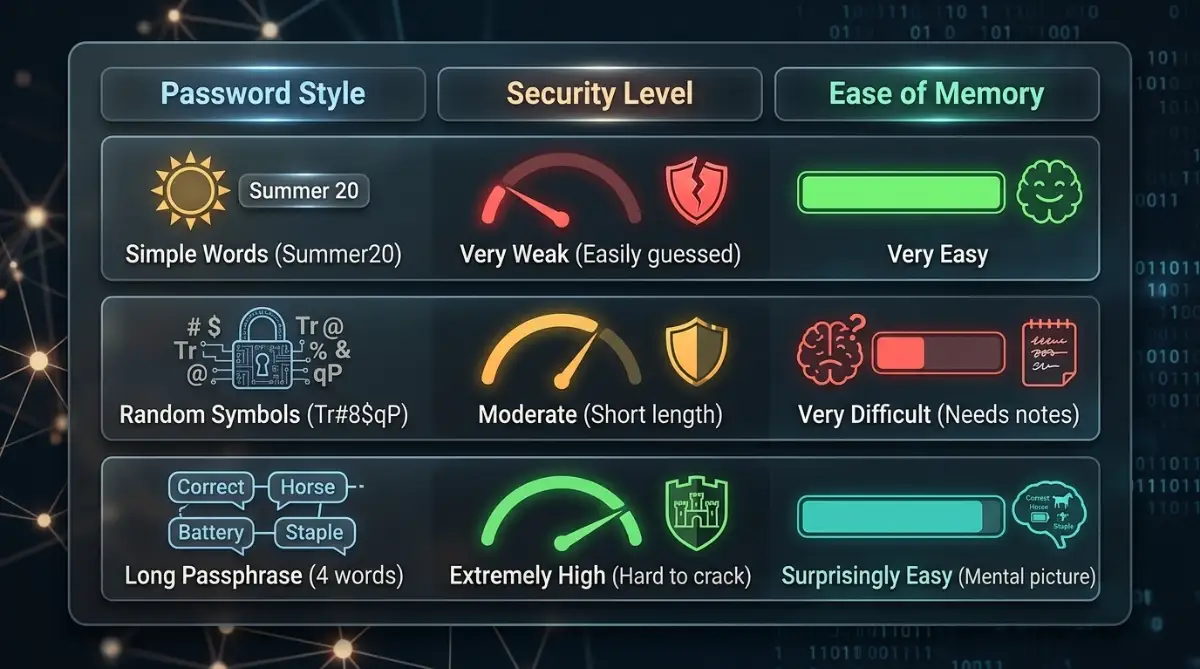
That morning taught me a hard truth about our digital world. We are forcing our human brains to act like hard drives. Tech blogs tell us to remember twenty-character soup like "Tr#8$qP@99," but real people simply cannot do that. When systems push us too far, we get sloppy. We start using the same lazy word on ten different accounts, or we stick passwords on bright sticky notes right next to our webcams.
I decided to stop that nonsense right then and there. In this guide, I will share the simple passphrase habits and everyday tricks that saved my sanity, cut out my morning panic, and made my accounts unbreakable.
Quick Takeaways: What You Need to Know
Length Beats Chaos: A 20-character phrase made of 4 simple words protects your accounts thousands of times better than a short, messy string filled with symbols.
Stop the 30-Day Reset Frenzy: Forcing yourself to change passwords every single month just makes you pick lazy variations like Summer25 to Summer26. Only change your code if an actual breach happens.
The Hybrid System Wins: Keep your main master phrase in your memory, write a physical paper copy for your locked home drawer, and let a clean digital vault handle the rest of your daily accounts.
Hardware Over SMS: Hackers can easily hijack text message codes through phone company tricks. A simple USB key or authenticator app stops them in their tracks.

Rethinking How We Build Unbreakable Login Codes
The Problem With Traditional Password Advice
For years, technical experts told everyone to create short strings of completely random characters. They wanted us to mix capital letters, low-case letters, numbers, and strange punctuation marks into something like P@ssw0rd!99.
This approach sounds smart on the surface, but it actually creates two huge security flaws. First, computer programs can guess these standard symbol substitutions in seconds because predictable patterns are easy to calculate. Second, human minds find random strings nearly impossible to recall after a few days without practice.
When security rules collide with human nature, human nature always wins in the end. People start reusing those exact same complicated strings across every social media site, banking portal, and online shopping cart. If just one small website suffers a data breach, hackers immediately test those stolen credentials across hundreds of popular web platforms.
The Power of Length Over Pure Randomness
Modern security research shows that length matters far more than mixing up weird characters. A computer trying to guess a password works by calculating every possible combination of letters and symbols. Every single character you add to your passphrase exponentially increases the time required for automated guessing tools.
When you shift your goal from creating complex single words to building long natural word groups, security becomes fun. You no longer need to stress over whether you put a dollar sign before or after a random number. You simply combine words in clever ways that make total sense to you while leaving computers completely confused.
Building Your Core Passphrase Frame
Here is how I build passphrases today without getting a headache. Sit back, look around your desk, and pick four completely random things that have nothing to do with each other. Look right now: maybe you see a blue mug, an old dictionary, a rusty stapler, and a potted fern.
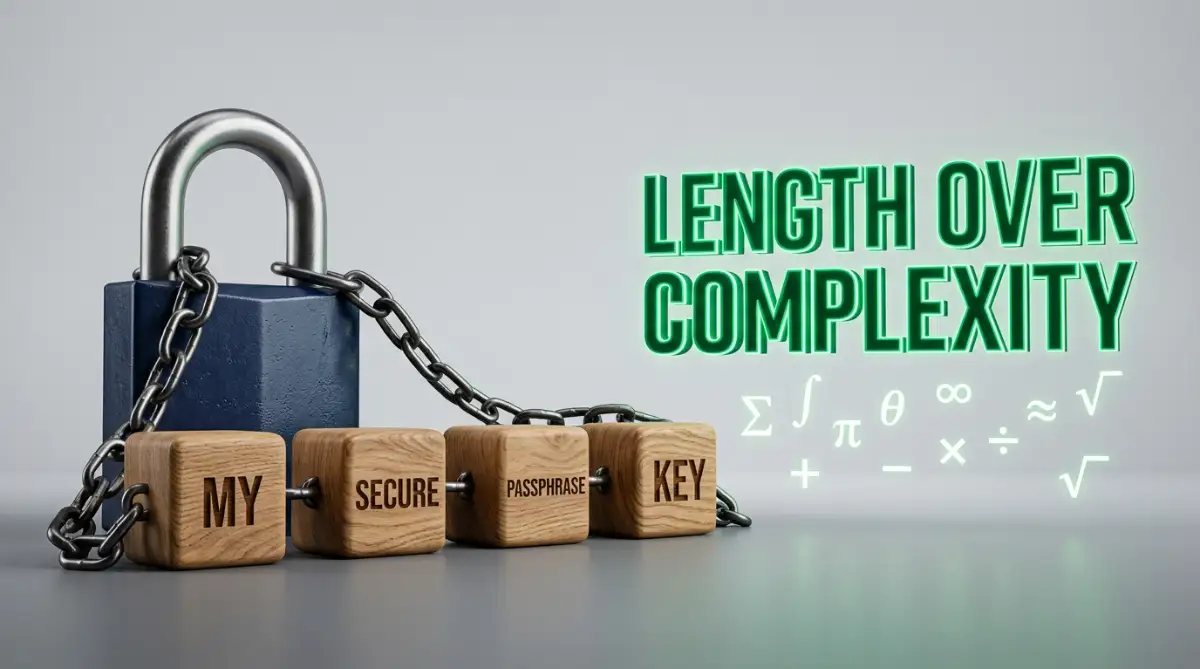
Put them together in a line: "blue stapler fern dictionary." Just like that, you created a phrase that is 27 characters long. When an automated password attack runs against a string that long, it hits a giant mathematical brick wall.
To give it a little extra kick, I toss a hyphen or a simple number between the words, like "blue-stapler-fern-dictionary-7." My fingers pick up the typing rhythm within two days, and my mind holds onto the funny mental image of a stapler resting on a fern leaf. It is simple, it stays in your head, and no automated tool will ever guess it in your lifetime.
The Sentence and Acronym Shortcut
Another powerful mental trick is turning a clear personal sentence into a custom character sequence. Think of a simple sentence about your real life that only you would know. For instance, you might think: "I bought my first red bicycle when I was twelve years old!"
Take the first letter of every single word in that private memory to construct your base string. That sentence instantly turns into Ibmfrbwiw12yo!, giving you a highly complex mix of uppercase letters, lowercase letters, numbers, and symbols.
Because the string comes directly from a vivid memory you already own, you do not need to memorize the random string itself. You simply repeat your short personal sentence in your mind, and your fingers automatically type out the corresponding initial letters. This bridges the gap between high digital defense and natural human memory retention.
Pro Tip: I used to struggle constantly with typing complex passphrases on small mobile keyboards during my daily commute. I realized that picking words with smooth alternating finger patterns made typing twice as fast and eliminated almost all entry errors. Now I always test my new passphrases on a smartphone keypad first to make sure they feel totally natural to type.
Transforming Personal Memories Into Anchor Codes
Your life is full of tiny specific details that nobody else on earth shares with you in the exact same way. You can use these personal anchors to create codes that are totally personal yet impossible for outsiders to guess through public research.
Think about your very first childhood pet, the color of your first school backpack, and the number of your childhood house. Combining those specific pieces into a single phrase creates an