Why Carrying Debt Can Feel Like a Second Job
You check your bank account and your stomach drops.
Another payment is due. Another bill just landed in your inbox. No matter how hard you work, the debt never seems to shrink.
You are not imagining this. Millions of people feel this exact weight every single month.
The bills keep coming. The minimum payments barely touch what you owe. The interest keeps piling on top, like a hole you can't climb out of no matter how fast you dig.
This isn't about being bad with money. It's about not having a clear plan. And without a plan, even smart, hardworking people stay stuck for years.
Why So Much Debt Advice Leaves You More Confused
Search online for "how to pay off debt" and you'll get hundreds of conflicting answers. That's part of the problem.
- Some sites tell you to pay off the highest interest debt first, with no clear steps on how to stick with it
- Other sites push credit consolidation loans that just shift debt around instead of removing it
- Many articles are written by people selling a product, not people who have actually paid off debt
- Most guides skip the psychological side of money, even though that's often the real reason plans fail
- A lot of advice assumes you have extra cash lying around, which most people simply don't have
This flood of mixed advice leaves people frozen. You read three articles and end up more unsure than when you started.
The Hidden Toll Debt Takes On Your Mind
Debt isn't only a money problem. It's a mental one too.
- It shows up as trouble sleeping, because your brain keeps replaying the numbers
- It creates tension at home, even between partners who never argue about anything else
- It chips away at self-confidence, making you feel like you're failing even when you're trying your hardest
- It causes people to avoid opening bills, which only makes the problem worse
- It can quietly turn into chronic stress, the kind that affects your mood, your focus, and even your physical health
None of this means you're weak or careless. It means you're human, and debt is genuinely heavy to carry.
What Happens When You Don't Have a System
Here's a scenario you might recognize. You get a small bonus or tax refund. You feel hopeful, so you split it between three different cards.
Each balance drops a little. But none of them disappear. A month later, the excitement is gone, and the bills look almost the same as before.
This is what happens without a system. Effort goes in, but progress is invisible, so motivation quietly dies.
Compare that to someone who puts that exact same bonus toward just one debt, the smallest one. That debt vanishes completely. One bill disappears from their life forever.
That feeling, of actually finishing something, is the entire reason the method in this guide works so well. It isn't about math. It's about momentum.
Think of it like cleaning a messy room. If you wipe a little dust off every surface, the room still looks messy an hour later. But if you fully clear one corner first, you can actually see progress, and that visible win pushes you to keep going.
Debt payoff works the same way. Seeing one bill hit zero changes how you feel about all the rest.

What Is the Debt Snowball Method, Exactly?
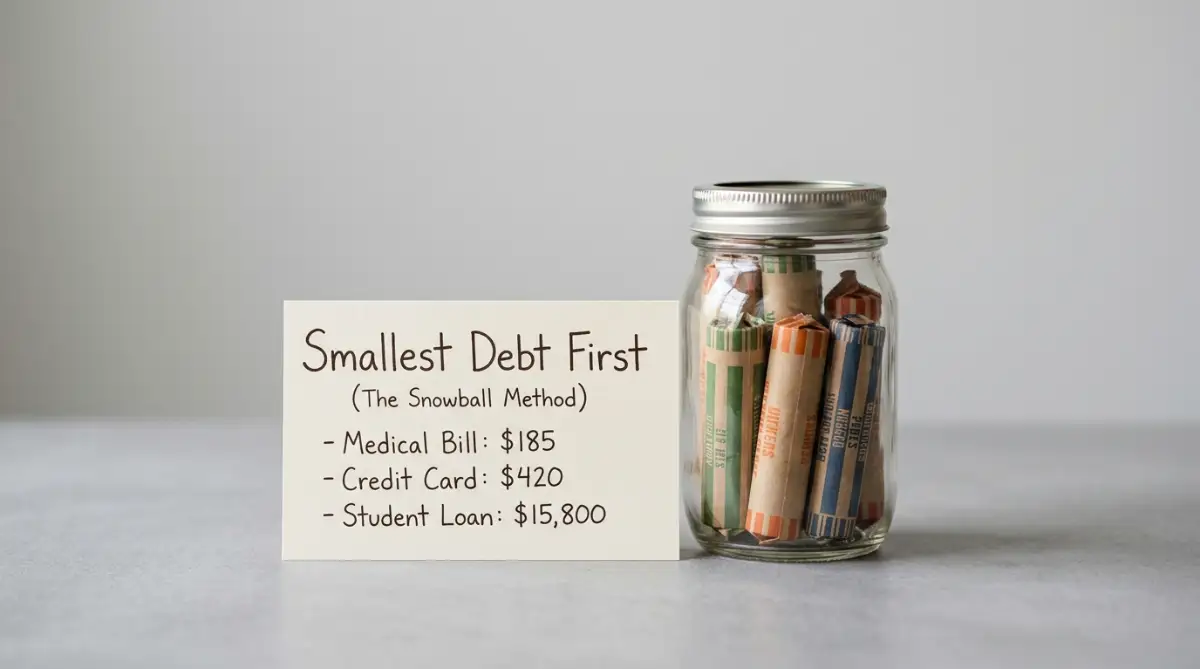
The debt snowball method is a simple way to pay off multiple debts by focusing on one debt at a time, starting with the smallest balance, while paying only the minimum on everything else.
Once that smallest debt is paid off, you take the money you were putting toward it and add it to the payment for the next smallest debt. Like a snowball rolling downhill, your payments grow bigger and faster with every debt you clear.
It isn't a trick. It isn't a loan. It's simply a system for where your money goes each month.
Step 1: List Every Debt From Smallest Balance to Largest
Grab a notebook, a spreadsheet, or even the notes app on your phone. Write down every debt you owe.
Include credit cards, personal loans, medical bills, and store cards. For each one, write the total balance, the minimum payment, and the interest rate.
Now reorder that list from the smallest balance to the largest, ignoring the interest rate for now. This step alone gives most people their first real sense of clarity in months.
Real-life example: Imagine you owe $400 on one card, $1,200 on another, and $6,000 on a personal loan. Your new order is simple: the $400 card comes first, then the $1,200 card, then the $6,000 loan.
Step 2: Pay Minimums on Everything Except the Smallest Debt
This is where the method becomes manageable instead of overwhelming.
You keep making the minimum payment on every debt except the smallest one. That way, nothing falls behind and your credit stays protected.
All of your extra focus and extra cash goes toward that one smallest balance. You are not trying to attack five debts at once. You are attacking one.
This single shift removes so much of the mental noise that comes with juggling multiple bills. Instead of feeling pulled in five directions, you have one clear target.
Step 3: Throw Every Extra Dollar at That One Debt
Now comes the part that actually creates momentum.
Any spare cash you find, whether it's from cutting a subscription, selling something you don't use, or a small bonus at work, goes straight to that smallest debt.
Once it hits zero, something powerful happens. You don't pocket that freed-up payment. You roll it into the minimum payment of the next debt on your list.
So if you were paying $50 toward that first card, and its minimum was $25, you now have $75 extra to throw at debt number two, on top of its own minimum payment.
This is the snowball effect. Each payoff makes the next one faster, because your monthly "attack amount" keeps growing.
Why This Works So Well, Even Though It Isn't Mathematically Perfect
If you compare total interest paid, some experts will point out that paying off the highest interest rate debt first technically saves a little more money.
That approach has a name too, and it's worth knowing about if you want to compare strategies. But here's the catch: it only works if you actually stick with it for years.
Research on behavior and motivation backs this up. A widely cited study published in the Journal of Marketing Research found that people were more likely to stay committed to debt payoff when they focused on clearing smaller balances first, because each payoff created a sense of progress that kept them going.
In plain terms, this method is built around how people actually behave, not just how spreadsheets behave. Quick wins keep you motivated, and motivation is what gets a debt plan finished instead of abandoned.
A Simple Way to Picture It
Think about training for a 5K instead of jumping straight into a marathon. Finishing that first short race gives you proof that you can do it.
That proof is what keeps you running. Paying off your first small debt works exactly the same way. It's proof, in black and white, that your plan actually works.
By the time you're tackling your largest debt, you'll have already built the habit, the discipline, and the confidence from every debt that came before it. The hardest part usually isn't math. It's getting started and not giving up halfway through.
This method removes that risk by giving you a small, fast, believable win right from the very first month.
Two Power Moves That Make Your Snowball Roll Even Faster
Once you've got your first debt rolling toward zero, you can speed things up even more. These next two moves separate people who finish the plan from people who quietly drift off it.
Find the "Hidden" Money You Didn't Know You Had
Most people think they need a second job to pay off debt faster. You usually don't. You just need to find money that's already leaking out of your budget.
Open your bank statement and look at the last 30 days. Circle every subscription you forgot you had, every delivery fee, every "small" purchase that adds up.
Real-life example: A $15 streaming app, a $40 gym membership you haven't used in months, and $60 in food delivery fees adds up to $115 a month. That's $115 you can throw straight at your smallest debt.
You can also try a quick negotiation call. Phone your internet or cell phone provider and simply ask, "Is there a lower plan available right now?" Companies say yes far more often than people expect, because keeping a customer is cheaper than losing one.
Selling things you no longer use is another fast source of cash. That old phone in your drawer, unused tools, clothes that don't fit anymore. None of it is doing you any good sitting in a closet, but it can knock weeks off your payoff timeline.
Automate Your Snowball So Willpower Isn't Required
Willpower runs out. Automation doesn't.
Right after payday, before you have a chance to spend it, set up an automatic transfer that sends your extra debt payment straight to your smallest balance.
This single habit removes the temptation that wrecks so many debt plans. The money is already gone before your brain even gets a vote.
Think of it like a gym buddy who shows up at your door every morning. You don't have to feel motivated. The system carries you on the days your motivation doesn't show up.
Use a Visual Tracker to Feed Your Motivation
Seeing numbers shrink on a screen is good. Seeing them shrink on a wall is better.
Draw a simple thermometer chart, a row of boxes, or even a printed list taped to your fridge. Color in a section every time you make a payment.
This isn't just decoration. Visual proof of progress is one of the biggest reasons people stick with the debt snowball method long enough to finish it, because the win becomes something you can actually see every single day.
How to Keep This Going After Your First Big Win
The biggest risk after paying off one or two debts isn't failure. It's comfort.
Once a card is gone, it's tempting to treat that freed-up payment as extra spending money. A little treat here, a nicer dinner there, and suddenly your "extra" cash has quietly vanished into your regular spending.
Here's the simple guideline that keeps people on track: every dollar that gets freed up moves to the next debt, with zero exceptions, until your list is completely empty.
Once every debt is paid, you don't stop the habit. You simply redirect that same monthly amount toward a real emergency fund, then toward savings or investing.
The skill you're really building here isn't just paying off debt. It's the habit of directing your money on purpose, instead of letting it disappear without a plan. That habit is worth far more than any single payoff.

The Most Common Ways People Stall Their Own Progress
Even a simple plan can get derailed. Here are the mistakes that trip people up the most, and what they actually cost you.
Mistake 1: Adding New Debt While Paying Off Old Debt
This is the single fastest way to undo months of progress. Swiping a credit card "just this once" while you're also trying to pay it down keeps you running in place.
The cost: Every new charge cancels out part of the extra payment you worked hard to make. It can turn a 12-month plan into a 24-month plan without you even noticing.
Mistake 2: Skipping a Small Safety Cushion First
Jumping straight into aggressive debt payoff with zero savings sounds fast, but it backfires the moment your car needs a repair or your hours get cut at work.
The cost: Without even a small buffer, one surprise expense forces you right back onto the credit card you just paid off. A basic safety cushion of even $500 to $1,000 protects all the progress you've already made.
Mistake 3: Switching Strategies Halfway Through
Some people start with the smallest-balance approach, get impatient, switch to chasing the highest interest rate debt instead, then switch back again a few months later.
The cost: Constant switching resets your sense of progress every time. You lose the exact momentum that makes this method work in the first place.
Mistake 4: Not Automating the Minimum Payments
Forgetting even one minimum payment on a "smaller priority" debt can trigger a late fee and a hit to your credit score.
The cost: One missed payment can cost $25 to $40 in fees alone, plus months of credit score damage. That's real money pulled straight out of your debt payoff plan.
Mistake 5: Letting Freed-Up Cash Disappear Into Daily Spending
This is the quiet killer. A debt gets paid off, everyone celebrates, and then that freed-up payment slowly gets absorbed into everyday spending instead of rolling into the next debt.
The cost: This single habit is the reason so many people pay off one or two debts and then stall out for years on the rest. The snowball only works if the money keeps rolling forward.
You Already Have Everything You Need to Start
Paying off debt was never really about being good at math. It's about building one habit, one small win, at a time.
You've now seen exactly how the debt snowball method works, why it works on a psychological level, and the small moves that make it even faster. You also know the mistakes that quietly stop most people before they finish.
None of this requires a perfect financial situation. It just requires a list, a little extra cash each month, and the choice to start.
Pick your smallest debt today. Write it down. Make one extra payment toward it this week, even if it's small.
That one decision is how every debt-free story actually begins.