
Why Your Daily To-Do List Feels Like a Constant Trap

You wake up every single morning with big plans to change your life. You open a fresh notebook or open a modern digital app on your phone.

Then, you write down a long list of things you want to achieve before the sun goes down.

Yet, by the time evening arrives, you find yourself staring at the exact same list. Most of the items are still unchecked, and you feel completely exhausted.

You wonder where all those precious hours went while your stress levels rise.

I know exactly how that feels because I spent years trapped in that identical loop. You start your day with high hopes, but by 3:00 PM, you find yourself staring blankly at your screen, wondering where all your energy went.

The truth is, we are often taught that staying busy is the same as being productive, but that is a costly mistake. If we want to reclaim our time and protect our mental energy, we need to stop looking for complex software or impossible routines.

Instead, we need to focus on practical, science-backed productivity hacks that work in harmony with our biology rather than fighting against it. Let us look at how we can simplify our approach to daily planning.

This daily struggle makes you feel like you are running on a treadmill. You are moving as fast as you can, but you are not getting any closer to your goals.

You start to doubt your own skills and feel guilty about not being disciplined enough.

This cycle triggers a psychological phenomenon known as decision fatigue. Every single unchecked item on your daily checklist forces your brain to make a micro-decision: Should I do this now? Or later?

Or skip it entirely? By the time you write down twenty tasks, you deplete your limited mental energy before you even touch a single key. Your brain is not broken; it is simply trying to protect itself from cognitive overload.

Many people try to fix this by searching for quick answers online. Sadly, they often fall into traps that make their situation much worse. Here is why the usual advice does not work for most of us:

  • We try to copy busy influencers who have completely different lives, jobs, and energy levels than we do.
  • We download too many complex apps that actually take more time to manage than the actual tasks we need to complete.
  • We focus on staying busy instead of being productive, which leads to doing easy, useless tasks just to feel active.
  • We try to do everything at once without realizing that our brains have a strict limit on focus and energy.
  • We ignore our natural body clocks and try to force ourselves to work when our minds are completely drained.

This constant cycle of failure does not just hurt your work output. It slowly damages your mental peace and drains your self-confidence over time.

  • You live in constant fear of falling behind, which makes it impossible to enjoy your free time with your family.
  • You start to believe you are simply lazy, even though you are actually working ten hours a day.
  • Your brain feels cloudy and tired, making it hard to make simple decisions or think of creative ideas.
  • You lose the joy in your work, turning your passions into a heavy source of anxiety and frustration.

I still remember the Tuesday afternoon when I finally hit rock bottom. I was sitting at my desk, surrounded by half-empty coffee cups, with 27 browser tabs open, trying to write an urgent proposal.

My phone buzzed every 45 seconds, and although I felt incredibly busy, when I looked at the clock at 6:00 PM, I realized I hadn't completed a single meaningful task. I was exhausted, anxious, and felt like a complete failure.

That was the moment I realized that grinding harder wasn't the answer. We don't need more hours; we need a better relationship with our focus.

Once I stopped fighting my biology and started designing a system around how my brain actually works, everything changed. Let me show you exactly what worked for me.

Before we jump into how we block our hours, let me share a simple mental filter that completely changed how I plan my days.

I used to dump 20 tasks onto my notepad, which immediately triggered my procrastination. Now, I use a framework called the 1-3-5 Rule.

It is incredibly simple: each day, you commit to accomplishing just 1 big thing, 3 medium things, and 5 small things. That’s it.

By setting a hard limit of nine tasks, you force yourself to prioritize before your day even starts. It prevents that overwhelming feeling of staring at an endless list and gives your brain a highly realistic roadmap.

To help you put this into practice right away, let me show you how I personally break down my daily 1-3-5 list:

  • 1 Big Task: This is your "must-win" of the day. It is the task that requires your sharpest mental energy and about 2 to 3 hours of deep, uninterrupted focus (e.g., drafting a major client proposal or designing a website layout).
  • 3 Medium Tasks: These are important but require less cognitive power. They usually take 30 to 60 minutes each (e.g., preparing a meeting agenda, reviewing a team project, or preparing a presentation slide).
  • 5 Small Tasks: These are quick, administrative chores that you can easily batch together at the end of the day, taking 5 to 15 minutes each (e.g., paying a bill, replying to routine emails, or filing expenses).

By limiting yourself to this structure, you protect your brain from decision fatigue and finish each day feeling a genuine sense of progress.

To help you put this framework into action, let me share a brilliant resource that helped me digitalize this workflow.

If you want to dive deeper into how to integrate this daily prioritization technique into your routine, I encourage you to read Any.do's Ultimate Guide on the 1-3-5 Rule.

It will show you exactly how to structure your daily priorities using simple digital planners so you can stop staring at an endless list of unchecked tasks.

The Science-Backed Routine to Reclaim Your Focus

To fix this issue, we must stop relying on raw willpower alone. Willpower is like a phone battery that starts full in the morning and slowly dies as the day goes on.

Instead, we need a simple, logical system that works with our natural brain chemistry.

I used to believe that highly productive people had some sort of superhuman willpower. I thought they simply woke up, gritted their teeth, and powered through their lists.

But when I actually looked into the cognitive science, I realized we are all working with the exact same biological limitations.

Willpower is a finite chemical resource in our prefrontal cortex. That’s why we need a system that doesn’t require us to constantly force ourselves to focus.

We need to build structure. And that is where our first practical strategy comes in.

Let us explore the most effective, easy-to-use strategies that you can start using today. These are not complex theories but real steps that bring clear results.

Most people make the mistake of working from a messy list of tasks. They jump from writing an email to checking social media, then to working on a project.

This constant switching drains your brain power quickly.

Step 1: Time Blocking

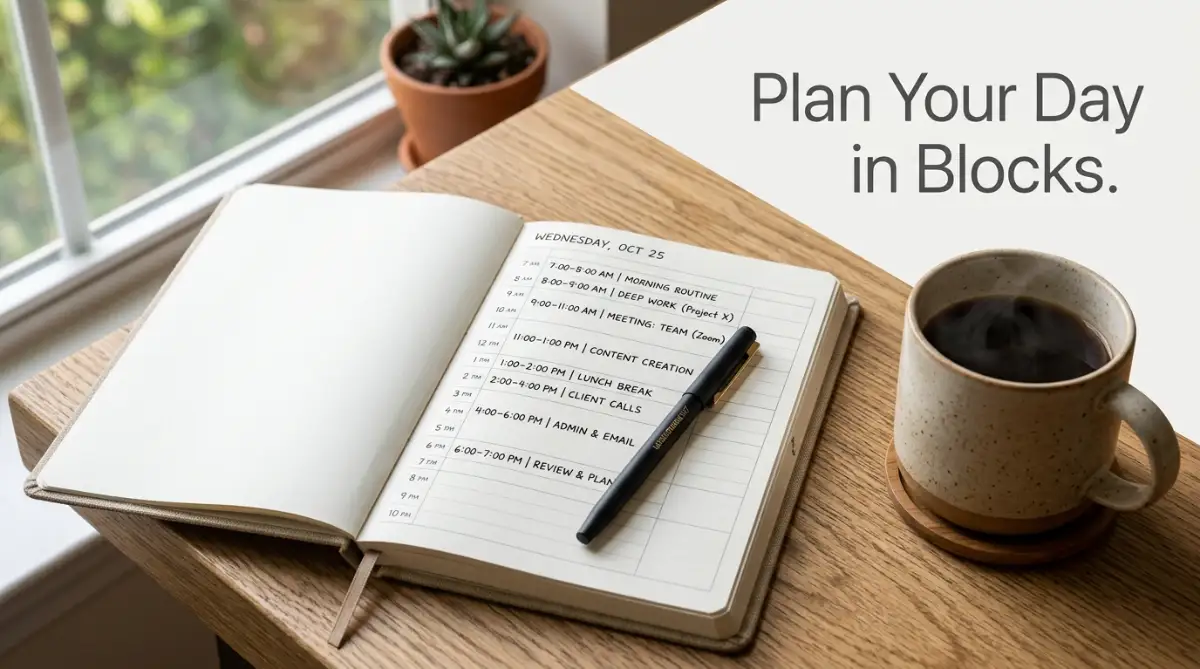
Instead, you should use a simple method called Time Blocking. This means you divide your day into small, dedicated boxes of time. Each box is meant for only one specific activity.


+-------------------------------------------------------------+
|                     DAILY TIME BLOCK EXAMPLE                |
+------------------------------+------------------------------+
| 09:00 AM - 10:30 AM          | Deep Work Block (No Phones)  |
+------------------------------+------------------------------+
| 10:30 AM - 11:00 AM          | Break & Light Stretching     |
+------------------------------+------------------------------+
| 11:00 AM - 12:00 PM          | Email & Messages Batching    |
+------------------------------+------------------------------+

When you feel your energy dipping near the end of a 90-minute cycle, please don’t beat yourself up or try to force your way through. Just step away from your desk.

Our brains naturally run on ultradian rhythmsβ€”which are biological cycles of high-frequency mental activity followed by brief, essential down periods.

If you want to dive deep into how these internal clocks control your focus, mood, and sleepiness, I highly recommend checking out Healthline’s Guide on Biological Rhythms.

It’s a fantastic resource that completely changed how I look at my workday. Instead of feeling guilty about taking breaks, it showed me how to design my schedule around my natural biological peaks.

Think of these 90-minute blocks as a natural wave of mental energy. In the first ten to fifteen minutes, your brain is just warming up.

It is searching for context, resisting the urge to wander, and slowly building momentum. This is the friction phase. Around the twenty-minute mark, you finally catch the wave.

You enter a deep flow state where thoughts come easily and hours feel like minutes.

But as you approach the eighty-minute mark, your mental fuel begins to run dry. Your eyes drift. You start to fidget.

Instead of forcing yourself to keep grindingβ€”which only produces sloppy, error-prone workβ€”accept that your biological wave has peaked.

Step away. A brief ten-minute walk or stretch resets your system so you can ride the next wave with equal power.

When you work inside a block, you must shut down every other distraction. Close your extra browser tabs and put your phone in another room.

Our brains take about twenty minutes to regain deep focus after a single interruption. By protecting your time blocks, you save hours of wasted mental energy.

You will finish your main tasks in half the time it used to take you.

However, I must warn you about a common trap that I fell into when I first started time blocking: the planning fallacy.

As humans, we naturally overestimate what we can accomplish in a single day and underestimate how long individual tasks actually take.

My schedule used to fall apart by lunch because a single meeting ran ten minutes over.

To protect yourself from this, I highly recommend adding a daily 30-minute "Buffer Block" in the middle of your afternoon.

Think of this block as a shock absorber for your schedule. It is a guilt-free space to catch any spillover tasks, reply to urgent matters, or simply stretch your legs.

By built-in buffer blocks, you keep your stress levels low and maintain control over your day, even when things do not go according to plan.

We often let small, tiny tasks pile up until they look like a mountain. This includes replying to a simple message, filing a receipt, or cleaning your desk.

These little tasks sit in your head and create constant mental noise.

Step 2: The Two-Minute Rule

To solve this, use a rule created by productivity expert David Allen: The Two-Minute Rule. If a task takes less than two minutes to complete, do it immediately.

I first stumbled upon this life-saving concept while digging into David Allen’s groundbreaking work on stress-free productivity.

If you've ever felt like your brain is constantly buzzing with 'open loops'β€”unfinished tasks that you keep trying to rememberβ€”it’s because our minds are actually terrible at storing ideas but great at processing them.

The two-minute rule is just a tiny piece of a larger, brilliant system. To truly understand how to empty your brain and gain absolute control over your day,

I highly encourage you to explore the framework directly on the official Getting Things Done (GTD) Website.

It gave me a completely new perspective on how to clear mental clutter so I could focus on what actually matters.

Do not write it down on your list and do not put it off for later. Just take action and get it out of your way right now.

This simple habit keeps your to-do list incredibly clean and light. It also gives you a small boost of confidence early in the day.

You will feel in control of your environment instead of feeling overwhelmed by it.

There is a deep psychological reason why this works so well. When you leave tiny tasks unfinished, they create what psychologists call the Zeigarnik Effect.

Our brains are literally wired to remember incomplete tasks more than completed ones. This means that unresolved email sitting in your inbox

is quietly eating up your mental processing power in the background, even when you are trying to relax.

But what about those tasks that take longer than two minutes, which you still keep putting off? Do not let them clog your mind.

I use a physical "holding pen" list on a notepad next to my desk. By writing them down immediately, I give my brain cognitive permission to let them go,

knowing I will schedule a dedicated time block to handle them later.

Step 3: Manage Your Energy, Not Your Time

Time is a fixed resource, but your personal energy is highly flexible. You can have eight open hours in a day, but they are useless if you are too tired to think.

This is why managing your energy levels is far more useful than tracking minutes.

First, you need to find your Peak Energy Hours. Most people have about three to four hours a day when their brain is sharpest.

For some, this is early in the morning; for others, it is late in the afternoon.

  • During peak hours: Work on your hardest, most creative tasks that require deep thought.
  • During low-energy hours: Do light work like clearing your inbox, organizing files, or scheduling meetings.

Never waste your best brain hours on cheap tasks like scrolling through emails. Treat your peak hours like pure gold and guard them with your life.

To truly master this, we need to look at our biological clock, also known as our chronotype. Research shows that most of us

follow a predictable daily energy pattern: a Peak (high focus), a Trough (early afternoon slump), and a Recovery (a lighter, creative rebound).

I used to beat myself up thinking that highly productive people were just robotic machines who could stay sharp 24/7.

But that myth was completely shattered for me when I read Daniel Pink’s fascinating research on the science of timing.

In his book When, Pink explains that about 80% of us experience a very predictable daily pattern: a sharp Peak in the morning, a deep Trough in the early afternoon, and a creative Recovery in the evening.

If you want to understand how to synchronize your hardest tasks with these natural waves, you can grab a copy of this eye-opening guide directly from Daniel Pink’s Official Books Page.

Shifting my analytical writing to my peak morning hours and saving mindless admin tasks for my afternoon trough completely changed the game for me.

During your Peakβ€”which is early in the day for about 80% of usβ€”your brain is naturally highly vigilant and defensive against distractions[5].

This is when you must schedule your analytical work; those demanding tasks that require deep logic, sharp problem-solving, and absolute precision.

During the Trough, your mood and energy take a dive. This is your administrative zone. Use it to clear out simple emails, file receipts, or tidy your desk[3].

Finally, during the Recovery phase, your brain relaxes its defensive guard. While you are less vigilant, your mood rises,

making this the golden window for creative brainstorming, loose ideas, and strategic insights[3]. When you stop fighting your natural daily rhythm, your workflow suddenly clicks into place.

Personally, I am a "morning lark," meaning my absolute peak hours are between 8:00 AM and 11:00 AM.

When I stopped checking my email during these gold hours and instead dedicated them to my hardest writing projects, my productivity completely changed.

If you are a "night owl," your peak might be at 9:00 PM. The secret is not to work when society tells you to, but to align your hardest cognitive work with your natural biological peaks.

If you want to identify your exact peak hours, try tracking your energy levels for one week. Simply set a gentle alarm on your phone every two hours and rate your mental sharpness on a scale of 1 to 10 in a pocket notepad.

Within five days, you will spot a clear, recurring pattern. This personal data shows you exactly when to schedule your "genius hours" and when to save the mindless tasks for your low-energy slumps.


Myth vs. Reality: What Actually Works?

To truly improve, we must separate common myths from proven facts. Many things we think are good for us are actually ruining our daily progress.

Before we move into batching, we have to talk about the biggest silent killer of our daily focus: multitasking.

We often wear our ability to juggle five things at once as a badge of honor. But let’s be honest with ourselvesβ€”when we try to reply to a Slack

message while editing a spreadsheet, we aren't actually doing both at once. Our brains are just rapidly switching back and forth.

According to the groundbreaking American Psychological Association's multitasking research, this constant 'task-switching' can drain up to 40% of our daily productivity.

Every time you switch your attention, your brain is forced to spend valuable cognitive energy loading new rules and contexts.

It is the mental equivalent of starting and stopping your car engine in stop-and-go traffic. By the end of the day, you feel completely exhausted even if you didn't finish a single major task.

If we want to keep our minds fresh, we must learn to single-task.

Step 4: Batch Your Tasks to Keep Your Mind Clear

Think of your brain like a car engine. If you constantly stop and start the car, you burn a lot of fuel very quickly. The same thing happens when you switch between different types of tasks.

Task Batching is the habit of grouping similar activities together and doing them in one single session. This keeps your brain in a steady flow state.

  • Communication Batch: Set two times a day to check and reply to all your emails and chat messages.
  • Creation Batch: Set aside a long block of time solely for writing, designing, or planning.
  • Admin Batch: Do all your quick, boring tasks like paying bills or filling out sheets at the very end of the day.

When you separate these tasks, your mind does not have to adapt to new rules constantly. You will feel much calmer and get through your work with less struggle.

Step 5: Build a Distraction-Free Workspace

Our physical environment has a massive impact on how we think and feel. A messy desk or a noisy room sends constant stress signals to our brain.

This makes it very hard to sit still and focus on a single project.

You do not need an expensive office setup to be highly productive. A few small, simple changes can make a world of difference.

  • Clear your physical desk: Keep only the items you need for your current task on your table.
  • Clean your computer desktop: Hide messy files and close all browser tabs that are not related to your current work.
  • Use noise-canceling options: Put on simple white noise or instrumental music to block out background sounds.
  • Keep a physical notepad nearby: If a random thought pops into your head, write it down on paper and go right back to work.

By removing these small visual blocks, you make focusing feel natural and easy. Your mind can relax and put all its energy into the task at hand.

Real-Life Scenario: How Mark Reclaimed His Evenings

To see how these rules work in real life, let us look at the story of Mark. Mark was a software designer who felt like he was drowning in work every day.

He worked twelve hours a day but always felt behind on his main projects.

He decided to make a few small changes to his daily routine. First, he stopped checking his emails first thing in the morning. Instead, he used his first two hours of the day to write code.

Second, he started putting his phone inside a drawer during his focus times. Lastly, he grouped all his team meetings into a single afternoon block.

Within two weeks, Mark saw a massive shift in his life. He was finishing his primary work in just five hours instead of twelve.

He no longer felt tired at night and finally had time to cook healthy meals and exercise.

Mark did not work harder or run faster. He simply stopped fighting his brain and started using a smart, logical system.

Step 6: The Great Power of Planned Rest

Many people believe that the best way to get more done is to work without stopping. They skip lunch, drink too much coffee, and ignore their body's need for a break.

This approach always leads to a sudden, painful burnout.

Your brain needs regular rest to process information and build new ideas. Short, planned breaks actually keep your focus sharp over long hours.

One great way to do this is the classic Pomodoro Technique. You work with high focus for twenty-five minutes, then take a short five-minute break.

But here is the real secret that most of us get wrong about this technique: a Pomodoro is indivisible. If you get interrupted by a phone call or a colleague halfway through, that 25-minute block is void, and you must restart.

Francesco Cirillo, the brilliant mind behind this method, developed it using a simple tomato-shaped kitchen timer to build focus.

When we protect our work blocks with this kind of boundary, we train our brains to ignore distractions and enter a deeper flow state.

To get your hands on the official planning templates and understand the pure philosophy from the creator himself, I highly recommend visiting the official Pomodoro Technique Website.

It completely shifted how I value my 25-minute windows of attention.

During this break, get up from your chair, stretch your legs, or drink a glass of water. Do not look at your phone screen or check social media, as that does not count as real rest.

After doing four work blocks, take a longer break of twenty to thirty minutes. This system keeps your energy steady and stops you from feeling exhausted at the end of your day.

Step 7: Say No to Low-Value Projects

Sometimes, the best productivity hack has nothing to do with speed. It is simply about choosing what not to do in the first place. We often say yes to too many projects because we want to please others.

Every time you say yes to a minor task, you are saying no to your main goals. Learn to protect your limited time with polite but firm boundaries.

  • Ask yourself: "Will this project help me reach my main goals for this month?"
  • If the answer is no: Politely decline or ask to do it at a later date when you have more free time.
  • Keep your focus narrow: It is much better to do three important things wonderfully than ten minor things poorly.

By narrowing your focus, you make real, measurable progress on the things that truly matter. You will feel lighter, happier, and much more successful.

Final Steps to Start Your New Journey Today

Changing your daily work habits does not happen overnight. Do not try to apply all these steps at once, as that will only cause more stress.

Instead, pick just one small method from this guide to try today. Maybe you can start by putting your phone in another room for one hour. Or perhaps you can try using the two-minute rule after lunch.

Once that simple habit feels easy and natural, add another one to your routine. Over time, these small shifts will add up to create a massive change in your life.

You will finally break free from the constant stress of the daily grind. You will get more done, enjoy your personal time, and regain your peace of mind.

Deepening Your Daily Focus: Advanced Systems for High Performers

Now that we have covered the basic systems of managing your daily schedules, let us look at the deeper habits.

Many people understand the basic rules of time management but still struggle to maintain their focus over several weeks.

To build a lifestyle where you consistently get high-quality work done without feeling tired, you need advanced systems.

These systems look closely at how your brain processes attention and how your environment controls your choices.

We will explore how to set up your work environment, manage your physical energy, and build habits that last for months.

These strategies are used by top performers who manage massive projects without losing their mental peace.

The Art of Digital Minimalism

Our phones and laptops are amazing tools, but they are also designed to steal our attention. Every notification, message, and alert is a small battle for your brain power.

If you want to keep your mind sharp, you must design a clean digital space. This means removing anything that does not serve your direct goals.

Start by turning off all non-human notifications on your phone. You do not need to know when someone likes a post or when an app has an update.

You should only allow messages from real people who need urgent answers. For other updates, schedule a specific time in your day to open the apps and check them manually.

Let’s be honest for a second. How many times have you put your phone on silent, flipped it face down on your desk, and thought, 'Okay, now I’m safe from distractions'?

I used to do this every single day, believing my willpower was strong enough to resist checking it. But science recently gave me a much-needed reality check.

A classic study highlighted in the Harvard Business Review on Smartphone Distraction reveals that simply having your phone in your line of sight actively sabotages your cognitive performance.

The researchers discovered a silent culprit they call 'brain drain'. Even when your device is switched off and face down, your brain is still working incredibly hard not to check it.

This constant, subconscious battle quietly eats up your limited working memory, leaving you with significantly less brainpower for the task right in front of you.

To help you reclaim this wasted brainpower and escape this mental trap, I highly recommend taking these three simple steps today:

1. Go Grayscale: Turn your phone's screen to grayscale mode. This instantly strips away the dopamine reward of colorful notifications and makes social media feeds look incredibly boring.

2. Hide Your Apps: Move all social media and distracting apps off your main home screen and tuck them into a single, hard-to-find folder.

3. Create Physical Distance: When you are entering a deep work block, physically place your phone in another room or lock it in a desk drawer.

Trust me, out of sight really is out of mind when it comes to raw brainpower.

To counter this, make a rule to keep your phone in another room during your deep focus times. This simple physical boundary makes it much easier to stay on task for longer periods.

Creating Your Dedicated Deep Work Space

Your physical space tells your brain what it should be doing. If you work in your bed, your brain will get confused between sleeping and working.

You need to assign specific spots for specific activities. If you work from home, try to set up one single desk that is only used for your professional tasks.

When you sit at this desk, your brain should immediately recognize that it is time to focus. If you do not have space for a separate desk, you can use smaller cues.

For example, you could use a specific desk lamp that you only turn on when you are working on high-value tasks.

Or you can put on a specific pair of noise-canceling headphones to signal to your mind that it is time to lock in.

I have found that building a structured morning routine helps prepare your mind for this deep work space. When you follow the same steps every morning, you remove the decision-making stress that tires your brain early in the day.

As one of my favorite productivity mentors, Cal Newport, beautifully explains on his famous Study Hacks Blog, deep work is not a natural talent we are born withβ€”it is a cognitive muscle that we must actively build.

One of Cal’s concepts that completely saved my evenings (and my sanity) is the 'shutdown ritual.' It’s a structured sequence of actions you perform at the very end of your workday to tell your brain, 'We are officially done.'

If you struggle to disconnect and often find yourself checking emails during dinner, I highly recommend reading his blog to understand the psychology behind this.

He teaches us how to close all open mental loops so that we can fully show up for our families and our hobbies without any lingering work anxiety.

So, how do we actually run a shutdown ritual in our daily lives? Let me share the simple routine I borrowed from Cal's insights that saved my evenings.

At the end of my workday, I take exactly ten minutes to do a clean sweep:

  1. I do a quick pass over my inbox to ensure no critical, time-sensitive fires have started.
  2. I update my task list, transferring any scribbled notes from my desk pad into my digital system.
  3. I review my calendar for the next two days so my brain isn't secretly panicking about what's coming.
  4. I say a literal phrase out loudβ€”mine is simply, 'Shutdown complete.'

It sounds incredibly silly at first, I know. But speaking those words acts as a clear psychological boundary.

It is a cue that tells my brain it is safe to stop processing work problems. Since I started doing this, my evening anxiety has almost completely vanished, and I can finally be present with the people I love.

Just as we need a shutdown ritual to close our minds for the evening, we also need a structured way to boot up our brain in the morning.

I call this my Morning Start-up Ritual. Without it, you are at the mercy of your inbox and everyone else's priorities.

Before I touch my keyboard, I spend ten minutes reviewing my 1-3-5 list, verifying my time blocks for the day, and clearing off any clutter on my desk.

It acts as a cognitive runway, helping me transition from a sleepy state into deep, intentional focus. When

we combine a clear start-up with a disciplined shutdown, we create a secure psychological container for our entire workday.

Biological Hacks for High-Level Mental Power

We often treat our minds like computers that can run forever without fuel. But your brain is a physical organ that depends on your body's overall health.

If you eat heavy food, skip sleep, or sit all day, your brain will struggle to focus. You cannot solve a biological energy problem with just a better schedule.

If you are feeling a strange mental fog rolling in around 3:00 PM, please don’t reach for another coffee just yet.

You probably aren't lazy; you are likely just dehydrated. Since your brain is made of roughly 73% water, even a tiny 1% drop in your hydration levels can slow down neural signals,

giving you a headache and clouding your working memory. Keeping a reusable bottle of water on your desk is the simplest, cheapest focus hack you will ever find.

If you want to see the solid, peer-reviewed science behind how drinking water keeps your brain sharp and energy steady,

take a few minutes to read the Healthline Guide on Water Benefits. It will completely change how you view your daily hydration habits.

We often treat our brains like computers that can run forever without fuel, but we forget that our daily focus is directly tied to what we eat.

Sugary snacks and processed carbs give you a temporary high followed by a brutal crash that leaves you exhausted. Personally,

swapping my processed afternoon chips for raw almonds and fresh blueberries made an immediate, noticeable difference in keeping my evening energy levels steady.

If you want to learn which foods actually nourish your brain cells, improve memory, and prevent brain fatigue,

I highly suggest bookmarking the Healthline Science-Backed Guide to Brain Foods. It is a goldmine of evidence-based dietary tips that will help you fuel your focus naturally.

Finally, never underestimate the power of high-quality sleep. When you sleep, your brain washes away metabolic waste and builds new memories.

To help you fix your sleep patterns and wake up feeling refreshed, I suggest focusing on a few simple, daily adjustments that can make a massive difference:

  1. Ditch the Screens: Turn off all phones, tablets, and laptops at least 30 to 45 minutes before you plan to sleep. The blue light from these devices tricks your brain into thinking it is still daytime, suppressing melatonin.
  2. Keep a Consistent Schedule: Try to go to bed and wake up at roughly the same time every dayβ€”even on weekends. This helps stabilize your natural biological clock.
  3. Cool and Dark Environment: Keep your bedroom slightly cool and dark to signal to your body that it is time to rest.

Building Long-Term Systems over Short-Term Goals

Many people fail because they focus too much on massive, scary goals. They say things like, "I want to write a whole book this month."

This goal is so big that it creates fear and procrastination. Instead of focusing on the final goal, you should focus on building a simple daily system.

A system is a small habit that you can easily do every single day. For example, instead of trying to write a book, your system could be to write two hundred words every morning.

This small action feels very easy to do, so you will rarely skip it. Over several months, these tiny steps will add up to create huge results.

This is the beautiful concept of compounding habits. As James Clear beautifully highlights in his popular Atomic Habits Book Summary,

if you can manage to get just one percent better at your systems each day, you will end up thirty-seven times better by the end of a single year.

We don't need giant, overnight leaps to change our lives; we just need small, daily systems that reduce friction for things we want to do and increase it for things we want to avoid.

Focus on the daily process, and the big goals will naturally take care of themselves.

Hidden Mistakes That Secretly Ruin Your Progress

Even when we try our best, we often make mistakes that quiet down our daily progress. These pitfalls are hard to see because they often look like useful work on the surface.

Let us identify these common traps so you can protect your time and energy. Avoiding these mistakes is just as important as starting new habits.

I have seen many people spend days setting up complex organization systems. They download five different apps, connect them with automation tools, and color-code every task.

They feel highly productive while doing this, but they are actually procrastinating. This is a common form of active procrastination where you do useless work to avoid hard, creative tasks.

You do not need a fancy digital system to get things done. A simple paper notepad and a pen are often much better than any expensive phone app.

Keep your tools as simple as possible. The goal is to spend your time doing the actual work, not organizing it.

This is highly unrealistic and always leads to deep frustration. Your brain can only handle about four hours of deep, focused work per day.

If you try to push past this limit, the quality of your work will drop quickly. You will make simple mistakes that take hours to fix later.

We often get so caught up in the pursuit of 'doing more' that we completely miss the early warning signs of chronic exhaustion.

Burnout doesn’t hit us like a sudden lightning bolt; it quietly creeps in. First, you start dragging yourself to your desk in the morning.

Then, you find yourself feeling unusually critical or cynical about your projects. Soon, you are using extra caffeine or late-night scrolling just to cope with the daily stress.

If this sounds familiar, please stop and listen to your body. I found immense clarity by checking my own symptoms against the Mayo Clinic's Guide on Job Burnout.

It was a gentle but necessary wake-up call that forced me to re-evaluate my relationship with my schedule. To heal, I started doing a weekly 'Energy Audit' every Friday.

I look back at my calendar and label tasks with a plus (+) if they energized me, and a minus (-) if they drained me.

This simple habit helped me set healthier boundaries and gradually eliminate the tasks that were quietly hollowing out my mental peace.

If you recognize these symptoms in yourself, do not ignore them. I highly recommend running a "Weekly Energy Audit."

At the end of every week, look back at your calendar and place a plus sign (+) next to the tasks that energized you, and a minus sign (-) next to the tasks that left you feeling drained.

This simple five-minute reflection will show you exactly where your time is being wasted and where you need to set firmer boundaries.

Many of us are people-pleasers who hate saying no to others. When a coworker asks for help or a friend invites us to a project, we immediately say yes.

But every time you say yes to something unimportant, you are saying no to your own future. You are giving away your limited time to solve other people's problems.

Learn to use polite but firm boundaries in your daily life. You can say, "I would love to help, but my schedule is completely full this week."

At the end of the day, remember that your sleep isn't just about resting your eyesβ€”it’s the ultimate cognitive reset button.

When we ignore our bedtime boundaries, we directly sabotage our focus for the next day. Transitioning to a healthier nightly routine takes time,

but it is one of the most powerful adjustments you can make for your career and well-being.

If you are ready to design a night-time routine that actually works for your lifestyle, I highly recommend checking out Healthline’s Guide on Sleep Hygiene.

It offers incredibly practical, expert-backed tips to help you wind down properly, stabilize your biological clock, and wake up with your mental batteries fully charged.

Q&A: Common Questions About Daily Habits

Here are some common questions that people ask when trying to build better daily habits.

Motivation is highly unreliable and comes and goes like the wind. Do not wait for motivation to start your daily tasks.

Instead, use the "five-minute rule" to trick your brain. Tell yourself that you will work on the task for just five minutes, and if you still hate it, you can stop.

Most of the time, once you start, your brain gets used to the task and you will want to keep going. Action always creates motivation.

If you work in a busy office or have a loud family, constant interruptions are normal. To solve this, you must set clear visual signals for your focus times.

You can wear bright red headphones or place a small sign on your desk that says "Focus Mode." Let your team know that when they see this sign,

they should not disturb you unless it is a real emergency.

If you have had a busy, stressful week, your brain needs proper rest to heal. Do not spend your weekend staring at screens or thinking about work.

Spend time in nature, go for a walk, or read a physical paper book. This helps your brain relax and prepares your mind for the upcoming week.

Your Daily Action Plan for Tomorrow

To make sure this guide actually changes your life, let us create a simple plan for tomorrow. Do not try to change your whole routine at once. Just follow these simple steps to start your journey.

Follow this simple checklist tomorrow, and see how much better you feel. You do not need to be perfect; you just need to start.

A Final Word of Encouragement

Building better habits is not about becoming a robot who works every second of the day. It is about organizing your work so you can fully enjoy your personal life.

It is about leaving your office at a normal hour without feeling guilty or stressed. It is about having the mental energy to play with your kids, read a book, or enjoy a hobby.

I know how hard it can be to break free from old, stressful routines. It takes time, patience, and a lot of self-kindness to build a better way of living.

If you make a mistake and have a bad day, do not worry or give up. Just forgive yourself and start fresh the very next morning.

You have the power to take control of your time and your mind. Start with one small step today, and let your habits build your success over time.

Disclaimer:

The information provided in this article is for educational and informational purposes only. It does not constitute professional medical, psychological, or career advice. While the strategies shared here are based on common productivity research and expert opinions, individual results may vary depending on personal circumstances, health conditions, and work environments. Always consult with a qualified professional or health specialist before making major changes to your diet, sleep patterns, or physical routines.

About the Author:

Kamal Uddin is a writer, productivity strategist, and entrepreneur. After spending years struggling with chronic overwork and digital distractions, Kamal dedicated his life to researching and implementing practical, science-backed systems that help modern professionals regain control of their time. He shares actionable strategies on workflows, time management, and mental performance to help you work smarter while keeping your mental peace intact.