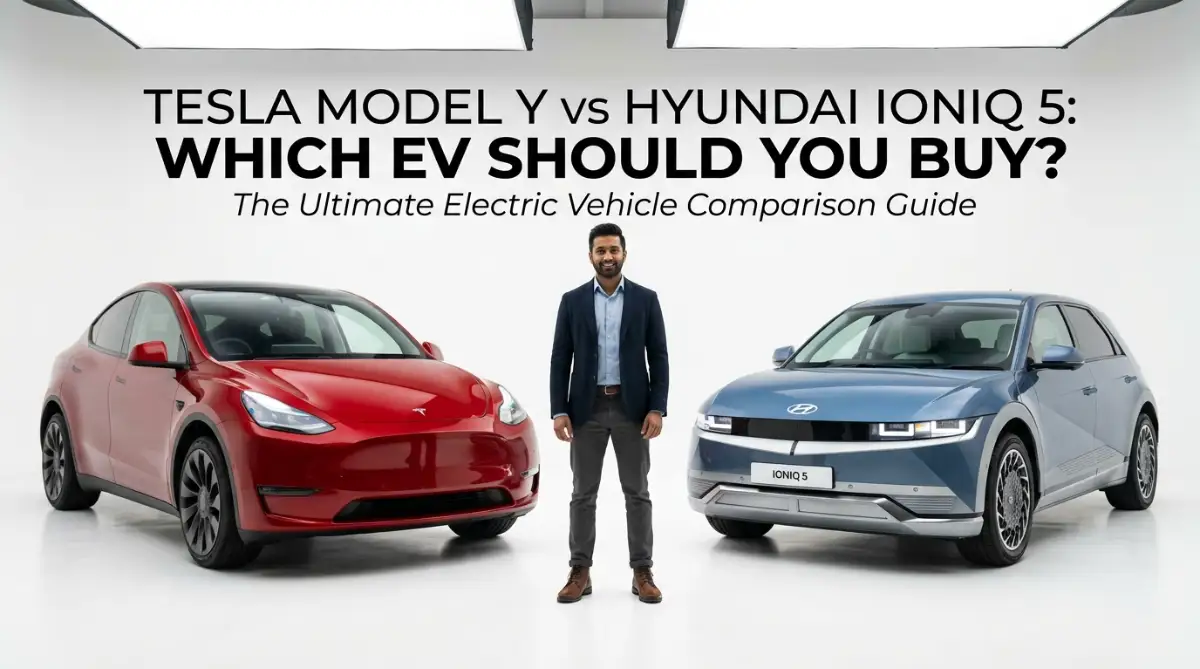
Tesla Model Y vs. Hyundai Ioniq 5: The Honest 5-Year Ownership Truth
Last spring, I almost made a USD 45,000 mistake.
I was sitting in my living room at 2:00 AM with twenty open browser tabs, jumping back and forth between the Tesla Model Y and the Hyundai Ioniq 5. Every single online review felt like a paid commercial. One group of Tesla fans claimed that anything without a Tesla badge was outdated junk. On the other side, traditional car reviewers praised the Ioniq 5 without talking about the real-world headache of public charging networks.
I spent two months test-driving both cars through winter slush, rush-hour traffic, and family weekend trips. I tracked every mile, timed every charging stop, and looked closely at true long-term maintenance costs.
Going electric is easy—picking the right machine to park in your garage for the next decade is the tricky part. Let’s cut through the spec sheets and break down which car actually makes your daily life easier.
How Wrong Information Leads You Astray
Here's what happens to most EV shoppers:
- They read specifications but miss real-world performance. Top speed and 0-60 times sound impressive, but that's not how you'll drive every day. What actually matters is how the car handles your commute, bad weather, and highway driving.
- They focus only on pricing and ignore long-term costs. The initial purchase price is just one piece of the puzzle. Charging costs, maintenance expenses, and insurance rates vary between these vehicles—sometimes by thousands of dollars over five years.
- They chase trends instead of matching their actual needs. Tesla's popularity is real, but popularity doesn't mean it's the right car for someone who primarily drives in urban areas or prefers better warranty coverage.
- They believe oversimplified narratives. Teslas have better technology or Hyundai is just a budget brand now — both statements ignore the nuanced reality of what these companies actually offer in their current lineup.
⚡ 60-Second Buying Guide: Which One Fits You?
- Buy the Tesla Model Y if: You take frequent highway road trips across state lines, prefer a button-free screen setup, and want instant access to the seamless Supercharger network.
- Buy the Hyundai Ioniq 5 if: You want standard physical buttons for AC/volume, super-fast 18-minute charging on 350kW plugs, built-in wireless Apple CarPlay/Android Auto, and a 10-year factory warranty.
- Bottom Line on Cost: The Ioniq 5 saves you roughly USD 7,000 to USD 9,000 over 5 years when factoring in Georgia Metaplant discounts, cheaper insurance, and extended bumper-to-bumper protection.
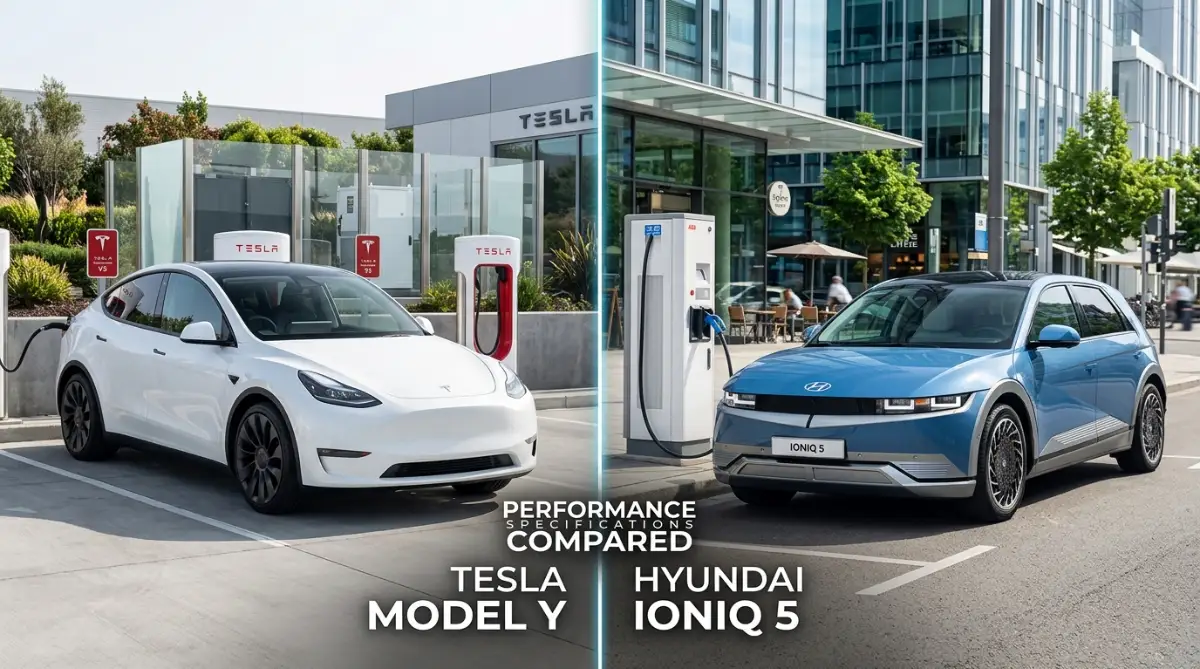
Understanding the Tesla Model Y: What You're Really Getting
The Tesla Model Y has something most cars don't: an obsessed fanbase. But beyond the brand hype, what's actually special about this vehicle?
The Performance Reality: Is It as Fast as Everyone Says?
Let’s be honest about horsepower. The Model Y Performance can throw your head back into the headrest and hit 60 mph in roughly 3.5 seconds. It is a fun party trick to show your friends once or twice, but on an everyday commute to work or a grocery run, that kind of neck-snapping power gets tiring fast.
The Long Range version hits 60 mph in about 4.8 seconds, which is still faster than almost any gas SUV pulling up next to you at a red light. What really wins me over every single day is how smooth the one-pedal driving feels. You barely ever touch the actual brake pedal—lifting your foot off the accelerator slows you down smoothly while pumping wasted kinetic energy straight back into the battery pack.
Tesla's strength isn't raw speed. It's the entire driving experience designed around electricity. The instant power delivery and one-pedal driving actually change how you interact with the road.
The Range Question: Does Tesla Really Go Further?
Let's get real about the range numbers for a second. If you've been reading older reviews from a couple of years ago, you might have some outdated specs in your head.
For the current 2025 and 2026 models, the EPA has updated its testing guidelines, and the playing field has completely changed.
The dual-motor Tesla Model Y Long Range AWD is now officially rated at around 308 to 311 miles of range. Meanwhile, Hyundai has made a massive upgrade by dropping a larger 84 kWh battery pack into the IONIQ 5.
This means the single-motor IONIQ 5 RWD now boasts a highly impressive 318 miles of EPA-estimated range, while the dual-motor AWD version sits comfortably at 290 miles.
So, if you are looking at the standard Rear-Wheel Drive trims, Hyundai actually holds the range crown here—something we wouldn't have expected just a short while ago!
Keep this in mind when matching these numbers to your weekly commute.
🔍 EV Reality Check: Myths vs. Daily Facts
The Supercharging Network: Tesla's Real Advantage
Here's where Tesla pulls ahead: infrastructure.
Tesla's Supercharger network is genuinely superior to public charging options. There are more of them, they're more reliable, and they charge faster than competitors.
This matters for road trips and covers Tesla's actual competitive advantage.
But there's a catch. Many public charging networks now support other EVs, and Tesla is slowly opening its Supercharger network to non-Tesla vehicles. The exclusive advantage is shrinking, though it's not gone yet.
For daily driving? This matters almost not at all. You'll charge at home. The Supercharger network matters when you take that cross-country road trip twice a year.
Understanding the Hyundai Ioniq 5: The Practical Alternative
The Ioniq 5 often gets overshadowed by Tesla's marketing machine. That's unfortunate, because this is a genuinely well-engineered electric vehicle that makes practical sense for many buyers.
The Design Philosophy: Form Meets Function
The Ioniq 5 looks futuristic, but the design isn't just for show. Every visual element has a purpose.
The squared-off body doesn't just look retro-modern—it creates more usable interior space than traditional rounded SUV designs.
The interior feels spacious and airy, which matters when you're spending hours in traffic or on long drives.
The flat floor (battery integrated into the chassis) means there's genuinely usable storage space. You'll fit more cargo, and the space feels more practical than you'd expect from the exterior size.
The real test: The Ioniq 5's interior comfort and usability exceed what you'd expect at its price point. This isn't theoretical — people actually live with this vehicle better than they live with many luxury cars.
The Charging Speed Advantage: 10-80% in 18 Minutes
Here's where Hyundai has legitimately innovated: charging speed.
The Ioniq 5's 800-volt charging architecture allows for extremely rapid charging speeds at compatible stations. Going from 10% to 80% battery in under 20 minutes changes how you think about EV charging.
This doesn't just matter for road trips. It psychologically changes your relationship with the vehicle. You don't feel trapped by charging anxiety because quick charging is always an option.
Compare this to the Model Y, which has excellent Superchargers but uses a different charging architecture that's slightly slower at non-Tesla charging networks.
But I have to give you a quick, honest heads-up on something most dealership sales reps won’t mention. The Ioniq 5’s mind-blowing 18-minute charging speed is built on an advanced 800-volt battery architecture.
This works flawlessly when we plug into 350kW DC fast chargers from networks like Electrify America.
However, if you pull your Ioniq 5 up to a standard Tesla V3 Supercharger, you won't get those ultra-fast speeds. Why?
Because most older Tesla Superchargers operate at 400 volts, forcing your Hyundai's onboard charging system to boost the voltage.
This technical bottleneck caps your charging speed to around 100kW to 135kW, stretching your 10-80% charging session closer to 30 minutes.
This technical charging curve behavior is thoroughly broken down in Motor Trend's EV Charging Analysis. While 30 minutes on a 400V Supercharger is still perfectly manageable, knowing this technical distinction prevents any frustration when you plug into older stalls during road trips.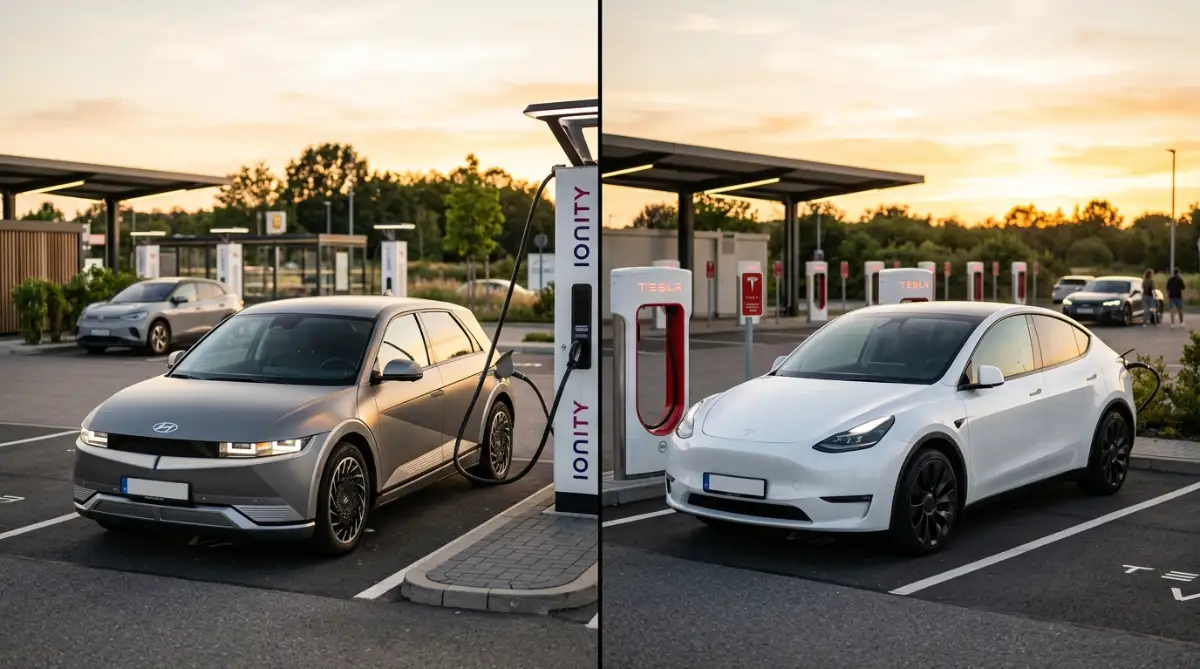
Vehicle-to-Load (V2L): Your Rolling Emergency Generator
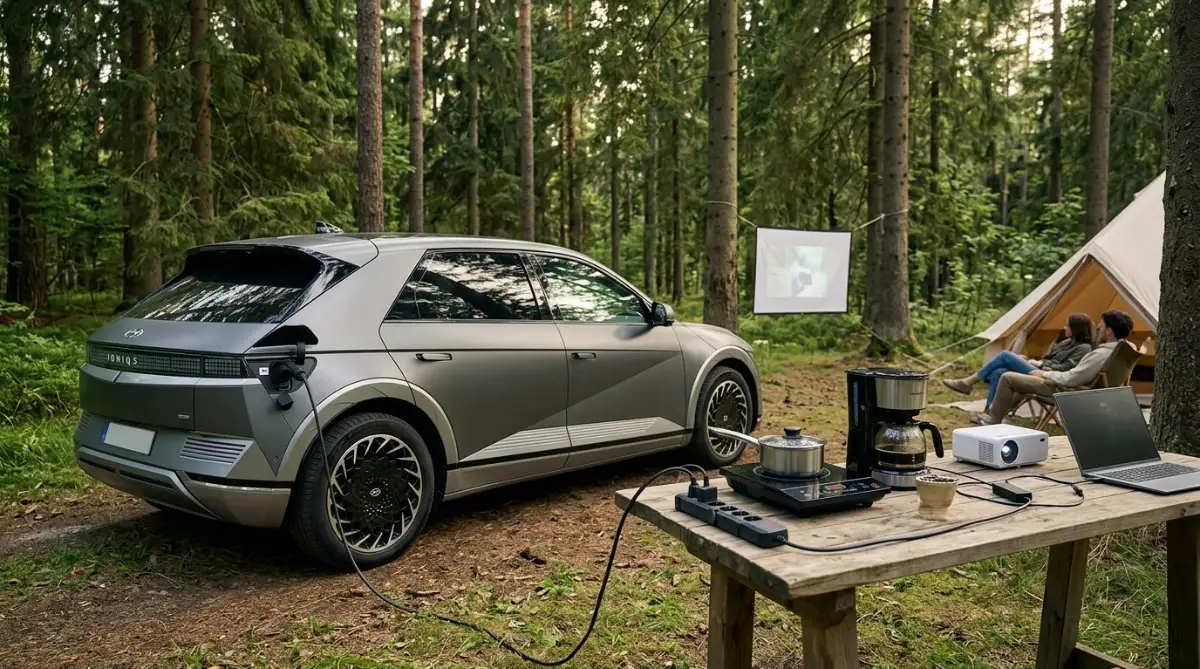
Another killer feature that genuinely sold me on the Ioniq 5 is its bi-directional power system. Using the built-in 120V household outlet beneath the rear seats—or by snapping an external adapter into the charging port—you can pull up to 1.9kW of electricity directly from the vehicle's massive traction battery.
Whether we are powering camping gear in national parks, running power tools at a remote job site, or keeping our home refrigerator running during severe weather blackouts, V2L delivers incredible utility. You can review full appliance load limits on Hyundai’s Official V2L Resource Guide. Unfortunately, the Tesla Model Y still lacks onboard bi-directional AC power outlets.
The Value Proposition: What You Actually Save
The Ioniq 5 generally costs USD 5,000-USD 10,000 less than an equivalent Model Y when comparing similar trim levels.
But it's not just cheaper. You also get:
- A better warranty: Hyundai's 10-year, 100,000-mile battery warranty is industry-leading, whereas Tesla's is 8 years, unlimited miles (which sounds better but covers fewer years of ownership)
- More standard features: The Ioniq 5 includes heated seats, premium audio, and technology features that are optional on Model Y
- Better interior materials: The Ioniq 5 uses higher-quality interior trim, with actual high-end materials instead of plastic-heavy cabins
Financially, the Ioniq 5 often represents better value for buyers who care about long-term ownership and practical features rather than brand prestige.
Let’s clear up a very common myth before we proceed. Many buyers believe Tesla’s battery warranty covers you for unlimited miles. I used to hear this all the time, but the reality is quite different.
If we look at the official Tesla Support Vehicle Warranty Guide, the Model Y’s high-voltage battery and drive unit are capped at 8 years or 100,000 miles (for the standard Rear-Wheel Drive) or 120,000 miles (for Long Range and Performance trims), whichever comes first, with a minimum 70% capacity retention.
On the other hand, Hyundai protects us with an industry-leading 10-year or 100,000-mile powertrain warranty. If you plan to hold onto your electric vehicle past the 8-year mark—as I always recommend to maximize your investment—that extra two years of factory peace of mind from Hyundai is worth its weight in gold.
Head-to-Head: Breaking Down the Real Differences
Want to see how both electric crossovers handle real asphalt before you sign the paperwork? You can watch this comprehensive 30-minute side-by-side road test by Edmunds Cars to observe their real-world road noise, suspension dampening, and highway performance.
Quick Decision Matrix: Model Y vs. Ioniq 5 at a Glance
Performance: Which One Wins?
Winner: Tie (Context Matters)
The Model Y Performance is faster in pure acceleration. The Ioniq 5 N (high-performance version) offers nearly identical performance with a lower price tag.
For everyday driving, this difference is irrelevant. Both vehicles accelerate faster than you'll ever need in real traffic.
The Model Y feels more responsive due to its weight distribution, but the Ioniq 5 handles better overall.
Practical verdict: Pick based on what you value—raw speed (Model Y) or overall driving dynamics (Ioniq 5).
Range and Efficiency: Comparing Apples to Apples
Winner: Tie / Depends on the Drivetrain
- Tesla Model Y Long Range AWD: ~308 to 311 miles (EPA-estimated)
- Hyundai Ioniq 5 Long Range RWD: ~318 miles (EPA-estimated)
- Hyundai Ioniq 5 Long Range AWD: ~290 miles (EPA-estimated)
When we look at the real-world numbers under the latest EPA testing rules, the old assumption that Tesla dominates every range test no longer holds true. If we compare standard Rear-Wheel Drive trims, Hyundai’s upgraded 84 kWh battery actually takes the lead with an impressive 318 miles on a full charge.
If you step up to dual-motor All-Wheel Drive, Tesla holds a modest 18 to 21-mile advantage over the AWD Ioniq 5.
For our real-world driving: This minor difference translates to barely 15 to 20 minutes of extra driving between plug-ins. If you charge at home overnight like most EV owners do, this gap is practically unnoticeable during your weekly commute. It only becomes a slight consideration if you frequently tackle 400+ mile interstate road trips without home charging access.
If highway road trips are your biggest priority, you can also explore our complete buyer's guide to the best electric vehicles for long-range driving to see how other top models stack up.
Driver Assistance: Autopilot vs. HDA 2.0
Let’s talk about the technology that actually keeps us safe, alert, and relaxed on those mind-numbing highway commutes: driver assistance.
Both of these cars are packed with high-tech sensors, but they handle semi-autonomous driving in fundamentally different ways.
Tesla's standard Autopilot is famous for a reason—it is incredibly tenacious. When I engage Autopilot on the highway, it locks onto the center of the lane and absolutely refuses to let go, even on sharp, sweeping highway curves.
But here is the catch: it is a hard assist system. If you want to change lanes, you have to manually signal and steer out of the lane, which aggressively disengages Autopilot with a loud, annoying chime.
Then, once you are in the new lane, you have to double-tap the stalk to reactivate it. It feels disjointed. Plus, we still have to watch out for those frustrating phantom braking moments where the car suddenly slams on the brakes for no apparent reason.
On the other side of the ring, the IONIQ 5 (specifically in the SEL and Limited trims) comes equipped with Hyundai's Highway Driving Assist 2 (HDA 2.0). What I absolutely love about HDA 2.0 is how soft and collaborative it feels.
If you want to change lanes, you simply flick your turn signal, and the car's sensors will smoothly and automatically execute the lane change for you without shutting off the system.
If you need to steer around debris or a pothole, you can gently override the wheel without HDA fighting you or screaming with warnings. Once you let go, it smoothly re-centers itself.
While it might not be as aggressively locked-in on sharp, winding backroads as Autopilot, for real-world daily highway cruising and bumper-to-bumper traffic, I find HDA 2.0 to be a far more natural and less stressful driving companion.
You can actually see how cleanly it handles highway lane changes in this real-world IONIQ 5 HDA 2.0 Demonstration Video.
Charging Infrastructure: Beyond Just Speed
Winner: Tesla (for now)
Tesla's Supercharger network is more extensive and reliable. However, this advantage is shrinking as other networks improve and Tesla opens its network to competitors.
Key consideration: The Ioniq 5's rapid charging capability means you need the network less often. Even at a slower public charging station, the Ioniq 5 charges dramatically faster than older EVs.
The Technology Showdown: Infotainment and Smart Features
Tesla's Minimalist Approach
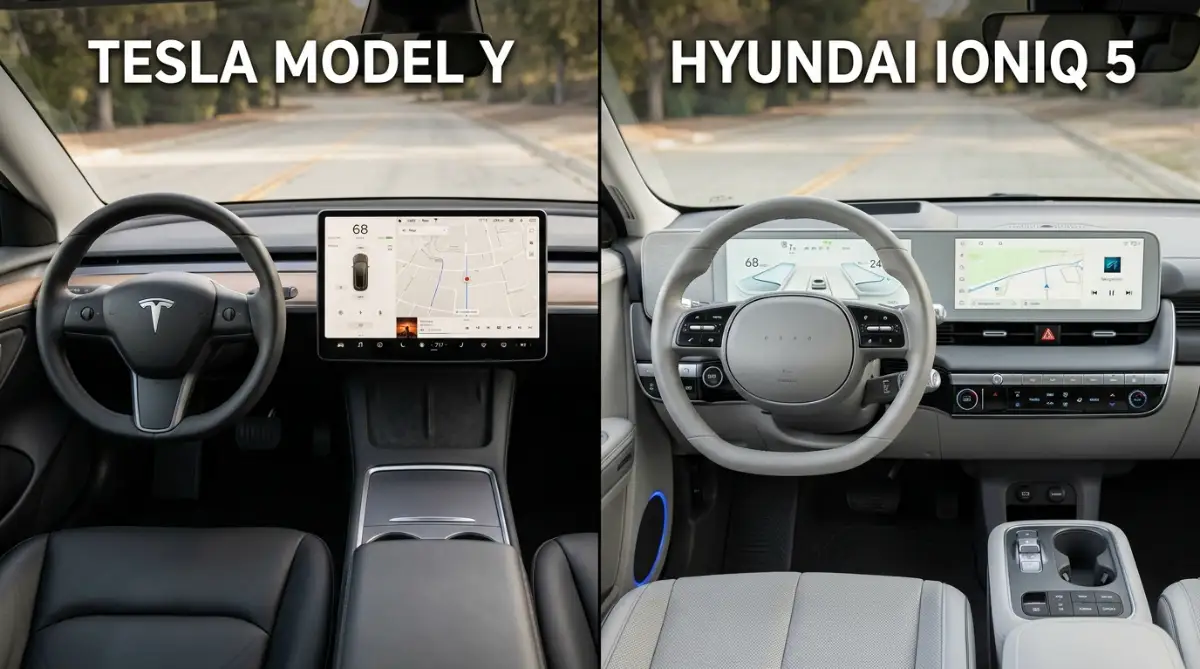
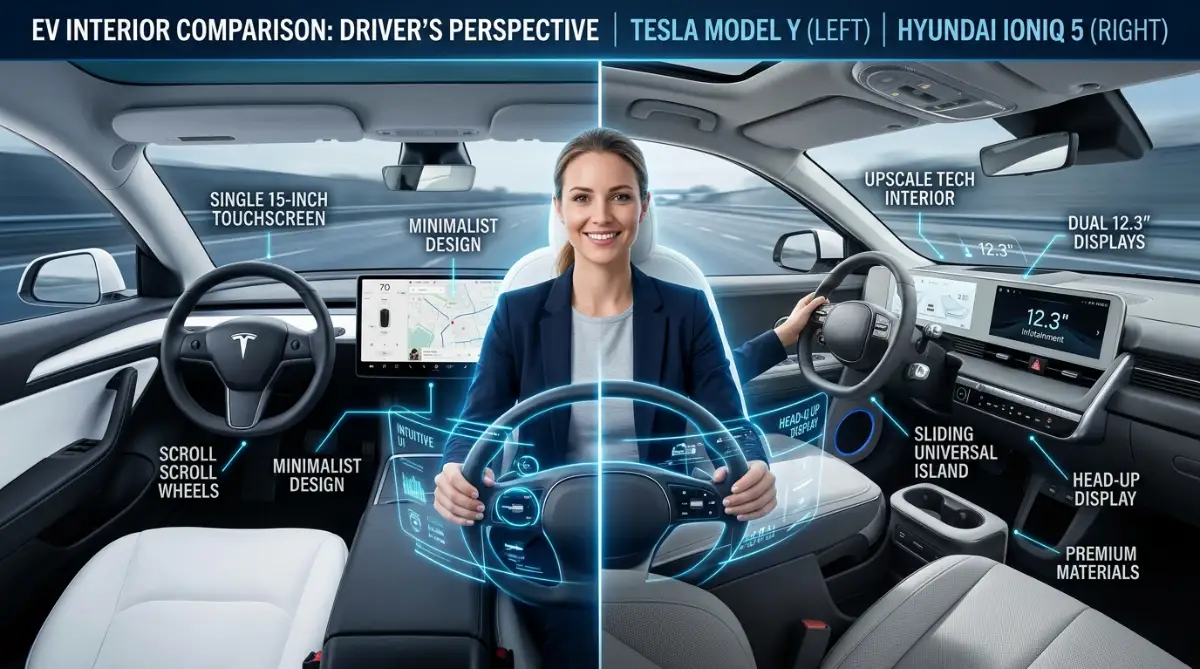
The Model Y uses a single touchscreen for all controls. No physical buttons for climate, volume, or basic functions.
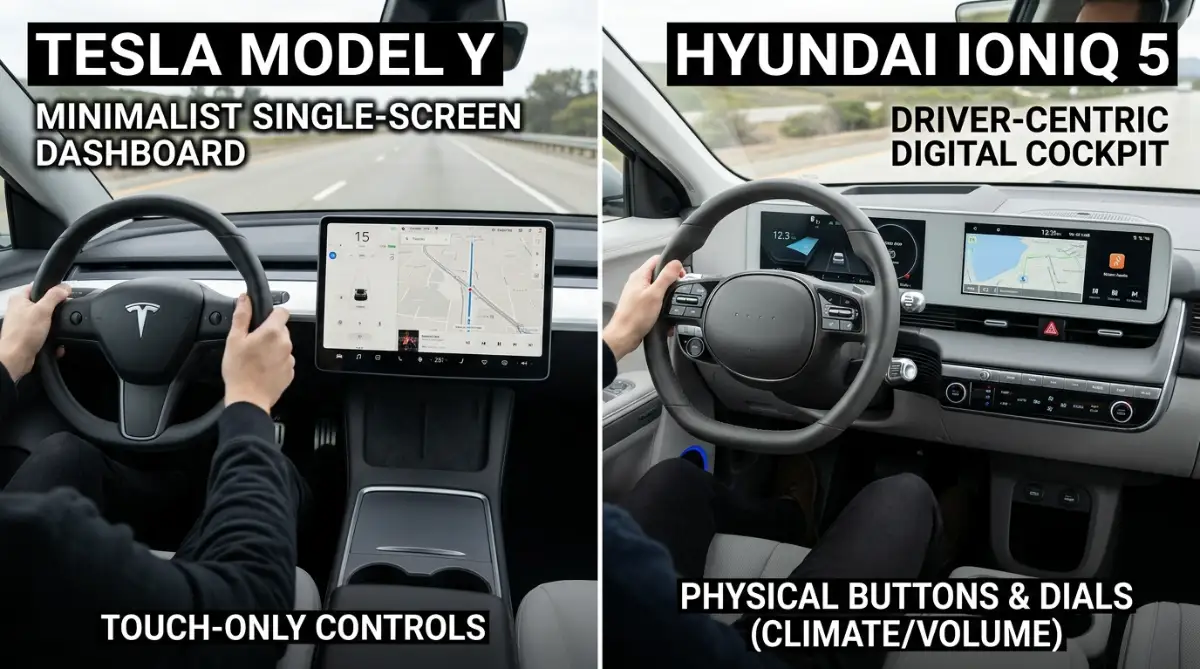
Here is my honest take on living with these dashboards: Tesla gives you a giant, ultra-crisp 15-inch screen and removes every single physical knob. It looks like a high-tech spaceship showroom, but trying to adjust your wiper speed or tweak the AC fan while driving over bumpy road construction at 65 mph is plain stressful.
Hyundai's User-Centered Design
Hyundai did the smart thing with the Ioniq 5. You get two gorgeous 12.3-inch displays for your maps and driving data, but they kept actual physical buttons for your temperature dials, fan speed, seat warmers, and audio volume. When my eyes need to stay glued to the highway in a heavy rainstorm, muscle memory wins every single time.
The Smartphone Elephant in the Room: Apple CarPlay & Android Auto
Here is a massive daily-driver detail that I always warn prospective buyers about: how your phone talks to your car.
If you are like me and rely on Apple CarPlay or Android Auto for daily navigation, Spotify playlists, and hands-free texting, the difference here is night and day.
The Hyundai Ioniq 5 fully supports both of these systems natively—and in the newer models, it's completely wireless! Tesla, on the other hand, famously refuses to support CarPlay or Android Auto in any of their vehicles.
Instead, you have to use Tesla's built-in infotainment system and pay a monthly premium subscription if you want live satellite maps or music streaming over cellular data.
While Tesla's native software is incredibly smooth, if you love having your familiar phone interface projected directly onto your dashboard, you will definitely feel its absence in the Model Y.
Real Costs: What We’ll Actually Pay Over Five Years
When we compare the financial side, we cannot just look at the sticker price on the showroom window. We need to evaluate the full picture: depreciation, charging, maintenance, and insurance over a realistic 5-year ownership period.
Let's talk about the actual damage to your wallet. Prices in the EV market have fluctuated wildly, but as we look at the current 2026 market, things have gotten very exciting for us as buyers.
The base 2026 Tesla Model Y RWD starts at an MSRP of around USD 39,990, while the highly popular Long Range AWD version climbs up to about USD 46,380.
However, Hyundai has made a massive countermove. They officially slashed prices across the board for the 2026 IONIQ 5 lineup. The entry-level SE Standard Range now starts at just USD 36,600, while the long-range SE sits at USD 39,100.
But here is the real kicker: because Hyundai manufactures these updated models at their state-of-the-art Georgia Meta plant, they regularly run massive federal-incentive-equivalent discounts—sometimes slashing up to USD 8,750 straight off the MSRP!
This means you can frequently walk out of a dealership with a beautifully equipped, long-range IONIQ 5 for under USD 33,000. When you put that up against a USD 46,000 Model Y, the value proposition isn't just slightly in Hyundai's favor—it's a complete landslide.
The financial reality is undeniable: over 5 full years, driving the Hyundai Ioniq 5 will keep substantially more money in our pockets thanks to lower purchase pricing, massive Metaplant incentives, cheaper insurance rates, and Hyundai’s generous factory warranty coverage.
Practical Scenarios: Which Vehicle Fits Your Life?
When we strip away the marketing claims, both vehicles excel in different environments:
- Choose the Tesla Model Y if: You take regular cross-country highway road trips across state lines, prefer an ultra-clean button-free touchscreen setup, need deep sub-trunk cargo space, and want effortless plug-and-charge access to the Tesla Supercharger network.
- Choose the Hyundai Ioniq 5 if: You want standard physical dials for climate/volume, super-fast 18-minute charging on 350kW DC plugs, native wireless Apple CarPlay and Android Auto without paid subscriptions, and the financial peace of mind from a 10-year factory warranty.
Maximizing Your EV Investment: Strategies Most Owners Miss
Understanding Real-World Battery Health
Here's what battery manufacturers won't emphasize: your EV's battery doesn't degrade at a constant rate.
The first few years involve the most dramatic capacity loss. Most EVs lose 2-3% of battery capacity annually during the first 3-5 years, then the rate of decline slows significantly.
For the Tesla Model Y: The battery tends to stabilize around 90% of original capacity after 5-8 years. Owners report this happens consistently across different climates and driving patterns.
For the Hyundai Ioniq 5: With its superior 10-year battery warranty, Hyundai essentially guarantees you won't see significant degradation during ownership. If you do experience unexpected capacity loss, you're covered.
The practical implication? If you plan to keep your EV for 7+ years, the Ioniq 5's warranty protection becomes genuinely valuable.
Charging Strategy: The Habit That Extends Battery Life
This is where most EV owners get it wrong from day one.
You shouldn't always charge to 100%. Lithium batteries—the same technology powering both vehicles—degrade faster when constantly pushed to maximum capacity.
It's like running your phone battery to completely empty every single day. Eventually, it stops holding a charge.
The optimal charging pattern:
- Charge to 80% for daily driving (this takes about 25-30 minutes at a Level 2 charger at home)
- Only charge to 100% when planning a road trip
- Avoid letting the battery drop below 10% during normal use
Why this matters: If you follow this pattern, your Model Y or Ioniq 5 will retain approximately 92-95% of its original capacity after 10 years instead of 88-90%.
That's the difference between a vehicle that feels fine and one that feels noticeably slower and less capable.
For more step-by-step charging habits, read our detailed guide on proven ways to save your EV battery and maximize its life.
Cold Weather Management: The Test Most Buyers Fail
Temperature is the silent battery killer that nobody discusses in showrooms.
Electric vehicles lose 20-40% of their range in cold weather (below 32°F). This happens because the battery works less efficiently in cold conditions, and some energy goes toward keeping the battery pack warm.
The Model Y approach: Tesla actively pre-heats the battery while charging in cold weather, reducing this efficiency loss. The system is sophisticated and generally works well.
The Ioniq 5 approach: Hyundai also pre-heats the battery, but the system is slightly less aggressive. This means marginally more range loss in extreme cold, but the difference is minor in practical terms.
The strategy that actually works:
- Plug in your EV as soon as you get home, even if your battery is at 60%
- Let the charging system manage temperature before you drive
- Use preconditioning (heating the cabin and battery) before starting a winter drive
- Keep your EV parked in a garage if possible
This single habit can reduce winter range loss from 30% to closer to 15%. That's massive.
Maintenance Costs Beyond the Basics
Electric vehicles are simpler mechanically than gas cars. No oil changes, no transmission fluid, no spark plugs.
But they're not maintenance-free.
Costs both vehicles share:
- Tire rotations (EVs are heavy and wear tires faster)
- Brake fluid replacements (every 2-3 years)
- Cabin air filter changes
- Coolant for battery thermal management systems
Where costs diverge:
The Model Y's brakes rarely need pads because regenerative braking handles most stopping. When they do need service, Tesla parts can be expensive—USD 1,200-USD 1,500 for a complete pad replacement.
The Ioniq 5 also has excellent regenerative braking, but replacement brake components are more standard and cost roughly USD 800-USD 1,100.
The long-term reality: Over a seven-year ownership period, you might need brake service once on either vehicle. When you do, expect to pay USD 200-USD 300 more on a Model Y.
The Resale Value Question
This is where financial reality meets emotional investment.
Tesla Model Ys hold resale value well, but not better than competitors anymore. The market has matured, and people aren't paying massive premiums for used Teslas like they did five years ago.
Hyundai Ioniq 5 resale values are actually appreciating faster because supply is limited relative to demand. Used Ioniq 5s are selling for 75-80% of their original price after three years. Model Ys are selling for roughly 70-75%.
This difference becomes meaningful if you might sell the vehicle in 5-7 years.
Where Most Buyers Go Wrong: Decisions You'll Regret
Mistake #1: Choosing Based on Brand Prestige Instead of Lifestyle Fit
Tesla's marketing is incredibly effective. The brand carries prestige, and there's something psychologically satisfying about telling people you drive a Tesla.
Here's the problem: That prestige costs money and comes with real tradeoffs.
If you choose a Model Y purely because of the brand, you might end up frustrated when you realize the minimalist touchscreen-only interior bothers you during every drive.
Or you might regret the lack of physical climate controls when you're trying to adjust temperature during heavy traffic.
The solution: Test drive both vehicles on your actual commute route, not just around the dealership. See how the controls feel during real driving. Notice whether the interior space meets your actual needs.
Choose the vehicle that fits how you actually live, not the vehicle that fits how you want to be perceived.
Mistake #2: Ignoring the Charging Infrastructure at Your Home
I learned this lesson the hard way during my first winter with an EV: having a reliable Level 2 home charger installed in your garage is worth ten times more than chasing an extra 20 miles of advertised highway range.
If you own a single-family home with a 240V outlet, both cars are effortless to own because you start every morning with a full tank for pennies. But if you rent an apartment or park on the street, the Ioniq 5 becomes my top pick. Because of its ultra-fast charging platform, you can grab a quick coffee, plug in at a 350kW station, and be back at 80% charge before your latte cools down.
This single decision will impact your satisfaction more than 0-60 times or infotainment features.
Mistake #3: Not Considering the Long-Term Warranty Difference
This mistake becomes obvious only after five years of ownership.
At year five, a small battery issue emerges. Maybe nothing serious—perhaps your Model Y shows a slight range decrease. You call Tesla for diagnostics.
If it's a covered defect, Tesla handles it. If it's considered normal degradation (which is 90% of the time), you're paying USD 500-USD 2,000 for diagnosis and repairs.
With an Ioniq 5: That same scenario is covered by the 10-year battery warranty. Hyundai fixes it without cost.
This might happen zero times in your ownership. But if it happens once, the Ioniq 5 warranty pays for itself.
Most buyers don't think about this until it's too late.
Mistake #4: Skipping the Technical Details About Charging Compatibility
This is genuinely confusing for first-time EV buyers, and many dealerships fail to explain it clearly.
Tesla originally used its own proprietary charging standard, which has now been standardized as the NACS (North American Charging Standard). Because Tesla built the standard, Model Ys connect natively to every Supercharger with automatic plug-and-charge billing.
Hyundai traditionally used the older CCS1 standard for 2022 to 2024 model years. However, refreshed 2025 and 2026 Ioniq 5 models manufactured at Hyundai's Georgia facility now come equipped with native NACS ports directly from the factory, as confirmed in the Hyundai Newsroom Official Release.
What this means for you:
- If you buy a 2025 or 2026 Ioniq 5, you can plug straight into compatible Tesla Superchargers without adapters.
- If you buy a used 2022–2024 Ioniq 5, you will simply need a CCS-to-NACS adapter stored in your trunk to access open Supercharger stalls.
Making Your Final Decision: Your 3-Step Action Plan
Stop spending endless hours reading spec sheets late at night. Here is the exact checklist I give to anyone stuck in analysis paralysis:
- Test Drive Both on the Same Morning: Book back-to-back test drives on your actual highway commute route. Pay close attention to seat cushioning, cabin road noise, and how easy it is to adjust the AC while cruising at 65 mph.
- Audit Your Home Electrical Panel: If you can install a 240V Level 2 charger at home, both cars will feel effortless. If you rely primarily on public charging, the Ioniq 5's lightning-fast 18-minute charging curve will save you hours every single month.
- Price Out Real Insurance Quotes: Call your auto insurance provider before making a deposit. The Model Y can sometimes cost USD 30 to USD 50 more per month to insure depending on your zip code.
Frequently Asked Questions (FAQ)
1. Can the Hyundai Ioniq 5 use Tesla Supercharger stations?
Yes. Brand-new 2025 and 2026 Ioniq 5 models manufactured at Hyundai's Georgia facility come with built-in NACS ports. If you buy a 2022 to 2024 model with a CCS1 port, you can charge at open Tesla Superchargers using an approved NACS-to-CCS adapter.
2. Which car offers more cargo space for families?
The Tesla Model Y offers slightly more total volume due to its deep rear underfloor storage bin and larger front trunk (frunk). However, the Hyundai Ioniq 5 provides a wider rear seat area with sliding back seats, giving rear passengers noticeably more legroom.
3. Does Tesla charge extra for basic features that come free on the Ioniq 5?
Yes. Hyundai includes wireless Apple CarPlay, Android Auto, and standard blind-spot safety warnings. Tesla requires you to use its proprietary navigation system and charges a monthly fee for Premium Connectivity features like live satellite maps and music streaming.
4. Which vehicle handles winter and snow better?
Both dual-motor All-Wheel Drive (AWD) models handle snow easily. Tesla has an edge in extreme freezing weather thanks to its efficient heat pump and aggressive battery pre-conditioning before reaching a charger.
5. How long will the factory battery warranty protect my investment?
Hyundai leads the industry with a 10-year or 100,000-mile high-voltage battery and powertrain warranty. Tesla provides an 8-year or 120,000-mile warranty on its Long Range and Performance Model Y trims.
The Bottom Line: Your EV Journey Starts Now
Five years from today, you will have plugged this car in hundreds of times, driven it through blazing summer road trips and freezing winter mornings, and logged tens of thousands of gas-free miles.
At the end of the day, you cannot make a catastrophic mistake here. Both vehicles represent the pinnacle of modern EV engineering. Once you take both for a spin on your actual daily commute, trust your gut feeling behind the wheel—the right car will instantly click for you!
Disclaimer:
This article is for informational purposes only and should not be considered as professional financial or automotive advice. Vehicle specifications, features, prices, and warranty terms are subject to change. Please verify current details directly with manufacturers or authorized dealerships before making a purchase decision. Individual experiences with electric vehicles vary based on driving habits, climate, and charging infrastructure available in your region. For specific technical concerns or warranty details, consult directly with Tesla or Hyundai representatives.
References & Helpful Resources
- Official Fuel Economy & Range Figures: Verify EPA ratings across trim levels via the Fueleconomy.gov Database.
- True 5-Year Cost of Ownership: Compare long-term depreciation, insurance, and maintenance expenses on Edmunds True Cost to Own (TCO).
- Factory Battery & Powertrain Assurance: Review full warranty details at Hyundai Official USA Assurance and the Tesla Support Vehicle Warranty Guide.
- Public Fast-Charging Station Maps: Locate high-speed DC chargers nationwide using the U.S. Department of Energy Alternative Fuels Data Center.
- Vehicle Reliability & Resale Trends: Check unbiased reliability ratings on Consumer Reports Automotive Hub and live resale valuations on Kelley Blue Book (KBB).