
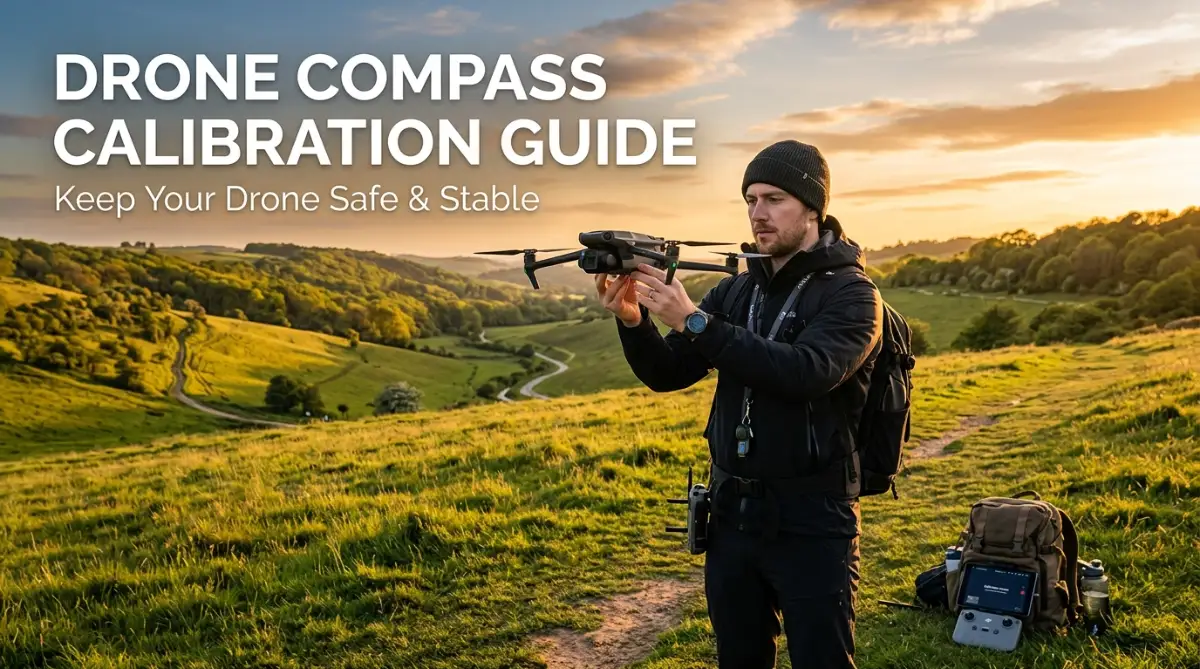
I still get cold sweats thinking about the afternoon I almost lost my $1,200 camera drone. I was standing on a scenic cliff right at sunset, expecting an easy, cinematic flight. I turned on the motors, pushed the throttle up, and waited for a smooth hover. Instead, the drone began spinning like an angry hornet and took off sideways toward a wall of thick pine trees. My controller sticks were totally useless. I had to force-land it hard into tall weeds, breaking three props in the process. When I checked my logs, the culprit was simple: I had launched the drone directly over a buried iron water pipe. If your compass gets fed junk data on the ground, your flight is in serious danger before you even take off.
⚡ Quick Takeaways: Stay Safe in 60 Seconds
- GPS tracks spot, compass tracks direction: GPS only knows your map coordinates; your compass tells the drone which way it faces. If they disagree, your drone circles out of control.
- Never calibrate on concrete or near cars: Hidden metal rebar in driveways and iron engine blocks corrupt your sensor calibration instantly.
- Only calibrate when needed: You do not need to calibrate before every flight—only when traveling over 30 miles, after a firmware update, or after a crash.
- If it spins, switch modes immediately: If you see widening spiral flight (Toilet Bowl Effect), switch to manual/ATTI mode right away and land.
My Drone Almost Flew Away: The Terrifying Reality of Compass Errors
That single experience taught me a hard lesson about how delicate drone sensors really are. Safe flying is not just about battery levels or clear skies.
It starts with giving your drone a clean, accurate sense of direction. If your compass sensor is lost, your whole aircraft is living on borrowed time.
Losing control of a drone is one of the most helpless feelings you can experience as a pilot. You watch hundreds or thousands of dollars drift away into the sky, completely deaf to your inputs.
You find yourself staring at the aircraft in a hover, holding your breath, and waiting for it to shoot sideways. That constant worry completely ruins the joy of capturing aerial photos and flying outdoors.
Many beginners assume that GPS handles everything automatically. They do not realize that GPS only tells the drone where it is located on a map.
The compass tells the drone which direction its nose is pointing. When those two sensors disagree with each other, the internal flight computer panics.
This disagreement causes unpredictable drifting, strange spinning loops, or total flyways. You end up spending your afternoon searching through thick bushes instead of enjoying your hobby.

How Your Drone Compass Works Behind the Scenes
Inside your drone sits a tiny magnetic sensor called a magnetometer. It works just like a pocket compass, reading Earth's natural magnetic pull to tell the flight computer where the nose is pointed. Whether you fly a $300 starter mini drone or a $3,000 professional rig, they all rely on this same little chip. If that sensor gets tricked by nearby metal, your drone has no idea which way is forward, and that is when expensive crashes happen.
Whether you are flying a compact DJI Mini 4 Pro, a professional Mavic 3, or an Autel Evo II, they all share this exact same vulnerability. I don't care how expensive your rig is—if that tiny magnetometer gets confused, your high-end drone turns into a very expensive, uncontrollable brick.
It measures the Earth's natural magnetic field to work out heading directions. The flight controller uses this heading info along with GPS data to stay still in the air.
When you push the forward stick, the drone needs to know which way is actually forward. If the magnetometer reports that the drone points North when it points East, trouble begins.
The flight computer tries to correct its position based on faulty direction data. This continuous loop of wrong corrections causes the infamous toilet bowl effect.
During this effect, the drone flies in wider and wider circles automatically. Left unchecked, the aircraft will speed up and collide with nearby obstacles.

Earth's Magnetic Field
↓
Digital Magnetometer
↓
Flight Controller Software
←
GPS Module Data
↓
Stable Hover & Vector Flight
If you feed bad directional data into those calculations, the flight system fails quickly. Proper sensor setup is your first line of defense against unexpected crashes.
High-Risk Areas That Ruin Compass Sensor Accuracy
You might be surprised by how many everyday objects generate magnetic noise. Metal is everywhere in our modern world, and much of it remains hidden underground or inside structures.
Here are common places you should always avoid when starting up or calibrating your drone:
- Reinforced Concrete: Sidewalks, parking structures, and patios contain hidden steel rebar underneath.
- Park Benches & Tables: Many outdoor tables have iron frames painted over to look like wood or plastic.
- Car Roofs & Hoods: Setting your drone on a vehicle hood creates immediate magnetic distortion.
- High-Voltage Power Lines: Large electrical lines produce heavy electromagnetic fields that interfere with sensors.
- Cell Towers & Utility Boxes: Electrical ground boxes and antennas pollute the immediate airspace with interference.
- Magnetic Sand: Certain beaches contain iron deposits in the black sand that throw off sensors instantly.