

My $1,200 Drone Crash and the Hard Lesson About Carrying Weight
I watched my $1,200 drone smash into gravel less than forty seconds after takeoff. My heart sank instantly. I had just bolted a fancy new mirrorless camera and heavy gimbal to the frame, convinced my setup had enough power. I was totally wrong. The motors screamed, the battery voltage dropped off a cliff, and my drone tumbled out of the air like a rock. If you love flying cameras as much as I do, you need to understand payload limits before you risk your hard-earned gear. Here is the exact guide I wish I had read before that costly crash.
Many drone pilots face this exact heartbreak every single day. You invest your hard-earned money into high-end aerial cameras, heavy battery setups, and custom mounts.
You expect smooth flight, crisp video footage, and reliable performance during every single flight mission. But when you ignore or miscalculate weight limits, everything can go wrong in a heartbeat.
Hover stability disappears, making the craft drift unpredictably near trees, power lines, or people. Worse yet, sudden drop-offs can smash expensive payloads, destroying your gear and crushing your creative confidence.
The constant fear of a sudden drop ruins the entire joy of flying. Understanding your aircraft load boundaries is the only way to protect your investment and fly with peace of mind.

📌 Quick Takeaways: What You Need to Know in 30 Seconds
- Know Your Hard Limit: Never exceed your drone's certified Maximum Takeoff Weight (MTOW), no matter how brief the flight is.
- The 2:1 Golden Rule: For safe hovering and wind control, ensure your motors produce at least double the total weight of your drone and gear.
- Heavy Payloads Drain Batteries: Extra gear cuts your airtime by 50% or more and creates severe voltage drops.
- Balance Matters More Than Weight: Off-center camera mounts overwork single corner motors and cause sudden flips in mid-air.
What Drone Payload Capacity Means for Your Aircraft
Payload capacity refers to the exact maximum amount of extra weight a drone can lift and carry safely during flight. This extra weight includes everything you attach to the base frame, such as cameras, gimbals, extra batteries, sensors, and mounting hardware.
If an object is not part of the bare original frame, it counts as part of your payload. Knowing this number prevents motor strain and keeps your flight controller working within safe limits.
Every aircraft has physical limits set by its motor power, propeller size, and battery output. When a manufacturer lists weight ratings, they are giving you strict safety boundaries.
Exceeding these limits forces the flight controller to run motors at maximum capacity continuously just to maintain a simple hover. That leaves zero extra thrust available for wind resistance, quick maneuvering, or emergency stops.
When your craft carries the right balance of weight, the flight controller makes effortless micro-adjustments. The aircraft feels light, responsive, and steady even when sudden weather changes happen.
| Term | Simple Definition |
| :--- | :--- |
| Frame Weight (Dry) | The weight of the bare drone without battery or extra gear attached. |
| Gross Weight | Total weight of drone, battery, camera, sensors, and all accessories combined. |
| Max Takeoff Weight (MTOW) | Absolute maximum total weight the drone can safely lift into the air. |
| Net Payload Capacity | Usable extra gear weight allowed after deducting battery and dry frame weight. |
Essential Weight Terms Every Drone Pilot Needs to Know
Before you do any math, you need to understand four basic technical weight terms used in aviation. The first term is Maximum Takeoff Weight (MTOW), which represents the total heaviest weight at which an aircraft is certified to lift off.
This number is fixed by motor thrust tests and frame strength calculations. You should never exceed the MTOW under any circumstances.
The second key term is Tare Weight or Dry Weight. This is the weight of the drone frame, flight controller, receiver, and motors combined without any battery or extra gear attached.
Dry weight remains static unless you physically swap hardware components or change frame arms. It serves as your baseline starting number for all future payload calculations.
The third term is Operating Battery Weight. Drone batteries are surprisingly heavy, often making up thirty to forty percent of total aircraft weight.
Because battery sizes vary depending on desired flight times, you must weigh your specific flight pack separately. Never guess battery weight, as high-capacity lithium batteries add significant load to your frame.
The final term is Net Payload Capacity. This is the actual usable carrying budget remaining for your cameras, gimbals, lights, and sensors.
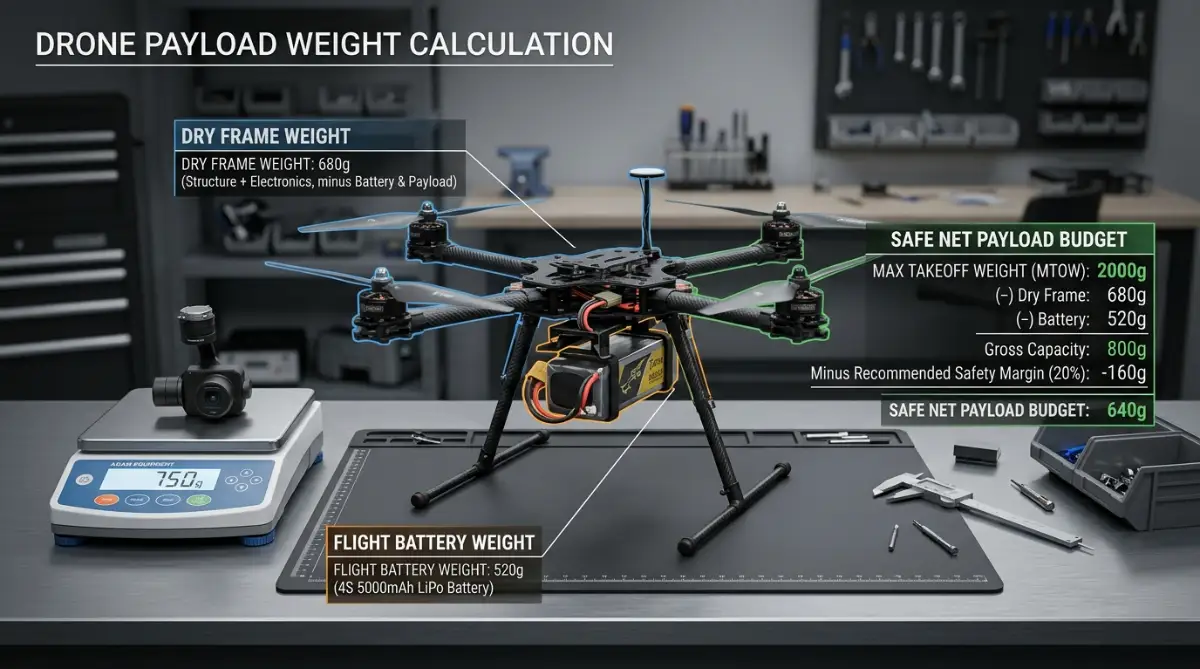
Net payload capacity is calculated by subtracting dry frame weight and battery weight from the overall MTOW number. This remaining figure represents your safe operational window for gear.
The Science of Thrust-to-Weight Ratio Explained Simply
To understand why payload limits exist, you must look at how propellers generate lift against gravity. Electric motors spin propellers to push air downwards, creating upward force known as total thrust.
For a drone to hover in place, total upward thrust must exactly equal total downward gravitational force. However, simply equaling gravity is not enough for real-world safe flying.
Safe multirotor flight requires a minimum Thrust-to-Weight Ratio of 2 to 1 for standard camera drones. This means if your fully loaded drone weighs two kilograms, your motors must produce at least four kilograms of total combined thrust.
This extra headroom allows your flight controller to fight wind gusts, execute sharp turns, and land smoothly without hitting the ground too hard.
Commercial heavy-lift drones or stunt quadcopters often target even higher ratios like 3 to 1 or 4 to 1. Higher ratios provide rapid acceleration and extreme stability in rough mountain air.
If your thrust ratio drops down near 1.2 to 1, your drone will feel heavy, respond slowly to joystick commands, and struggle to hold height during basic turns.
Pro Tip: Early in my flying career, I thought a 1.5 to 1 thrust ratio was enough for steady flights. I quickly learned during a windy afternoon that having at least a 2 to 1 ratio gives your motors the necessary headroom to counter sudden atmospheric gusts without losing lift.
Key Formulas to Calculate Drone Payload Capacity
Calculating your usable payload capacity does not require complex scientific calculators or advanced engineering degrees. You only need a simple digital scale and basic subtraction arithmetic.
The master formula used by commercial pilots is straight to the point and works for every multirotor aircraft:
Net Payload Capacity = Maximum Takeoff Weight - (Dry Frame Weight + Battery Weight)
Let us work through a practical numerical example to show how this formula functions in daily life. Imagine your drone manufacturer specifies a Maximum Takeoff Weight (MTOW) of 3,500 grams for your craft.
You place the bare drone frame on your scale and find its Dry Weight is 1,400 grams. Next, you weigh your preferred flight battery, which comes out to 900 grams.
Now, add your dry frame weight and battery weight together to find total base aircraft weight. In this example, 1,400 grams plus 900 grams equals 2,300 grams of essential base gear.
Finally, subtract 2,300 grams from the total MTOW limit of 3,500 grams. This calculation leaves you with exactly 1,200 grams of safe Net Payload Capacity.
Step 1: Base Weight = 1,400g (Dry) + 900g (Battery) = 2,300g
Step 2: Net Payload = 3,500g (MTOW) - 2,300g (Base) = 1,200g
Result: You can safely attach up to 1,200g of camera equipment.