

The Secret Frustration Behind Buying Bad Headphones
I still remember the sinking feeling in my stomach seven years ago on the 8:15 AM downtown train. I had just dropped 250 USD on brand-new over-ear headphones that promised total peace and quiet on the packaging. I stepped inside the noisy carriage, pressed play on my favorite acoustic guitar track, and waited for the magic.
Instead of clean sound, the deep rattle of the steel tracks and the roar of the diesel engine rushed straight into my ears. I felt cheated. My immediate reaction was like everyone else: I jacked the volume slider up past 85 percent just to drown out the noise. Within twenty minutes, my ears started throbbing with pain, yet that low engine rumble was still there, buzzing behind the distorted music.
I thought I bought a broken unit. I went back to the electronics shop, ready to argue with the clerk, only to find out nothing was broken with the device. I had simply bought passive isolation padding when my daily routine desperately needed active phase cancellation.
Since that frustrating morning, I have spent the last eight years testing more than a hundred pairs of headphones across subways, packed cafes, and loud open offices. Here is my honest, bullshit-free breakdown of how active and passive noise blocking actually work, where each one fails, and how you can save your money and protect your ears.
⚡ Quick Takeaways: What You Need to Know in 30 Seconds
- Passive Noise Isolation (Physical Shield): Uses thick memory foam, tight headband pressure, and silicone tips to physically seal off ear canals. Best at blocking erratic, high-pitched sounds like loud coworkers, keyboard clicks, and shouting babies. Requires zero battery power.
- Active Noise Cancellation (Digital Wave Killer): Uses microphones and a microchip to generate inverted sound waves that wipe out noise before it reaches your eardrum. Best at wiping out steady, low-frequency hums like jet airplane engines, bus rumbles, and air conditioner units.
- The Golden Rule: If your biggest enemy is erratic talking, buy deep-fitting memory foam tips (Passive). If your enemy is a deep droning engine or transit track, buy active electronics (ANC).
- Save Your Hearing: Never raise audio volume past 70 percent to fight outside background noise; fixing your physical ear seal gives you an instant 4 to 6 decibels of free noise reduction.
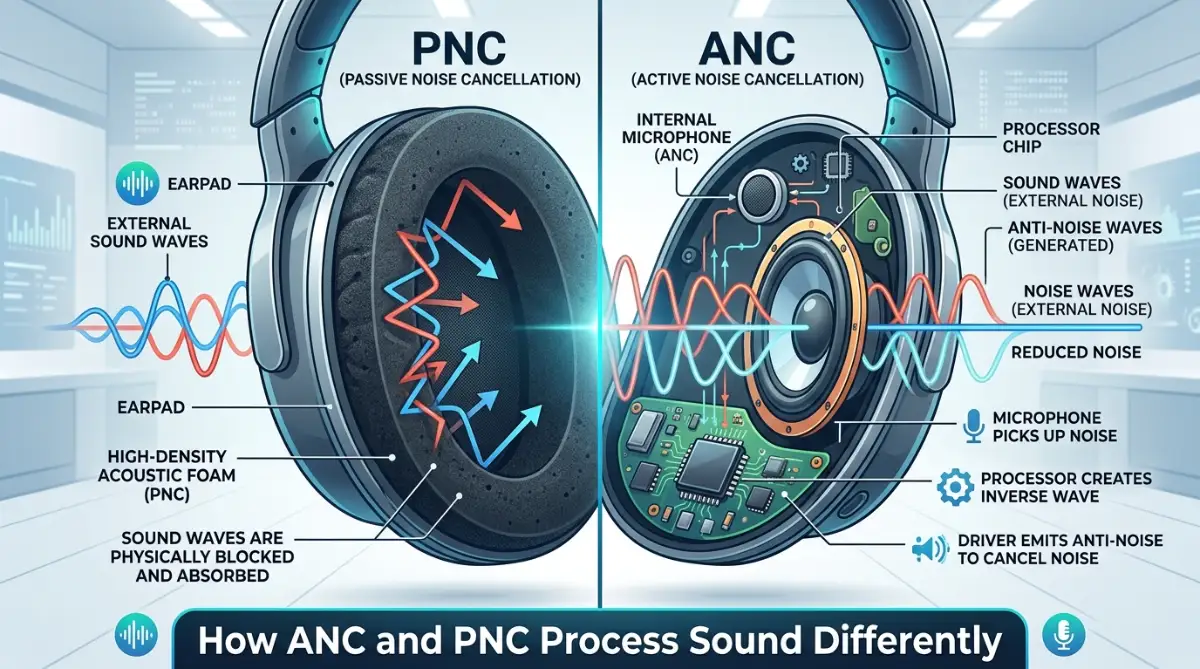
Decoding the Physics: How Sound Travels to Your Ears
Sound moves through the air in invisible pressure waves. When an engine rumbles or a room fan spins, it pushes air molecules back and forth in a repeating pattern.
These sound waves travel straight into your ear canal, vibrating your eardrum. To stop sound from reaching your ear, you must either block those waves physically or neutralize them digitally.
This basic physical reality creates two completely different engineering approaches in modern audio design. One uses physical barriers, while the other uses smart electronics and mathematical phase inversion.
What Is Passive Noise Cancellation? (Physical Isolation)
Passive noise cancellation is actually a slight misnomer. In the audio industry, experts usually call it passive sound isolation because no electrical power or digital processing is involved.
This method relies entirely on physical materials to create a dense seal around or inside your ear. Think of it like wearing heavy winter curtains over a window to block out traffic sounds.
The Engineering Behind Passive Isolation
When sound waves hit a dense object, part of the acoustic energy bounces off, and part gets absorbed as kinetic energy. Passive sound isolation uses high-density memory foam, thick silicone tips, and heavy ear cup shells to block waves.
The quality of passive noise cancellation depends entirely on the physical fit against your head. If there is even a tiny gap between your headphone pad and your skull, sound waves leak straight in.
Materials Used in High-Quality Passive Gear
- High-density acoustic memory foam that shapes itself around your head contour.
- Multi-flange silicone or memory foam ear tips designed for inside the ear canal.
- Thick polycarbonate outer cups built to reflect external sound vibrations.
- Tight headband tension that maintains constant pressure against the sides of your head.
Real-World Example: Passive Isolation in Action
Imagine standing near a busy construction site while wearing heavy construction earmuffs. You still feel the deep ground vibrations, but the sharp clanging of hammers and high-pitched drill sounds drop significantly.
That exact mechanical blocking process is how passive isolation protects your music. It works naturally, costs no battery power, and operates consistently regardless of whether your device is turned on.
What Is Active Noise Cancellation? (Digital Wave Neutralization)
Active noise cancellation (ANC) works like a miniature sound lab built right inside your ear cup. Instead of just setting up a thick wall of padding to push sound away, ANC headphones listen to the room around you in real time.
Tiny microphones on the outside pick up sounds—like the droning hum of an airplane engine—split seconds before it hits your eardrums. A processing chip reads the shape of that incoming sound wave and instantly creates an exact mirror opposite of it. When that opposite wave collides with the incoming noise inside your ear cup, both sound waves collide and flatten each other out. What reaches your eardrums is pure, peaceful quiet.
The Magic of Phase Cancellation
To understand active noise cancellation, imagine two people holding a long jump rope. If one person shakes the rope up, a wave moves cresting upward.
Now imagine the person on the other end shakes the rope down at the exact same millisecond with equal force. The two movements clash in the middle, and the rope stays flat and perfectly still.
That physical phenomenon is called destructive interference or phase inversion. Sound waves work the exact same way in the air.
💡 How ANC Inverts Noise Waves in Real-Time
1. External Noise Wave: Environmental noise (like a plane engine) enters as a continuous air pressure wave: [ Peak ➔ Trough ➔ Peak ]
2. Anti-Noise Wave Generated: Your headphone’s DSP chip instantly calculates and plays the exact inverse wave: [ Trough ➔ Peak ➔ Trough ]
3. Acoustic Silence: The sound waves collide inside the ear cup and equalize each other out to zero sound pressure: [ ————————— Silence ————————— ]
The Four Core Components of an ANC System
- External Microphones: Tiny sensors on the outside of the ear cup pick up ambient environmental sounds.
- Internal DSP Chip: A high-speed Digital Signal Processor analyzes the frequency and amplitude of the ambient sound waves within milliseconds.
- Anti-Noise Generator: The processor creates an inverted sound wave (shifted by 180 degrees) that mirrors the outside noise.
- Audio Driver: The internal speaker plays your music along with this invisible anti-noise wave directly into your ear.
Real-World Scenario: Active Cancellation in Action
Picture yourself sitting inside a commercial airplane cruising at 30,000 feet. The continuous low roar of the jet engine fills the cabin at a constant low frequency.
When you flip the switch for active noise cancellation, external microphones capture that low engine hum. The DSP chip creates a mirror-image wave, feeds it to your ear, and the jet engine rumble disappears almost instantly.
Step-by-Step Breakdown: Active vs Passive Noise Cancellation Side-by-Side
To help you understand how these technologies differ in daily use, let us analyze their performance across five key operational areas.