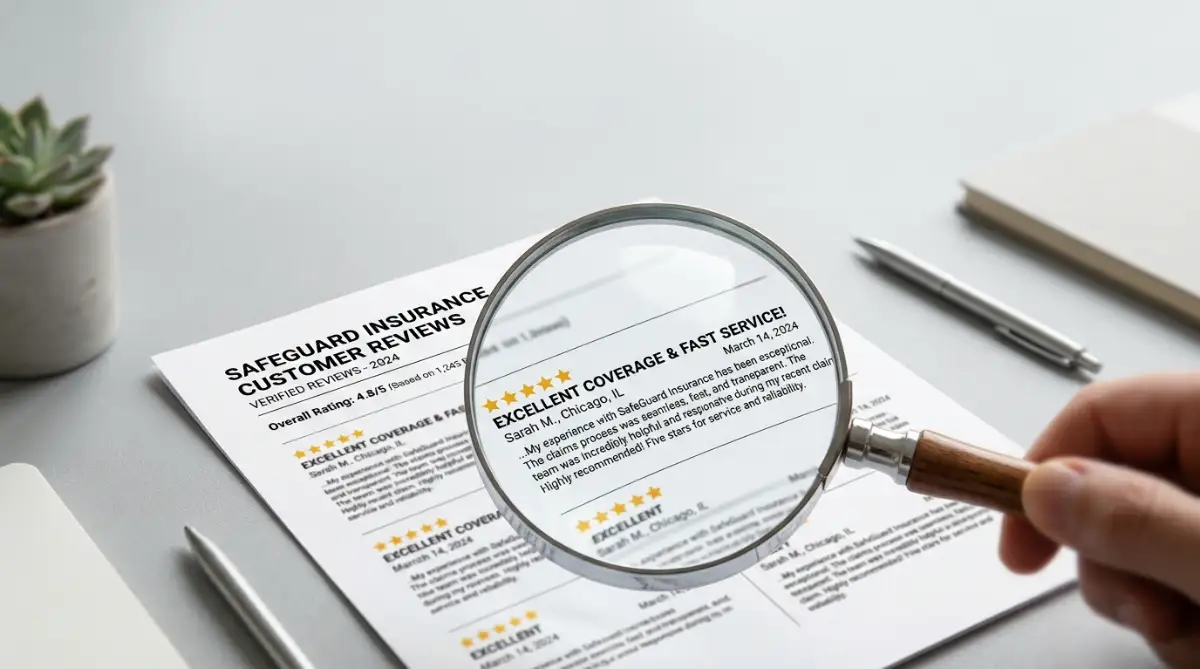
The Moment You Realize That 5-Star Review Lied to You
You spent two hours reading insurance reviews online. You felt confident. You picked the company with the most stars and the most glowing comments.
Then, six months later, you file your first claim.
And suddenly, everything that review described, the "fast response," the "hassle-free process," and the "amazing customer service," feels like a completely different company from the one you're now dealing with.
This experience is more common than most people realize. Cheap insurance reviews look helpful on the surface, but many of them are missing context, skewed by timing, or written by people whose situation was nothing like yours.
The frustrating part? You did everything right. You researched. You compared. You trusted the rating system. And it still let you down, not because you were careless, but because the review system itself has some real blind spots that nobody explains before you start reading.
Why Most People Can't Tell a Good Review From a Misleading One
The average insurance shopper reads reviews the same way they'd read restaurant reviews: more stars means better. But insurance is nothing like picking a restaurant.
Here's why cheap insurance reviews are so easy to misread:
- Most positive reviews are written right after sign-up, not after a claim. People who've never actually needed to use their policy are the ones writing five-star praise, often based on nothing more than a pleasant onboarding call.
- Review platforms rarely separate pricing feedback from claims feedback. A company might be praised for having a low premium but silently criticized for delays in claim processing, and the star rating blends both together into one misleading number.
- Affiliate and lead-generation sites have a financial incentive to feature reviews that push readers toward specific companies, not necessarily the best companies for those readers.
- One-star reviews get responses, five-star reviews don't. Insurers actively manage online reputation, sometimes offering callbacks or policy credits to unhappy customers in exchange for review updates, which quietly skews ratings upward.
- Cheap doesn't mean the same thing for every driver. A rate praised as "incredibly affordable" by one reviewer might not apply to someone with a different driving record, age group, or zip code.
- Review volume creates false confidence. A company with 10,000 reviews averaging 4.2 stars seems more trustworthy than one with 200 reviews at 4.8, even if the smaller company handles claims far better.
These aren't rare edge cases. They're built into how most online review systems work, and insurance is one of the categories where this disconnect between review and reality causes the most financial damage.
How This Quietly Damages Your Confidence and Your Wallet
Reading misleading insurance reviews doesn't just lead to a bad purchase. It erodes the trust you have in your own judgment, and that has a cost beyond the premium you end up overpaying.
- You second-guess yourself every renewal period. Once you've been burned by a review-driven decision, comparing insurers again feels less like research and more like a guessing game.
- You stay loyal to a bad insurer out of fear. If switching once led to a mistake, switching again feels riskier, even when staying is clearly costing you more.
- You feel like you're the problem. Many people blame their own research skills rather than recognizing that the review system itself is incomplete.
- Claims moments become dread-filled. People who've chosen based on misleading reviews often feel genuine anxiety when they need to file, because they no longer trust what they were promised.
- The financial impact compounds over time. Staying with an overpriced or underperforming insurer for two or three years because "switching is confusing" is a real cost, even if it never shows up as a single visible loss.
This is worth naming clearly: if you've ever felt confused or let down by insurance reviews, you're not bad at research. You're working with a system that wasn't designed to protect your specific interests.
What Makes Cheap Insurance Reviews Especially Tricky
There's an extra layer of complexity when the reviews are specifically about low-cost insurance options.
Budget-focused insurers often attract customers who are primarily shopping on price, meaning the reviews they receive reflect that priority. A person who chose an insurer because it was the cheapest available may leave a positive review simply because the price stayed low, even if coverage gaps appeared later or the claims process was slow.
This creates a pattern where cheap insurance consistently earns reviews from cost-satisfied customers, while the service and coverage quality go largely unmentioned until something goes wrong.
By the time the critical reviews catch up, you've already paid months of premiums and signed a policy based on ratings that were never measuring what you actually needed them to measure.
How to Read Insurance Reviews Like an Expert, Not a First-Timer
The good news is that once you know what to look for, reading insurance reviews becomes a much more useful skill. Here are three clear ways to start filtering signal from noise.
Step 1: Separate Pricing Reviews From Claims Reviews
The single most useful habit you can build is mentally splitting every insurance review into two categories before you even read the full text.
Ask yourself one question first: Did this reviewer actually file a claim?
- If the review mentions nothing about a claim experience, it's essentially a review of the company's website, their sales process, or their customer service phone tone. That's useful information, but it tells you almost nothing about what the company is like when you need them most.
- Look specifically for language like "when I filed my claim," "after my accident," or "during the repair process." These reviews are worth ten times the weight of a five-star note that only mentions a low premium.
A practical way to apply this right now: Go to any insurance review page and use your browser's "find" function to search the word "claim." Skip directly to those reviews and ignore the rest for your first read-through.
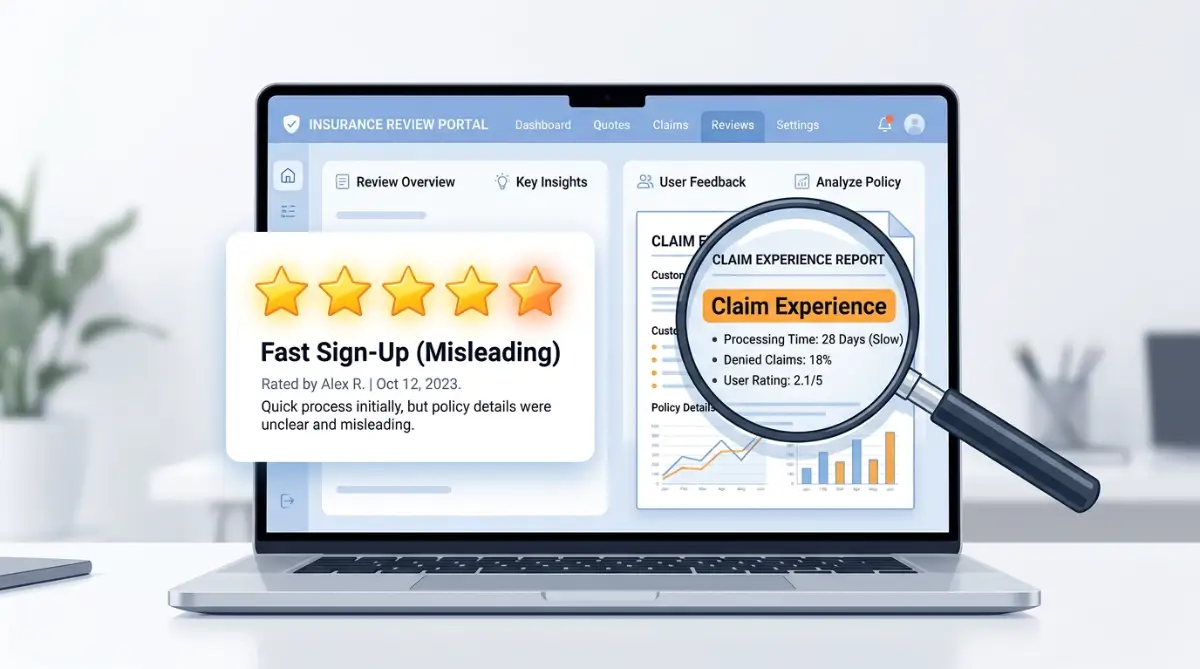
Real-life example: A driver picks an insurer that has 4.6 stars across 8,000 reviews. But when she searches for the word "claim" in the reviews, she finds mostly neutral or negative experiences, delays, underpayments, and long wait times. The high star average was driven almost entirely by pricing satisfaction, not service performance.
That same search could take you less than two minutes and save you from a very frustrating claims experience.
Step 2: Check Independent Data Sources, Not Just Review Platforms
Online star ratings are user-generated and largely unverified. There are two independent, data-backed sources that give you a much more accurate picture of how an insurance company actually behaves.
The first is the NAIC Complaint Index. The National Association of Insurance Commissioners publishes a publicly available complaint ratio for every licensed insurer in the United States. A score above 1.0 means the company receives more complaints than the industry average for its size. A score below 1.0 means it receives fewer.
This number is based on formal regulatory complaints, not optional online reviews. People file formal complaints when something genuinely went wrong, which makes this metric far harder to manipulate than a five-star rating system.
The second is J.D. Power's Auto Insurance Studies. J.D. Power surveys actual policyholders annually across multiple categories including claims satisfaction, price satisfaction, and overall experience. Because these are structured surveys rather than voluntary reviews, they capture a much broader and more balanced picture of real customer outcomes.
Here's how to use both: If an insurer has glowing online reviews but a high NAIC complaint index, that's a red flag worth taking seriously. If a company scores well in J.D. Power's claims satisfaction study, that's meaningful data that complements what you read in individual reviews.
Think of it this way: online reviews are like asking one friend for a restaurant recommendation. Independent data sources are like reading a professional food critic's review based on multiple visits. Both have value, but they carry very different levels of reliability.
Step 3: Match the Reviewer's Profile to Your Own Before You Trust the Rating
This step sounds simple, but almost nobody does it, and it changes how much weight you should give any individual review.
Insurance rates and service experiences vary significantly based on several personal factors: your driving record, your vehicle type, your location, your age, and the type of coverage you need. A five-star review from a 55-year-old homeowner with a clean record, insuring a single older car, means very little if you're a 28-year-old renting an apartment with two vehicles and a previous fender-bender on your record.
Here's how to filter reviews by relevance:
- Look for reviews that mention the reviewer's situation, like "as a new driver" or "after my second accident" or "for my truck."
- Give more weight to reviews from people who seem to share your driver profile or coverage needs.
- Ignore five-star reviews that read like they could apply to any product ("great service, highly recommend!") because these give you no useful context at all.
A simple analogy: Asking a marathon runner to review running shoes that you'll use for casual weekend walks is technically useful information, but only up to a point. Their experience is genuine, but their needs and yours are so different that the review can't fully apply to your situation.
The same is true with insurance. The review isn't wrong, it's just not necessarily about your situation.
Why All Three Steps Work Together
Each of these three steps addresses a different layer of the problem. Step 1 filters for relevant experience. Step 2 adds independent, verified data. Step 3 matches reviewer context to your own life.
Together, they replace the five-star guessing game with an actual decision-making process that gives you far more confidence before you sign any policy.
The reviews that survive all three filters are the ones worth trusting. And the insurers that hold up under all three types of scrutiny are the ones worth your monthly premium.
None of this takes as long as it sounds once you build the habit. The first time you do it, it might take an extra thirty minutes. By the third or fourth time, these three checks become second nature, and you'll never look at a simple star rating the same way again.
Three More Ways to Cut Through Insurance Review Noise Like a Pro
By now, you know how to filter reviews by claims experience, cross-check with independent data sources like the NAIC Consumer Information Source, and match reviewer profiles to your own situation. Those three steps alone put you ahead of most insurance shoppers.
But if you want to go even deeper, there are a few more methods that experienced consumers use to make sure their final choice holds up, not just on the day they sign the policy, but the first time something actually goes wrong.
Step 4: Look for Patterns in Reviews Over Time, Not Just the Recent Ones
Most people sort reviews by "most recent" and assume the newest reviews are the most accurate picture of the company. That's not always true.
Insurance companies can have sharp reputation swings in both directions. A company that had excellent service for years might have quietly shifted its claims process after a leadership change or a policy update. Conversely, a company with poor reviews from a couple of years ago might have genuinely improved after customer feedback led to structural changes.
Here's what to do instead of just reading the latest reviews:
- Sort reviews by "lowest rated" and look for patterns in the specific complaints, not just the star count.
- Then sort by "highest rated" and read what the five-star reviewers mention as stand-out positives.
- Finally, look at the reviews from six to eighteen months ago and compare the language to the most recent ones.
If you see a consistent pattern of the same complaint (slow claim responses, denied claims, billing errors) across multiple time periods and different reviewers, that's not a coincidence. That's a structural problem that's unlikely to change just because you sign up.
A real-life analogy: Think of a restaurant that gets five stars for its new opening week menu, then quietly lets quality slip after the initial buzz dies down. The reviews from the first month look very different from the ones a year later. Insurance companies follow the same pattern, and reading across time periods reveals it.
This approach takes slightly longer, but it's one of the clearest ways to separate companies that have earned their reputation over time from ones riding temporary goodwill.
Step 5: Find Real Conversations in Community Forums, Not Just Review Platforms
Review sites are useful. But they're also public-facing, often moderated, and sometimes actively managed by companies flagging reviews they disagree with.
Community forums, especially specific subreddits dedicated to personal finance or insurance, and state-specific consumer boards, tell a very different story. People posting there aren't trying to write a tidy review. They're sharing their experience in real time, often while frustrated or confused, and that raw quality gives you a more honest picture.
How to use this approach effectively:
- Search "[insurer name] claims experience" or "[insurer name] denied claim" on any major forum or search engine, filtering to discussions rather than articles.
- Pay attention to threads where multiple unrelated people describe the same type of problem, like slow responses after accidents or unexpected coverage exclusions.
- Look for responses from current policyholders who share how they resolved issues, since this tells you how the company actually responds to real escalations.
These conversations don't replace formal review platforms or independent data. But they often reveal specific, real-world patterns that carefully curated review sites never surface.
Just as tracking daily spending helps you spot money leaks you didn't know existed, reading unfiltered forum discussions helps you spot common financial mistakes when making major purchase decisions like choosing an insurer you haven't truly researched.
How to Maintain Smarter Insurance Research Habits for the Long Term
The three steps from Part 1 and the two you just read aren't meant to be a one-time checklist. They're habits that protect you every renewal period, not just when you first sign up.
Here's a simple long-term system you can actually stick to:
- At sign-up: Run all five review filters before choosing an insurer. Give yourself a week if the decision isn't urgent.
- At the six-month mark: Check if your monthly statements match what you were promised, and scan forums briefly for any new emerging patterns with your insurer.
- At renewal: Re-run the NAIC complaint index and quickly compare your current rate against one or two competitors. Insurance is one of those areas where staying informed and occasionally comparing options tends to stop financial bleeding that most people don't even notice over time.
The FTC has noted that fake and misleading reviews are a growing problem across industries, and insurance is no exception. Building these review habits now protects you before the next renewal, not after a bad claim experience.
The goal here isn't to become a cynical person who never trusts any review. It's to become someone who knows exactly what a review is actually telling you, and what it's quietly leaving out.

Five Review Research Mistakes That Leave Drivers Paying Too Much
Even people who try to research carefully end up making a few of these mistakes. Here's what to watch for, and why each one can cost you more than you'd expect.
Mistake 1: Reading Only the Star Rating Without Opening the Text
A 4.3-star average looks like a solid grade, but it's meaningless without reading what the reviews behind it actually say.
A common scenario: A driver picks an insurer with a 4.4-star average from over 6,000 reviews. What she doesn't check is that the majority of those reviews mention price satisfaction, not claims experience. When she eventually files a claim, the service quality is far below what that high rating suggested.
The cost of this mistake: You make a coverage decision based on a number that doesn't measure what you actually care about, which is how the company treats you when something goes wrong.
Mistake 2: Assuming a Newer Company With Fewer Reviews Is Less Trustworthy
Review count creates a bias. A company with 500 reviews automatically feels less reliable than one with 12,000, even when the data tells the opposite story.
A common scenario: A driver ignores a newer online insurer with 400 reviews averaging 4.9 stars and a very low NAIC complaint index. Instead, they choose the household name with 15,000 reviews and a 4.2 average, not realizing that the newer company's smaller but more specific review set actually reflects better claims service.
The cost of this mistake: You pay more or receive worse service because a higher review count felt more reassuring than the actual quality data did.
Mistake 3: Reading National Averages Without Filtering for Your State
Insurance is regulated and priced at the state level, which means a company's experience in one state can be dramatically different from another.
A common scenario: Someone in California reads reviews from a company that scores excellently across national aggregates. But when they dig into state-specific complaint data, the same insurer has a high complaint ratio in their home state due to a regional claims handling partner.
The cost of this mistake: You end up with a company that handles claims well everywhere except where you actually live, which is the only place that matters.
Mistake 4: Trusting Sales Process Reviews as a Substitute for Service Reviews
Being sold a policy smoothly is genuinely nice. But it has nothing to do with how the company handles a claim six months later.
A common scenario: A driver picks an insurer because multiple reviewers praised how helpful the sign-up call was, how fast the quote came back, and how pleasant the sales agent seemed. None of those reviews mentioned claims. Two months later, a fender-bender reveals a slow claims process that the smooth sign-up experience never hinted at.
The cost of this mistake: You optimize for the wrong thing, choosing a great sales experience while accidentally ignoring the actual service experience that matters most.
Mistake 5: Not Doing Any Review Research at Renewal Time
Most people research hard before their first policy. Then they stay with the same company for years simply because switching feels like too much effort.
A common scenario: A driver has been with the same insurer for four years. During that time, the company's complaint index has risen, their claims service has received consistently worse reviews, and a competitor now offers better coverage at a lower rate. But because the driver never checked again after signing up, none of this ever reached them.
The cost of this mistake: Loyalty to a company that no longer deserves it is one of the most expensive habits in personal finance. Building a simple emergency buffer and honest budget is smart, but paying too much for an insurance policy year after year quietly offsets those savings before they can grow.
You Now Know More About Insurance Reviews Than Most Drivers Ever Will
That's not an exaggeration. Most people pick an insurer based on a number, a friend's recommendation, or an ad they saw last week. You now have a complete, layered approach to reading reviews that most insurance consumers never develop.
You know how to separate pricing reviews from claims reviews. You know how to use the NAIC complaint index and J.D. Power satisfaction data as independent checks. You know how to match reviewer profiles to your own situation, read across time periods instead of just the most recent posts, and find unfiltered community conversations that reveal what review platforms often hide.
Here's your action plan for today:
- Pick the insurer you currently have or are considering.
- Spend ten minutes running just two checks: your NAIC complaint index and a quick forum search for their claims experiences.
- Compare what you find against their star rating on the most popular review site.
- Notice the gap. That gap is exactly what this article exists to help you close.
You don't need to become an insurance expert to make smarter decisions here. You just need to ask slightly better questions than most people do, and apply a few consistent filters before trusting a number that was never designed to answer the questions that actually matter to you.
And if you're thinking about how your insurance choice fits into your overall financial picture, understanding how to earn more from your savings while keeping costs like insurance in check is one of the most practical ways to build real financial stability over time.
Start with one small check today. You might be surprised at what the star rating wasn't telling you.
Disclaimer: This article is for general informational and educational purposes only and does not constitute financial, legal, or insurance advice. Insurance review credibility, complaint data, satisfaction rankings, and pricing patterns may change over time and vary significantly by region, provider, and individual circumstances. All external links are provided for informational reference only. Always verify current policy details, pricing, and company ratings directly with a licensed insurance provider or an independent regulatory body such as your state's Department of Insurance before making any purchasing decision.