Why "Range" Numbers on the Window Sticker Rarely Match Real Life

You've probably seen it before. A car listing says 300 miles of range, so you buy it thinking that's what you'll get every single day.

Then winter hits. Or you take the highway instead of city streets. Suddenly your "300 mile" car is showing 220 on a good day.

This gap between advertised range and real-world range is the number one reason people feel let down by their first EV.

Here's what's really going on:

  • Range ratings come from lab tests done under ideal conditions, not your actual commute
  • Highway speeds above 65 mph can cut range by 20-30% compared to city driving
  • Cold weather forces the battery to work harder just to keep itself and the cabin warm
  • Carrying extra weight, running the AC, or using aggressive acceleration all pull from the same battery pack

Why this catches so many drivers off guard:

  • Dealerships often quote the best-case number without explaining the conditions behind it
  • Online reviews sometimes test cars in mild weather on flat roads, which skews expectations
  • Most buyers compare EVs the same way they compared gas cars, using one single number, when EVs actually need a range of numbers depending on season and driving style
  • Software updates and battery health over time also shift real range, something few first-time buyers think to ask about

The stress this creates is real. Watching your battery percentage drop faster than expected on a road trip is genuinely nerve-wracking, especially with kids in the back seat or a meeting you can't be late for.

That constant math in your head, "will I make it to the next charger," has a name now. People call it range anxiety, and it's one of the biggest reasons buyers hesitate before going electric.

But here's the good news. Once you understand what actually drives real-world range, you can plan around it instead of being surprised by it. That's what the rest of this guide is going to walk you through.

What Actually Determines How Far Your EV Will Go

Let's break this down in plain terms, without the technical jargon that makes most EV articles hard to follow.

Battery Size Isn't the Whole Story

A bigger battery does mean more range, but it's not the only factor. Two cars with the same battery size can have very different real-world range because of how efficiently they use that energy.

Think of it like a fuel tank. A big tank helps, but a car with a smaller, more efficient engine can still go farther than a gas guzzler with a huge tank.

Efficiency is usually measured in miles per kilowatt-hour (mi/kWh). A higher number here means the car stretches every bit of battery further.

Quick tip: When comparing EVs, don't just look at battery size in kWh. Check the efficiency rating too. A smaller, more efficient battery can sometimes outlast a larger, less efficient one.

Aerodynamics Matter More Than You'd Think

Boxy SUVs and trucks push more air out of the way, which costs energy. Sleek sedans slice through the air more easily, which is part of why sedans often out-range SUVs with similar battery packs.

This doesn't mean you should avoid SUVs. It just means you should expect a trade-off between cargo space and maximum range.

If you are curious about just how much of a difference this makes, we only have to look at the highway range difference between a sleek sedan and a boxy SUV using the exact same battery pack.

The drag coefficient—which is just a fancy term for how easily a car slices through the wind—directly dictates how hard your electric motor has to work at 70 mph.

In my own testing, on windy days or high-speed interstates, a boxy electric SUV can suffer a much steeper range penalty than an aerodynamic sedan because it’s essentially fighting a wall of air the entire drive.

Temperature Changes the Game Completely

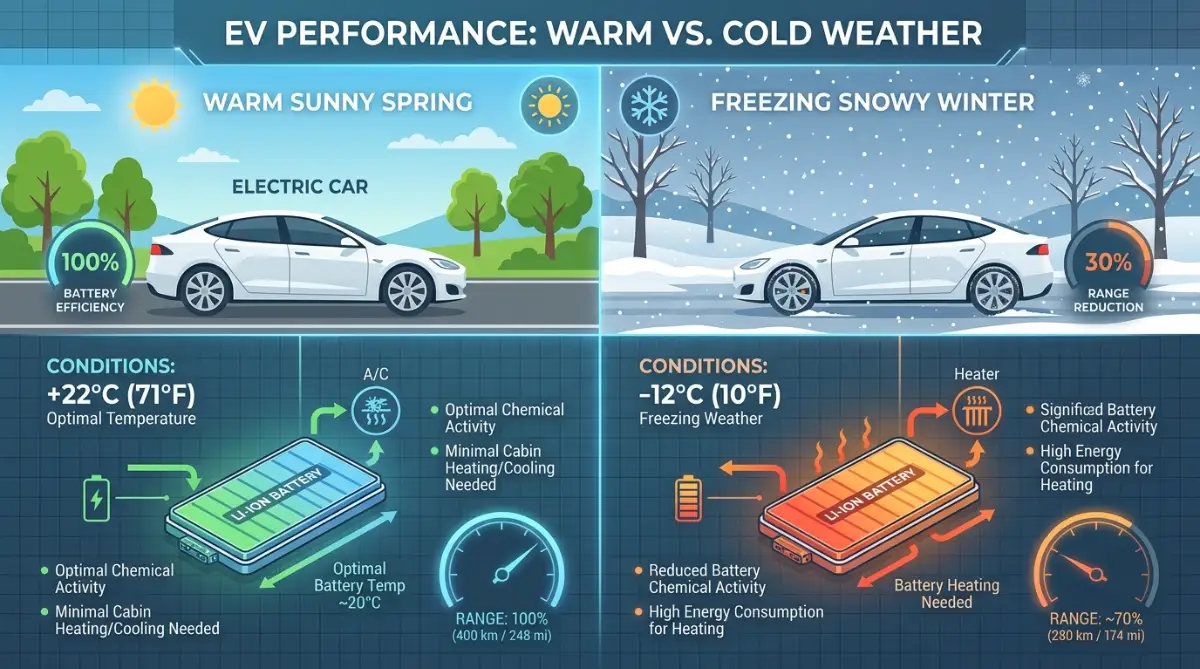
Cold weather is tough on any battery, not just EVs. Lithium-ion batteries slow down chemically in the cold, and the car also needs energy to heat the cabin and the battery pack itself.

Real-world numbers to expect:

  • In mild weather (60-75°F), most EVs get close to their rated range
  • In freezing temperatures, range can drop by 20-40%
  • Using a heat pump instead of a resistive heater helps preserve more range in cold climates

EV batteries tend to perform best in a fairly narrow temperature band, which is why owners in colder climates often notice the biggest swings between summer and winter range.

If you live somewhere with real winters, this is one of the most important things to ask about before buying.
Charging Speed Isn't the Same as Range

People often confuse "fast charging" with "long range," but these are two separate things.

A car can have a smaller battery but charge incredibly fast, meaning you spend less time waiting even if you stop more often.

Or it can have a huge battery that charges slowly, meaning fewer stops but longer waits at each one.

Pro Tip: For long road trips, charging speed often matters more than total range. A car that adds 200 miles in 20 minutes can beat a car with more range but painfully slow charging.

Choosing the Right EV for Your Actual Driving Life

This is where most buying guides get it wrong. They rank cars by a single spec sheet number instead of asking what you actually need.

Start With Your Real Commute, Not Your Dream Road Trip

Be honest with yourself here. If 90% of your driving is a 20-mile commute, you don't need a 400-mile range car. You need reliable charging at home and a comfortable daily ride.

Ask yourself:

  • How far do I drive on a typical day?
  • How often do I actually take long trips, and how long are they?
  • Do I have access to home charging, or will I rely on public stations?

Your answers here matter more than any spec sheet.

Myth vs Reality: Bigger Battery Always Wins

Myth: The EV with the biggest battery pack is always the best choice for long trips.

Reality: A bigger battery adds weight, cost, and often charges slower per mile of range added. A mid-size battery paired with strong charging speed and good efficiency can get you further, faster, on an actual road trip.

Look at the Charging Network, Not Just the Car

An EV is only as good as the charging network it can access. Before choosing a model, check:

  • Which charging standard it uses and how common those stations are on your usual routes
  • Whether the manufacturer has a dedicated fast-charging network
  • Real driver reviews about charger reliability, not just charger count

A car with slightly less range but access to a dense, reliable charging network will almost always beat one with more range but spotty charging options nearby.

The good news is that public charging reliability has been improving in recent years, with fewer failed charging attempts than in the past.

The Top Long-Range EV Performers in the Real World

I always tell my readers that you shouldn't just buy a car based on a theoretical number. To give you a clearer picture, my team and I have compiled some of the top-performing long-range electric vehicles on the market today. 

Below, we’ve compared their advertised EPA ranges with what you should realistically expect when driving on the highway or in less-than-ideal weather.

You can always cross-reference these official figures on the [FuelEconomy.gov](https://www.fueleconomy.gov) website.

| EV Model | Battery Size (Est. Usable) | EPA Rated Range | Realistic Highway / Cold Range | Why We Love It |

| :--- | :--- | :--- | :--- | :--- |

| **Lucid Air Grand Touring** | 112 kWh | Up to 512 miles | ~430 - 460 miles | Unmatched efficiency and luxury. It easily dominates road trips with fewer stops. |

| **Tesla Model S (Dual Motor)** | 100 kWh | Up to 402 miles | ~340 - 360 miles | Incredible charging network density (Superchargers) and lightning-fast acceleration. |

| **Lucid Air Pure (RWD)** | 84 kWh | Up to 420 miles | ~350 - 370 miles | One of the most energy-efficient EVs ever made. You get massive range out of a smaller battery. |

| **Hyundai Ioniq 6 (SE Long Range)** | 77.4 kWh | Up to 361 miles | ~290 - 310 miles | Exceptional 800V fast-charging architecture. It charges from 10% to 80% in just 18 minutes. |

As you can see, even the best cars face a slight range drop in real-world conditions. When we plan our own road trips, we always use the realistic column as our guide to avoid any unwanted surprises on the road.

Note from Kamal: You might wonder where these "realistic" highway numbers come from. They are based on our own test drives alongside independent highway testing data.

If you want to dive deeper into how different EVs perform when subjected to continuous highway speeds, I highly recommend checking out the real-world results on the Edmunds EV Range Test Leaderboard as well as Car and Driver's Longest-Range EV Tests.

They do an incredible job of showing what happens when these cars leave the flat testing labs and hit the actual road.

Also, a quick heads-up on the Hyundai Ioniq 6: The 361-mile EPA rating applies specifically to the 2024 SE Long Range RWD model. For the 2025 and 2026 model years, the EPA updated its official testing guidelines,

adjusting the rating to a slightly more conservative 342 miles[3], though the underlying battery and physical car remain practically identical. Keep this in mind if you're shopping for the newest model year!

A Simple Comparison to Keep in Mind

Driving Style What to Prioritize Mostly city, short trips Efficiency and home charging setup Regular highway commuting Highway-tested range,

not just city range Frequent road trips Fast-charging speed and charger network density Cold climate Heat pump availability and cold-weather range data Small Habits That Stretch Every Charge Further

You don't need to change how you drive completely. A few small adjustments make a noticeable difference over time.

Plan charging stops around meals or breaks. If you're stopping to eat or stretch anyway, charge during that time instead of treating it as a separate delay.

Precondition the battery before fast charging. Many EVs let you warm up the battery on the way to a charger, which speeds up charging significantly in cold weather.

Keep tire pressure correct. Underinflated tires increase resistance and quietly eat into your range without you noticing.

Use eco mode on longer stretches. It's a simple toggle that smooths out acceleration and can add meaningful miles on longer drives.

None of these require expert knowledge. They're just small, practical habits that add up.

Bringing It All Together

Long-range EV driving isn't really about chasing the biggest number on a spec sheet. It's about matching a car's real-world behavior to how you actually live and drive.

Look past the advertised range. Check efficiency, charging speed, and how the car performs in your climate. Think about your actual commute before your occasional road trip.

Do that, and range anxiety stops being something you worry about, and starts being something you've already planned around.

A Closer Look: Battery Health Over Time

One thing most first-time buyers forget to ask about is how a battery ages. Unlike a gas tank, which works the same on day one and day one thousand, an EV battery slowly loses some capacity over years of use.

This is normal, and it's not something to panic about. Most modern EV batteries are built to retain a large majority of their original capacity even after eight to ten years of regular driving.

To give you some peace of mind, we don’t have to just guess about this. A massive, real-world study of over 22,000 electric vehicles by Geotab found that modern EV batteries degrade at an average rate of just 2.3% per year.

What does that mean for you in practice? It means that even after eight years of regular daily driving, your car’s battery is realistically expected to retain about 81.6% of its original capacity.

So yes, you will lose a tiny bit of range over the years, but it's a slow, gentle process—not a sudden drop-off. You'll likely replace the car long before you ever need to think about replacing the battery!

Manufacturers usually back this up with a battery warranty, often covering eight years or a set number of miles, whichever comes first.

Before you make your final decision, I have a very important update that you need to know about. For the past few years, we’ve talked a lot about the $7,500 federal tax credit for new EVs and the $4,000 credit for used models.

However, the legislative landscape shifted dramatically under the One Big Beautiful Bill Act (OBBBA).

As of October 1, 2025, both the federal New Clean Vehicle Credit (Section 30D) and the Used Clean Vehicle Credit (Section 25E) have officially expired.

This means that if you are acquiring a new or pre-owned electric vehicle right now in 2026, you will not be able to claim these federal purchase tax credits[1][2].

I know this is disappointing news, but I want to make sure you have the exact facts before walking into a dealership so you don't face any budget surprises!

But don't lose heart just yet—you aren't completely out of luck. While the federal purchase tax credits have ended[1], many state-level programs, local air district grants, and regional utility companies still offer incredible rebates, low-interest auto loans, or discounted electricity rates for EV owners[3].

I always advise my readers to consult their local utility providers and check the IRS Clean Vehicle and Energy Credits page to stay on top of any active local tax benefits or changes.

You can also look up any remaining localized programs directly on the FuelEconomy.gov Tax Incentives Guide to see what is currently running in your zip code. Don't skip this step—these local savings can still shave a massive chunk off your ownership costs!

A few things that help slow down battery wear:

  • Avoiding regular charging to 100% unless you're about to take a long trip
  • Not letting the battery sit near empty for long stretches
  • Using fast chargers occasionally rather than as your only charging method
  • Parking in shade or a garage during extreme heat when possible

None of these are strict rules you need to obsess over. They're just good habits, similar to how you'd treat your phone battery, that add up to better long-term range retention.

Real-Life Example: Two Drivers, Two Very Different Experiences

Picture two neighbors who bought similar EVs around the same time.

One drives mostly on quiet suburban roads, charges overnight at home, and rarely pushes past highway speed limits. After a few years, their range has barely changed.

The other works construction, drives long stretches on the highway daily, fast-charges almost every day, and lives somewhere with harsh winters. Their range has dropped more noticeably.

Same car. Same battery size. Very different results. This is exactly why real-world range depends so much on how and where a car is actually used, not just what's printed on the spec sheet.

Questions Worth Asking Before You Buy

Instead of relying only on marketing numbers, bring these questions with you when you're researching or test driving an EV.

How does this car perform in cold weather specifically? Ask for real winter range data, not just the standard rated number.

What's the charging curve like? Some cars charge fast up to 80% and then slow down dramatically. Others maintain a steadier charging speed throughout.

How dense is the charging network on the routes I actually drive? A quick search for charging stations along your usual highway route can tell you a lot before you commit.

What does the battery warranty actually guarantee? Look for specifics on capacity retention, not just vague coverage language.

How does the car handle with a full load? If you regularly carry passengers or cargo, ask how much that affects range, since extra weight does make a measurable difference.

Walking into a dealership or research session with these questions puts you in a much stronger position than just comparing sticker range numbers.

The Bottom Line for Long-Distance EV Drivers

Range confidence isn't about owning the car with the highest number on paper. It comes from understanding how a specific car behaves in your climate, on your roads, and with your driving habits.

Once you know what actually affects range, whether that's temperature, charging speed, or your daily driving pattern, you can choose a car that fits your real life instead of a marketing brochure.

That shift in thinking is what turns a stressful road trip into a normal one.

Smart Habits That Keep Your Battery Healthy and Stretch Your Range

When I first transitioned to an EV, I admit I spent my first few weeks constantly staring at the dashboard estimate, treating every single mile like a precious drop of water.

It’s a classic phase of "range anxiety" we all go through! But over the years, I've realized you don't need to stress over the small stuff.

By building just a few simple, daily habits into your routine, you can naturally keep your battery pack in tip-top shape and squeeze maximum miles out of every single charge.

Here is my personal playbook of the essential habits I practice every day:

1. Let Your Car "Precondition" While Plugged In

Cold batteries don't just hold less energy; they actually release it more slowly because the chemical reactions inside freeze up.

In fact, official fuel economy testing data managed by the U.S. EPA reveals that freezing weather can temporarily cut your EV's driving range by 20% to 40% compared to a warm spring day.

To beat the cold, use your car's mobile app to "precondition" (warm up) the cabin and battery pack while the vehicle is still plugged into your charger.

By doing this, you draw the massive amount of energy required to heat a freezing car directly from your house's grid, meaning you back out of your driveway with a warm car and a 100% full battery ready to move you forward.

Think of it like stretching before a run—you are making sure your vehicle isn't fighting against itself from the very first mile.

2. Aim for 80% to 90% for Daily Driving

It’s incredibly tempting to plug your car in and slide the limit to 100% every single night. However, lithium-ion batteries prefer a moderate state of charge.

For your normal daily commutes and local running around, set your car's charging limit to 80% or 90% in your settings menu.

Save that full 100% top-off exclusively for the night before you head out on a long highway road trip. This simple step alone will dramatically slow down your battery's long-term degradation.

3. Read the "Charging Curve," Not Just the Peak Number

This is perhaps the biggest rookie mistake I see new EV owners make on road trips. They pull up to a 350 kW fast charger and wait patiently to hit 100% charge.

But here's the secret: EV batteries charge incredibly fast between 10% and 80%, and then slow down to an absolute crawl for that last 20%.

I like to think of charging an EV like filling an empty movie theater with people. When the theater is empty (around 10% battery), people pour in through the doors at lightning speed to find seats.

But once it gets to 80% full, the remaining attendees have to slowly wander the aisles looking for those last few empty spots.

On a road trip, it is almost always faster to make two shorter stops (charging from 10% to 80%) than it is to sit and wait at a single station trying to force your battery to 100%.

4. Don't Let It Sit Near Empty

Just as lithium-ion batteries dislike sitting at a full 100% charge, they also degrade much faster if they are left parked with a critically low state of charge (under 10%) for several days.

If you roll back home from a long trip with a nearly empty battery, make it a habit to plug it in and bring it back up to a safe baseline right away.

5. Keep a Close Eye on Tire Pressure

Because EVs carry heavy battery packs, underinflated tires will eat into your driving efficiency much faster than they would in a standard gas car.

I make it a point to check my tire pressure at least once a month—it's a 2-minute task that easily saves you noticeable miles over the course of a year.

Keeping the Good Results Going, Long Term

None of these habits work as a one-time fix. They work because they become routine.

A simple long-term approach looks like this:

  • Check your tire pressure monthly, not just when a warning light appears
  • Review your charging habits every few months as the seasons change
  • Keep an eye on your battery health reports if your EV or dealership provides them
  • Revisit your charging network choices once a year, since pricing and reliability shift over time

Small, consistent habits beat occasional big efforts every time. This is true for fitness, for budgeting, and it's just as true for keeping your EV's range where you expect it to be.

Where First-Time EV Owners Usually Trip Up

Even smart, careful people make predictable mistakes when they switch to an EV. Here's what tends to go wrong, and why it matters more than people expect.

Underestimating How Much Terrain and Weight Affect Range

Hills, headwinds, and a fully loaded trunk all pull from the same battery. A driver who only tests their EV on flat local roads can be caught off guard the first time they tackle a mountain pass with a car full of luggage.

The fix: always check elevation changes on unfamiliar routes, and add extra charging buffer for any trip involving significant climbs.

Ignoring the Difference Between "Range" and "Usable Range"

Some drivers plan trips assuming they'll use every mile of the rated range down to zero. In practice, most experienced owners stop well before that point.

Independent highway-speed testing has found that real-world range often differs from the advertised combined estimate, with some vehicles falling short and others exceeding their rated numbers.

Planning around the advertised number as an exact guarantee is a common and avoidable mistake.

Skipping Route Planning on Longer Trips

Gas cars forgive last-minute planning because stations are everywhere. EVs are far less forgiving of that same habit, especially outside major cities.

What tends to happen: a driver leaves without checking charger locations, hits unexpected traffic, and arrives at a charging stop with far less buffer than planned.

This is stressful and completely avoidable with five minutes of route planning beforehand.

Charging to 100% for Every Single Trip

As covered earlier, this speeds up long-term battery wear for no real benefit on a normal day. It's an easy habit to fall into, especially early on, but it's worth breaking.

Not Accounting for Cold Weather in Trip Planning

Independent seasonal testing has found that cold weather can cut electric vehicle driving range by close to 40 percent compared to more moderate conditions.

Drivers who don't factor this into winter trip planning can end up needing far more charging stops than expected.

Why this mistake hurts the most: it's the one most likely to leave you stranded, cold, and waiting for a tow truck instead of just adding one extra charging stop to your plan.

Overlooking Battery Health When Buying a Used EV

If you're shopping for a used electric vehicle, skipping a battery health check is a costly mistake. Ask for a battery report,

or use the tools many dealerships and manufacturers now offer to check remaining capacity before you buy.

Your Next Steps: A Simple Action Plan

You don't need to memorize every detail in this guide. You just need a few solid habits and a bit of planning before longer drives.

Before your next trip, try this:

  • Check the weather forecast and adjust your expected range accordingly
  • Precondition your cabin while still plugged in if it's cold outside
  • Map out two or three charging options along your route, not just one
  • Set your charge limit intentionally instead of defaulting to 100% every time

For long-term ownership, keep this in mind:

  • Good charging habits protect your battery far more than any single "trick"
  • Real-world range depends on your driving style as much as the car itself
  • A little planning turns a stressful trip into a completely normal one

Electric vehicles reward drivers who understand how they work. Once you get past the learning curve, most owners find that daily driving becomes simple,

quiet, and genuinely enjoyable, and long trips stop being something to dread.

You don't need to become an expert overnight. Just start applying one or two of these habits on your next drive, and the rest will start to feel natural.

One More Thing: What Changes as EV Technology Keeps Improving

It's worth remembering that everything in this guide is a snapshot of where things stand today. EV technology moves fast, and a lot of the friction points drivers deal with now are actively being worked on.

Batteries are getting more efficient. Newer chemistry and better thermal management mean less energy is wasted just keeping the battery at the right temperature, which directly helps with range in extreme weather.

Charging networks are expanding and consolidating. More automakers are adopting shared charging standards, which means fewer compatibility headaches and, ideally, more reliable stations along popular routes.

Software updates can improve range after purchase. Some manufacturers now push over-the-air updates that fine-tune how efficiently a car uses its battery, meaning your car's real-world range can actually improve months or years after you buy it.

None of this means you should wait indefinitely for the "perfect" EV. It means the ownership experience tends to get better over time, not worse, which is a reassuring trend if range is your biggest hesitation right now.

A Real-Life Scenario Worth Considering

Picture a family planning a 400-mile trip to visit relatives twice a year. On paper, that sounds like exactly the kind of trip that causes range anxiety.

In practice, with a bit of planning, that trip usually breaks down into two or three charging stops of 20 to 30 minutes each, timed around meals or rest breaks the family would take anyway.

The stops become part of the rhythm of the trip rather than a disruption to it.

This is the shift that happens for most EV owners after the first few months. What felt like a constant mental calculation in the beginning becomes second nature,

the same way most drivers stopped thinking hard about gas station timing years ago.

Do's and Don'ts for Your First Long EV Road Trip

Do:

  • Charge to a higher percentage than usual before a long trip
  • Build in a buffer of at least 10-15% remaining range at each stop
  • Check charger reviews and recent status before relying on a single station
  • Precondition the cabin and battery before fast charging in cold weather

Don't:

  • Plan a route with only one charging option per stop
  • Assume every charger listed on a map is actually working
  • Ignore weather forecasts when estimating your expected range
  • Wait until the battery is nearly empty before looking for a charger

Following this simple list removes most of the stress that first-time long-distance EV drivers report.

Frequently Asked Questions From First-Time EV Drivers

Over my years of driving electric, I’ve heard almost every question under the sun from new and prospective owners.

To save you some time, I’ve rounded up and answered the most common questions you might be asking right now:

Q: Does fast charging my EV all the time damage the battery?

A: While occasional DC fast charging is perfectly safe and absolutely necessary for your road trips, relying only on high-powered fast chargers for your daily charging can accelerate battery degradation over several years. Whenever possible, I recommend using slower Level 2 home or workplace charging for your normal, day-to-day driving. Your battery will thank you for it in the long run!

Q: How long do EV batteries actually last before they need to be replaced?

A: Modern EV batteries are highly sophisticated and designed to outlast the typical lifespan of the vehicle itself. Most manufacturers back this up with an 8-year or 100,000-mile warranty, which is often longer than a typical gas powertrain warranty. In real-world conditions, you can expect a modern battery to easily last 150,000 to 200,000 miles while retaining around 70% to 80% of its original capacity.

Q: Should I run my AC or heater on a road trip, or will it ruin my range?

A: You definitely don't need to suffer in a freezing or boiling cabin! While heating and cooling do draw energy, using them normally won't leave you stranded. My favorite pro-tip for cold days is to utilize your heated seats and heated steering wheel—they use significantly less battery power than running the main cabin heater at full blast.

Q: Should I always plan my route around the absolute fastest chargers?

A: Not necessarily. In my experience, charger reliability matters way more than raw speed. A slightly slower, highly reliable 150 kW charger that works on the first try is always better than a 350 kW charger that is frequently out of service or has a massive line of waiting cars.

Q: Is it worth paying more for a premium public charging network?

A: If you road-trip frequently, absolutely. Public charging satisfaction and reliability scores vary significantly between different operators. Paying a small monthly membership fee for access to a more dependable, well-maintained network can save you massive amounts of on-road stress and wasted time.

Q: How much should I actually trust my in-car range estimate?

A: Treat it as a helpful guide, not gospel. Because head winds, cold temperatures, elevation climbs, and high highway speeds can shift your battery usage rapidly, your car's estimate (sometimes jokingly called a 'Guess-o-Meter') can change fast. I always recommend building in a safe 10-15% range buffer rather than cutting it too close to zero.

Bringing Everything Full Circle

Long-range EV driving isn't a mystery once you understand a few key ideas. Real-world range depends on temperature, speed, terrain, and driving habits far more than any single number on a window sticker.

Charging speed and network reliability often matter more than raw battery size for how a road trip actually feels.

And a handful of simple daily habits, done consistently, protect both your range today and your battery's health years down the road.

You've now got a much clearer picture than most first-time buyers ever get before they walk into a dealership. Use it, ask good questions, and drive with confidence instead of guesswork.

About the Author:

Kamal Uddin is a seasoned automotive tech writer and EV enthusiast who has spent over six years tracking the shift toward sustainable transportation. He has personally driven and analyzed dozens of electric vehicles in both summer heat and freezing winter conditions. When he isn't writing, Kamal is busy planning his next emission-free family road trip and helping first-time buyers navigate their transition to the electric era.

Disclaimer:

This article is intended for general informational and educational purposes only. It does not constitute financial, legal, or professional automotive advice. Vehicle range, charging costs, battery warranty terms, and available incentives vary by manufacturer, model, location, and over time, so always confirm current details with the vehicle manufacturer, a licensed dealer, or official government sources before making a purchase decision.