The Hidden Frustration of Learning a New Language on a Budget
We all have that big dream of speaking another language with complete ease. You want to travel to beautiful places and talk to the locals without any fear.
You might want to get a better job or simply train your brain.
But then you look at the price tags of the most popular language courses. You see monthly fees that cost as much as your weekly food bill. It feels like a heavy door has been shut in your face.
You sit at your computer, eager to grow, but your wallet holds you back. It is a lonely feeling when you want to improve your life but get stopped by a price tag.
You want to learn, but the path ahead looks far too expensive and confusing.
- Many high-priced language programs make big promises but fail to teach real-life speaking skills.
- People get trapped in boring grammar drills that make them want to quit after just a few days.
- The internet is filled with too many options, causing you to feel lost and do nothing at all.
- Most free tools have hidden costs that pop up just when you start making actual progress.
- Learners often use old, outdated methods that do not match how the human brain actually learns speech.
- Failing to learn makes you feel like you do not have the natural talent for languages.
- This constant cycle of starting and stopping slowly hurts your self-belief over time.
- You feel left behind when your friends talk about their global connections and career growth.
- The mental stress of wanting to improve but feeling locked out can make you give up on other goals too.
- You begin to think that fluency is a luxury you will never be able to afford in your life.
How I Broke Through the Paywall (And How You Can Too)
I know exactly how you feel because Iโve been in those exact shoes. A few years ago, when I decided to learn Spanish, my heart was full of excitement but my bank account was practically empty.
I couldn't afford expensive private tutors, and looking at those pricey textbook sets only gave me a headache.
I almost gave up, thinking fluency was a luxury only for the wealthy. But then, I decided to experiment with free resources online.
By combining the exact strategies and free tools Iโm sharing with you today, I managed to go from struggling to say a simple "hola" to having deep, hours-long conversations with native speakers.
Trust me on this: you do not need a fat wallet to master a new language. We just need the right roadmap. Letโs build yours right now.

Your Free Path to Fluency: Simple Steps That Actually Work
You do not need to spend thousands of dollars to speak a new language. The internet has changed the way we learn, making top-quality tools open to everyone. You just need to know where to look and how to use them.
Let us explore a simple, step-by-step path to master any language using only free tools. These methods are backed by real learning science and can fit into any busy day.
Step 1: Train Your Ears First with Natural Audio
Before you try to speak, you must learn to listen. This is exactly how babies learn their first words. They do not read grammar books; they simply listen to the sounds around them.
Why Simple Listening is Your Secret Weapon
Your brain needs to get used to the rhythm and music of the new language. When you listen to native speakers, your brain naturally starts to map out the sounds. This build-up of sounds is what experts call comprehensible input.
You do not need to understand every single word at the start. The main goal is to help your brain recognize where one word ends and the next begins. Over time, those strange sounds will start to make complete sense to you.
Where to Find Free Audio Lessons
YouTube is the biggest free school on the planet for language learners. You can search for channels that offer "comprehensible input" in your target language.
These creators speak slowly and use drawings or gestures to help you understand.
Another great option is to use free podcast apps like Spotify or Google Podcasts. Look for shows designed specifically for beginners in your chosen language.
You can listen to these while you wash dishes, clean your room, or walk to work.
Step 2: Build a Strong Word Base Without Boring Memorization
Once your ears start to recognize the language, you need to build your word bank. But memorizing long lists of words from an old textbook is highly boring. It also does not help you remember them for very long.
The Magic of Spaced Repetition
The best way to remember new words is through a system called spaced repetition. This is a scientific method where you review words right before your brain is about to forget them.
It acts like a workout for your memory muscles.
When you review a word at the perfect time, the connection in your brain becomes much stronger. This shifts the word from your short-term memory into your long-term memory. It saves you hours of useless study time.

[New Word Learned] ---> [Review in 1 Day] ---> [Review in 3 Days] ---> [Review in 7 Days] ---> [Permanent Memory]
Best Free Vocabulary Apps Online
One of my absolute favorite tools for this is Anki. Itโs a super-powerful, free open-source flashcard app that uses a smart algorithm to schedule your reviews.
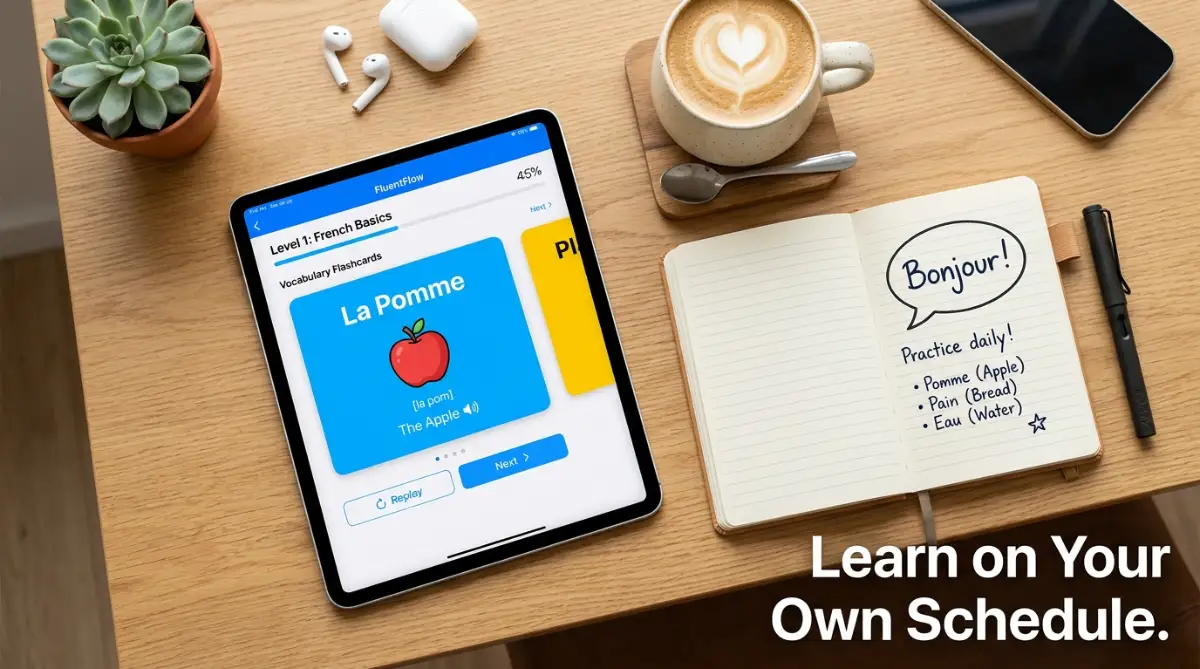
When I was starting out, I downloaded a pre-made Spanish deck and studied it for just five minutes during my morning coffee.
You can also sign up for a free AnkiWeb account to keep your progress beautifully synced across your phone and computer.
If you prefer a more colorful, game-like experience to kickstart your daily habit, I also recommend giving the free tier of Duolingo a quick try.
While it shouldn't be your only tool, it is brilliant for keeping you motivated on those busy days.
Step 3: Speak with Real Native Partners for Free
You can study words for years, but you will never feel ready until you actually start speaking. Many people think they need to hire a private tutor to practice speaking.
Luckily, you can do this for free by helping someone else.
The Power of Peer-to-Peer Learning
There are millions of people around the world who want to learn your native language. At the same time, they speak the language that you want to learn. You can connect with them and trade your skills.
This is called a language exchange. You spend half of your time speaking in your language to help them learn. Then, you switch and spend the other half speaking in their language so they can help you.
How to Stay Safe and Successful on Language Apps
To find your ideal practice partners, I highly recommend checking out HelloTalk or Tandem. Both are fantastic, completely free-to-use platforms designed specifically for peer-to-peer language exchange.
When I first signed up, I was incredibly nervous about making mistakes. But I quickly realized that people on these apps are just like usโthey are trying to learn English (or your native language), and they appreciate any help they can get.
The apps even have built-in translation and correction tools, so you don't have to worry about freezing up mid-conversation.
The Scientific Truth Behind Free Language Learning
You might still wonder if free tools can really match a paid classroom course. The science of learning shows that they often work much better. Real fluency does not come from a expensive paper degree.
How Your Brain Builds New Language Pathways
Your brain learns best when it is relaxed and having fun. This process of brain change is called neuroplasticity. When you use free, interactive tools on your own terms, you lower your stress levels.
Lower stress allows your brain to absorb information much faster. When you choose what you want to learn, you stay excited and study more often. Consistent daily practice is what builds strong neural paths, not high tuition fees.
The Myth of the Expensive Classroom
Classrooms often force you to learn at the pace of the slowest student. They also focus heavily on grammar rules that native speakers rarely use in daily life. This can make your speech sound stiff and unnatural.
With free online tools, you are the boss of your own study room. You can spend more time on topics you care about, like travel or business. This custom approach makes your study highly practical and rewarding.
A Quick Comparison of Top Free Resources
To help you choose the best starting point, here is a simple table of top free tools. Each of these resources excels in a different area of study.

Step 4: Master Grammar with Free Structured Websites
You do not need to avoid grammar completely, but you should learn it in a simple way. Do not buy giant, dusty grammar books that make your head hurt.
There are beautiful, free websites that explain grammar rules using clear English.
Simple Websites for Clear Rules
Websites like SpanishDict for Spanish or Deutsch-Lernen for German offer free learning paths. They break down tricky rules into small, bite-sized articles.
They also include free practice quizzes to test what you have just learned.
Another great option is to search for free online courses on Coursera or edX. Many world-class universities offer their language courses for free if you choose the "audit" option. This gives you top-tier materials without paying a single cent for a certificate.
Learn Grammar Through Context
The best way to master grammar is to see it used in real sentences. When you read free online newspapers or blogs, pay attention to how sentences are built.
This natural exposure is far more powerful than memorizing tables of verbs.
If you see a sentence pattern that looks strange, simply search for it online. You will find plenty of free forums, like Reddit's language learning groups,
where experts explain these rules. You can even post your own questions and get friendly answers within minutes.
Step 5: Turn Daily Entertainment into Free Study Sessions
Learning a language should not feel like an extra chore on your busy to-do list. The most successful learners are those who bring the language into their daily entertainment. You can do this easily without spending any money.
Swap Your Media Habits
If you love music, try searching for playlists in your target language on Spotify. It's an absolute goldmine for natural ear training! For video lovers, I cannot recommend Language Reactor enough.
It's a completely free Google Chrome extension that lets you watch YouTube and Netflix with dual subtitles.
This was a complete game - changer for me; I could just hover over a word to see its translation instantly, making vocabulary building feel completely effortless.

[Normal Video] ---> [Add Language Reactor] ---> [Dual Subtitles] ---> [Instant Vocabulary Click]
Read Simple Children's Books Online
When you're ready to transition into reading, don't spend money on expensive imported books. Head over to Project Gutenberg to download thousands of free, classic books directly to your device.
Starting with simple texts or translations of books you already know well will boost your confidence fast.
This keeps you from getting frustrated and wanting to close the book. As you grow more confident, you can move to reading free local news sites.
This keeps your vocabulary fresh and connected to the real world.
Your Weekly Free Language Study Routine
To make this easy, let us look at a simple weekly plan. You do not need hours of free time to make this work. You only need fifteen to twenty minutes of focused time each day.
The 15-Minute Daily Plan
- Monday: Spend 5 minutes on your vocabulary app, then listen to a 10-minute beginner podcast.
- Tuesday: Watch a 10-minute YouTube video made for learners, and review 5 flashcards.
- Wednesday: Write 5 simple sentences about your day and check them using free online tools.
- Thursday: Send a few text messages to your language partner on HelloTalk.
- Friday: Listen to three songs in your target language and look up the translation of the chorus.
- Saturday: Have a short 15-minute voice call with your language exchange partner.
- Sunday: Play a quick language learning game on your phone to review the week's words.
This routine is short, varied, and highly effective. It covers listening, writing, speaking, and vocabulary without ever feeling overwhelming.
It proves that small, daily steps lead to massive results over time.
How to Stay Motivated Without a Paid Teacher
When you are learning on your own for free, it is easy to lose focus. You do not have a teacher tracking your homework or a class to attend.
This is why you need to build a system of personal accountability.
Set Tiny Goals
The biggest mistake is trying to study for two hours on Saturday and doing nothing the rest of the week. This approach does not work for your brain.
It is much better to study for just five minutes every single day.
Set a goal that is so small and easy that you cannot say no to it. Tell yourself you will only review three flashcards today. Once you start, you will usually find the energy to do a little bit more.
Find an Online Study Group
You do not have to walk this path alone. There are massive online communities filled with free language learners just like you. Search for language learning groups on Reddit or Discord.
In these spaces, you can share your weekly progress and celebrate small wins. You can also ask for help when you get stuck on a difficult rule. Sharing your journey makes the entire process feel like an exciting team sport.
Going Beyond the Basics: Advanced Tactics for True Fluency
Now that you have your basic tools ready, it is time to look at how the experts study. Learning a new language is not just about memorizing words on a screen.
To truly speak like a native, you need to change how you think and how you interact with the language daily.
These advanced strategies will help you move from a basic beginner to a confident speaker. They do not cost a single cent, but they require a little bit of smart planning.
Let us look at how you can make your brain a language-learning machine.
The "Thinking in the Language" Method
Most people make a common mistake when they try to speak a new language. They think of a sentence in English first. Then, they translate it word-for-word in their head before speaking it out loud.
This translation step takes too much time and makes your conversations feel slow and awkward. To fix this, you must train your brain to connect words directly to real-world objects.

[Traditional Method]: Object ---> English Word ---> Translation ---> Target Word [Expert Method]: Object --------------------------------------> Target Word
For example, when you see a dog, do not think the English word "dog" and then translate it to "perro" or "chien". Instead, look at the animal and immediately say the target word in your head.
Start doing this with simple items around your house, like your coffee cup or your desk. If you do not know the name of an object, use highly-rated learning apps to quickly look it up.
This simple change removes the middleman in your brain, helping you speak much faster.
The Shadowing Technique for Perfect Pronunciation
If you want to sound natural, you need to work on your accent and speech flow. One of the best free methods to achieve this is called shadowing.
This technique involves listening to a native speaker and repeating what they say with a very short delay. You are essentially acting like an echo, repeating the sounds as soon as you hear them.
You can find excellent audio clips for this on BBC Languages or by watching short clips on YouTube. Do not worry about reading the text or writing anything down while doing this.
Focus entirely on the tone, the pauses, and the rising and falling of the speakerโs voice. Think of it like singing along to your favorite song.
With enough practice, your mouth muscles will adapt to these new sounds without any strain.
Building a Bulletproof Memory with Free Active Recall Tools
Reading a word over and over in a book is a very weak way to study. Your brain needs to be challenged if you want it to remember things for years to come.
This is where the science of active recall comes into play. Instead of looking at a list of words, you must force your brain to pull the answer from its memory.
You can use the free online platform AnkiWeb to build custom digital flashcards for this exact purpose. Put a picture or a question on the front of the card, and the target word on the back.
This forces your brain to work hard to find the right answer before you reveal it. Studies on spaced repetition show that this active effort builds much stronger memory paths. It is the single most effective way to keep your vocabulary sharp over months and years.
The Power of Micro-Learning and Habit Triggers
Many adult learners fail because they try to study for hours on the weekends but do nothing during the week. Our brains do not work well with large, irregular blocks of study.
Instead, you should use a method called habit triggering to link your language study to things you already do every day. This creates tiny, automatic study habits that require almost no willpower.
For instance, you can tell yourself, "As soon as I sit down with my morning tea, I will review five words on my phone." In this scenario, your tea acts as the automatic trigger that starts your study session.
You can use a simple daily study schedule to keep track of these small habits. Over time, these tiny sessions will add up to hundreds of hours of natural practice.
Transitioning to Monolingual Tools
Once you know about one thousand basic words, you should stop using English dictionaries. Using your native language to learn a new one will only hold you back at this stage.
Instead, start using a free monolingual dictionary designed for children or language learners. These dictionaries explain new words using very simple sentences in your target language.
This forces you to stay completely inside the new language for your entire study session. It is like a fun puzzle where you use simple words to unlock more complex ones.
It also helps you discover how native speakers naturally describe things when they forget a specific word. This is a key skill that will save you from freezing up during real conversations.
Structuring Your Free Learning Environment
You do not need to move to a different country to immerse yourself in a new tongue. You can easily build a free digital immersion bubble right in your own home.
Start by changing the default language setting on your smartphone and your social media accounts. This simple trick forces you to interact with the language dozens of times every single day.
Next, replace your standard web searches with searches in your target language. If you want to find a recipe for dinner, search for it using the words of the language you are learning.
You can also download free classical books from Project Gutenberg to practice your reading skills. These small changes turn your normal digital life into a highly effective learning environment.

Crucial Traps and How to Avoid Them
Even with the best free tools, many learners end up quitting before they reach their goals. This usually happens because they fall into common traps that drain their motivation and waste their time.
By knowing these mistakes in advance, you can protect your progress and keep moving forward. Let us look at the most common pitfalls and how you can avoid them.
Mistake 1: Relying Too Much on Game-Like Apps
Many people download a popular app and think they are studying just because they spend hours on it. While tools like Duolingo are great for starting out, they should not be your only resource.
These apps often make learning feel like a simple matching game. You might get really good at clicking the correct buttons on your screen, but this does not translate to real-world speaking.
To avoid this, make sure to mix your app usage with actual conversational practice. Use the apps for quick five-minute warm - ups, but spend the rest of your study time listening to real audio or chatting with people.
This balance ensures that your skills remain practical and useful in real-world scenarios. It keeps you from getting stuck in a comfortable but useless loop.
Mistake 2: Studying Grammar Rules Instead of Using the Language
It is very easy to get lost in complex grammar books and try to memorize endless verb tables. While grammar is important, learning it too early can actually slow down your speaking progress.
When you focus too much on perfect rules, you become afraid of making mistakes. This fear makes you hesitate every time you want to speak.
Remember that communication is always more important than perfect grammar. A native speaker will still understand you if you make a small mistake with a verb.
Focus on getting your message across first, and worry about perfect grammar later. You can always use free online courses to polish your grammar once you can hold a basic conversation.
Mistake 3: App Hopping and Changing Methods Constantly
When you search for free resources online, you will find thousands of different options. This abundance can lead to a state of choice paralysis.
Many learners spend more time searching for the "perfect" app than actually studying the language. They use one tool for three days, get bored, and then switch to a different one.
This constant jumping prevents you from making any real progress. The truth is that almost any popular free method can work if you stick with it for a long time.
Pick one listening tool and one vocabulary tool, and stick with them for at least a full month. Consistency is the real key to success, not finding some magical secret app.
Mistake 4: Waiting to Feel "Ready" Before Speaking
This is perhaps the biggest trap of all. Many adult learners believe they need to study for a year before they can talk to another person.
They are terrified of looking foolish or making simple mistakes in front of others. So, they keep studying in secret, waiting for a day when they will suddenly feel completely ready.
The hard truth is that you will never feel fully ready to speak a new language. Speaking is a physical skill that requires practice, just like playing an instrument or riding a bicycle.
You must be willing to speak badly before you can learn to speak well. Find a friendly partner on Tandem who is patient and happy to help you practice.
Mistake 5: Setting Unrealistic Timelines
Many articles online make silly promises like "Become Fluent in Thirty Days!" When learners do not speak like a native after a month, they assume they are simply not smart enough.
They get discouraged and quit, believing they lack the "language gene." This is a tragic waste of potential.
Real language acquisition is a slow, natural process that takes hundreds of hours of regular contact. It is more like a long marathon than a quick sprint.
Set your expectations early and enjoy the daily journey of learning. Celebrate the small wins, like understanding a short sentence in a podcast or learning ten new words.

[Unrealistic Goal]: Fluent in 30 Days (Leads to burnout and quitting) [Realistic Goal]: 15 Minutes a Day for 1 Year (Leads to steady, real-life fluency)

Your Action Plan for Tomorrow
To wrap things up, let us make a simple promise to ourselves. You do not need a lot of money, a private tutor, or expensive textbooks to learn a new language.
You already have everything you need on your computer and smartphone. The power to open up a whole new world of opportunities is entirely in your hands.
Do not wait for the perfect moment to start your journey. Tomorrow morning, take your very first step using this simple action plan:
- Find One Free Podcast: Spend five minutes searching for a beginner podcast in your target language on Spotify.
- Download a Vocabulary App: Install a free flashcard app on your phone and learn just five useful words.
- Change One Setting: Switch the language setting on your favorite social media app to your target language.
- Listen Active Recall Audio: Put on your headphones and spend five minutes listening to native speakers on YouTube.
Think about how amazing it will feel when you can finally understand a foreign movie or talk to a local during your next trip.
Think of the new friendships you will build and the exciting career paths that will open up for you.
Every single native speaker in the world started exactly where you are standing right now. They did not have special brains; they simply stayed consistent and kept trying every day.
Step away from the expensive paywalls and embrace the incredible world of free online learning. Your future self will thank you for the effort you put in today.
Get started now, stay patient with yourself, and enjoy the beautiful process of learning!
Frequently Asked Questions (FAQs)
Over the years, Iโve received a lot of questions about self-directed language learning. Here are some of the most common worries my readers share with me, along with my honest advice:
1. Can I really become fluent using only free tools?
Absolutely. I am living proof of this, and so are thousands of other language learners. Fluency isn't about how much money you spend; it's about consistency, exposure, and practice. Paid courses often just repackage grammar rules that you can easily find online for free if you know where to look.
2. What is the single best free tool to start with?
If you are an absolute beginner, I recommend starting with YouTube for slow, "comprehensible input" videos to train your ears. Combine that with a few minutes of daily vocabulary study using Anki to build a solid foundation of words.
3. Iโm too introverted to talk to native speakers. What should I do?
I completely understandโI used to be incredibly shy too! You donโt have to jump straight into voice calls. On apps like HelloTalk and Tandem, you can start by sending text messages or short voice notes. Take your time, get comfortable, and remember that making mistakes is the only way our brains actually learn.
4. How long will it take me to speak confidently?
Thereโs no magical "30-day" shortcut. But if you stick to the 15-minute daily routine I outlined above, youโll be amazed at how much you can understand in three months. Usually, you should be able to have basic, comfortable conversations within six months to a year. Be patient with yourself!
Disclaimer:
This blog post is for informational and educational purposes only. While we highlight free resources and methods, we are not directly associated with the third-party platforms mentioned in this article. Users should always review the privacy policies and safety terms of any application or website before creating a free account. Learning results can vary depending on your personal study time, starting level, and overall consistency.