My Daily Struggle With Racing Thoughts and Finding Peace
I used to start every morning feeling like my brain was running a marathon before my feet even touched the floor. My coffee was hot, my to-do list was endless, and my chest felt heavy with constant anxiety. I always believed that meditation required sitting quietly on a floor cushion for an hour every day. That thought alone overwhelmed me, so I kept putting it off for months. Every time I tried to sit still, my mind raced toward unread emails and forgotten chores. I felt defeated, exhausted, and stuck in a loop of constant overthinking. Then I realized I was trying to change my whole life all at once instead of taking one small step.
Many of us live with a constant quiet pressure hum in the background of our days. You wake up, grab your phone, and immediately absorb a flood of news, messages, and work demands. Your brain never gets a moment to reset or process what is happening. By noon, you feel tired, irritable, and disconnected from the people you care about most.
This non-stop noise wrecks your sleep and steals your daily joy. You find yourself snapped at family members or staring at a screen for hours without accomplishing anything meaningful. It feels like you are just surviving each day instead of actually living it. You want peace, but you simply do not have hours of free time to sit on a cushion.
Why Five Minutes Is All You Need to Reset Your Brain
You do not need an hour of silent meditation to experience real calm. Your nervous system responds quickly to very small pauses when you give it permission to slow down. Five minutes is short enough that your brain does not view it as a hard task. It is long enough to signal to your body that you are safe and in control.
Small daily habits build mental muscle faster than long, irregular sessions. Doing five minutes every single morning works far better than doing sixty minutes once a month. Think of it like brushing your teeth for your mind. You do not brush your teeth for two hours on Sunday and skip the rest of the week.
When you practice for just five minutes, you remove the barrier of time excuse. Everyone has five minutes, even on the busiest mornings. You can do it before your family wakes up or right at your work desk. Small efforts repeated daily create massive shifts in your emotional stability.
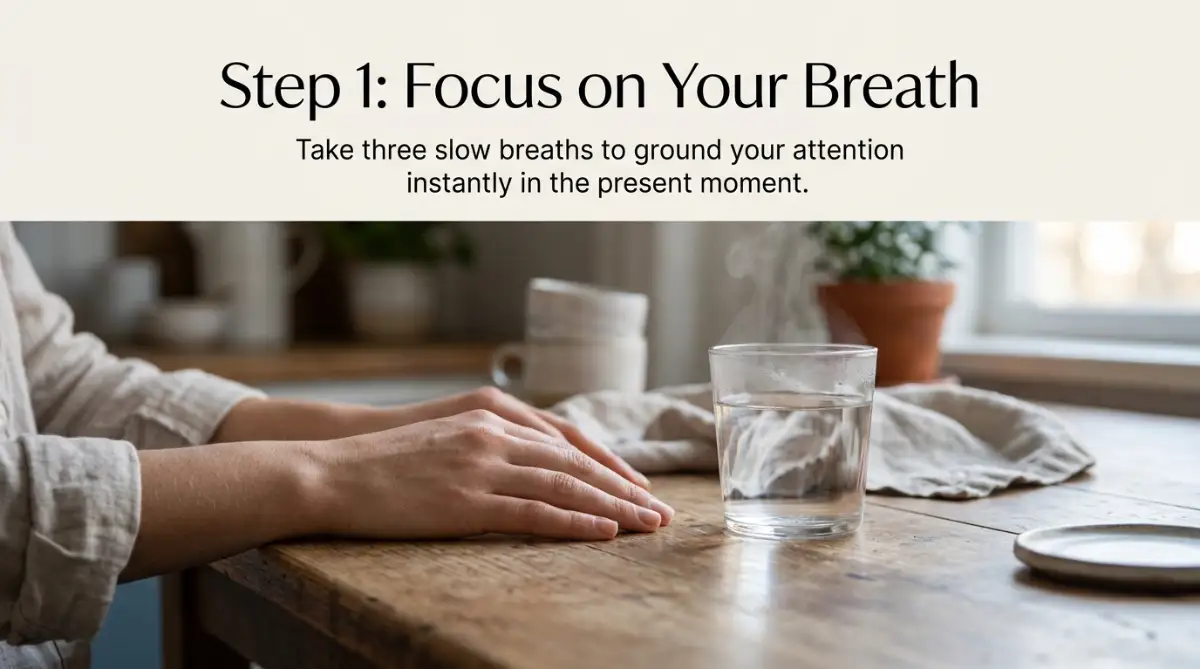
Step 1: The One-Minute Breathing Anchor
Start your five-minute session by settling into a comfortable seated position. You do not need to sit cross-legged on the floor unless you want to. A standard kitchen chair or the edge of your bed works perfectly well. Keep your spine gently upright, but keep your shoulders soft and relaxed.
Close your eyes soft or keep a soft downward gaze on the floor in front of you. Take a deep, slow breath in through your nose for a count of four. Hold that air gently in your lungs for two seconds. Then exhale slowly through your mouth for four seconds, letting your chest fall.
Repeat this simple breath cycle three or four times. Feel the cool air moving into your nostrils and warm air leaving your lips. This physical focus pulls your brain out of future worries and anchors you directly in the present room.
How to Use the Box Breathing Method
Box breathing is a simple counting technique that gives your busy mind a job to do. Inhale through your nose while counting slowly to four in your head. Hold your breath gently for another four-second count without straining your throat.
Exhale slowly through your mouth while counting to four once again. Hold your lungs empty for four final seconds before starting the next breath. Doing this square pattern three times naturally lowers your heart rate. It switches your body out of stress mode and into a state of quiet rest.
Step 2: The Two-Minute Body Scan Check
Once your breathing slows down, move your mental attention down into your physical body. Most of us spend our whole day living inside our racing thoughts, completely ignoring physical tension. Start by noticing how your feet feel pressed firmly against the solid floor.
Slowly scan your attention upward through your ankles, calves, and knees. Notice if you are holding tight muscles in your thighs or lower back. Do not try to force anything to change; simply notice where your body feels tight or warm.
Move up to your shoulders, neck, and jaw, which are common places where stress hides. Let your jaw drop open slightly and unclench your teeth completely. Let your shoulders drop away from your ears as you breathe out smoothly.
I used to force myself to stay completely still during meditation, which only made me feel more restless and frustrated. I finally realized that noticing my busy mind without judgment was the actual practice, not having a completely quiet brain.
Unlocking Tension in Your Face and Neck
We often carry hidden strain in the tiny muscles around our eyes and forehead. Take a deep breath and consciously smooth out your forehead brow as you exhale. Release any tight squeezing around your eyes and soften your tongue against the bottom of your mouth.
Roll your shoulders backward in two slow, smooth circles to release tight upper back muscles. Let your hands rest heavy and soft on your lap or knees. This brief physical release sends strong safety signals directly up to your brain.
Step 3: The One-Minute Mindful Sensory Connection
After scanning your body, open your awareness outward to the subtle sounds around you. Do not search for specific noises; just let sound come to your ears naturally. You might hear a distant car, a quiet refrigerator hum, or birds singing outside your window.
Label these sounds as simple neutral sounds without judging them as annoying or good. If a clock tick pops up, notice it and let it pass through your awareness like a cloud. This practice teaches your mind to observe life without immediately reacting with emotion.
Next, notice the physical feeling of the air resting gently on your exposed skin. Feel the texture of your clothes touching your arms or the warmth of your lap. This simple sensory check pulls you entirely out of mental storytelling and into physical reality. If you ever feel overwhelmed by sudden anxiety during the day, you can also explore how to use your 5 senses to calm panic and stress for an immediate grounding effect.
If you’re someone who learns better by watching, I highly recommend following along with a guided visual session. Taking just 15 minutes to practice alongside a guide can completely change how you approach your morning calm. Check out this excellent 15-Minute Guided Mindfulness Meditation Video by Boho Beautiful to help you get started smoothly today.
Step 4: The One-Minute Heartfelt Gratitude Reset
Spend your final minute focusing on one simple thing you are thankful for right now. It does not need to be a massive life event or a major success. It can be as small as a warm morning mug, a quiet room, or a soft blanket.
Bring that single positive image into your mind's eye and hold it clearly for a few seconds. Notice how pointing your focus toward a good thing creates a subtle warm feeling in your chest. Let yourself sit with that soft feeling for three slow breath cycles.
When your five minutes are up, slowly wiggle your fingers and toes to wake up your body. Gently open your eyes and take one final deep breath before moving off your seat. You have now completely reset your mental state for the rest of the day ahead.
Simple Daily Gratitude Prompts for Beginners
- A physical comfort: A warm morning shower, clean sheets, or a comfortable chair.
- A sensory pleasure: The smell of morning coffee, fresh air, or soft sunlight.
- A kind connection: A nice text message, a dog's greeting, or a friendly smile.
- A personal strength: Your breath, your body's health, or your resilience today.
Common Mindfulness Myths That Keep You Stuck
Many people quit mindfulness early because they fall for common false beliefs about meditation. They assume they are doing it wrong the moment a random thought enters their head. Understanding these common myths will help you stay consistent without feeling guilty or frustrated.
Myth 1: You must clear your mind of all thoughts completely.
Reality: Mindfulness is noticing thoughts without following them, not clearing them.
Myth 2: You need a silent room and special equipment to practice.
Reality: You can practice anywhere, even in a noisy room or on a crowded bus.
Myth 3: Five minutes is too short to make any real difference.
Reality: Consistent micro-habits rewrite neural pathways faster than long rare sessions.
The goal of mindfulness is not to stop thinking completely; that is impossible for a human brain. The real goal is changing your relationship with your thoughts when they appear. When a thought pops up, you simply notice it, label it gently as thinking, and return to your breath.
You do not need special cushion seats, candles, or expensive apps to practice effectively. Your breath is always with you, making this simple habit completely free and accessible anywhere. You can practice at your office desk, in your parked car, or on your living room couch.
Fitting Five Minutes Into a Busy Morning Schedule
The best way to build a lasting habit is to attach it to an existing morning routine. This strategy is called habit stacking, and it works remarkably well for busy people. Pair your five minutes of mindfulness directly with a task you already do every single day.
You can sit quietly right after you turn your coffee maker on while it brews. You can practice for five minutes right after brushing your teeth in the morning bathroom. By stacking the new habit onto an old one, your brain remembers to do it automatically.
If you miss a day, do not scold yourself or feel like you failed completely. Simply pick up your five-minute practice again the next morning without any harsh self-judgment. Consistency is built on gentle restarts, not rigid perfection.
Troubleshooting Your Daily Mindfulness Practice
It is completely normal to feel restless or bored when you first start sitting quietly. Your brain is used to constant scrolling, videos, and loud stimulants every minute. When you suddenly take those away, your mind might panic and generate dozens of thoughts at once.
When restlessness happens, gently shift your attention to physical sensations instead of mental quietness. Focus on the hard weight of your body pressing into your chair or your feet on the floor. Giving your mind a concrete physical touchstone helps settle nervous energy very quickly.
If you keep getting sleepy during your session, try practicing with your eyes open. Keep a soft, unfocused gaze on a spot on the floor roughly three feet in front of you. You can also stand up straight against a wall to keep your body awake and alert.
Remember that a bad session where your mind wanders non-stop is still a successful practice. The act of catching your mind wandering and bringing it back is what builds mental focus. Every single time you bring your attention back to your breath, your brain grows stronger.
Creating Your Ideal Five Minute Space at Home
You do not need a dedicated meditation room to build a quiet daily practice habit. You only need a small corner of a room where you feel safe and comfortable for five minutes. Choose a spot that stays relatively clean and free from clutter during morning hours.
Keep a comfortable chair or a firm cushion near that spot so it is ready for you. You might place a small houseplant or a cozy blanket nearby to make the space inviting. Having a visual cue in your home reminds your brain that it is time to sit and pause.
Tell your family members or housemates about your brief five-minute morning practice. Ask them gently not to interrupt you during those short three hundred seconds unless it is an emergency. Setting this small boundary helps you relax completely without worrying about unexpected interruptions.
Over time, simply sitting down in your designated space will trigger a natural relaxation response. Your body learns to associate that specific chair or spot with safety and peace. This makes entering a quiet state faster and much easier every single day.
Tracking Your Simple Progress Without Pressure
Avoid measuring your progress by how calm or happy you feel during your five minutes. Some days you will feel peaceful, while other days your mind will feel noisy and messy. Both outcomes are completely normal and part of a healthy human experience.
Instead, measure your success simply by whether you showed up and sat down for five minutes. Mark a simple checkmark on a wall calendar or in a notebook every morning you practice. Watching your checkmarks build up creates a visual chain of consistency that boosts your motivation.
Notice how you handle everyday stress after a few weeks of consistent five-minute practice. You might notice that you pause before reacting angrily to a minor inconvenience. You might find yourself breathing through a stressful moment at work instead of panicking.
These subtle real-world shifts are the true signs that your mindfulness practice is working deeply. You are building a calmer mind and a steady inner sanctuary, one short breath at a time. Start tomorrow morning with just five minutes, and let your practice grow naturally from there.
Advanced Techniques to Deepen Your Five Minute Daily Ritual
Once you practice five minutes of quiet sitting for a week, you can upgrade your routine with subtle focus tools. These small tweaks increase your ability to stay grounded during chaotic moments throughout the rest of your day. You do not need extra time; you simply bring deeper mental quality to your five minutes.
One effective strategy is anchor anchoring, where you pair your physical breath with a soft internal word. As you inhale slowly, repeat the quiet word "calm" inside your mind. As you exhale smoothly, repeat the word "release" to let go of physical tension in your chest.
Clinical evidence supported by the National Institutes of Health shows that simple, structured focus techniques actively lower stress hormones like cortisol in your body. Using a soft mental anchor helps quiet internal chatter much faster than sitting in complete, uneasy silence.
Master the Art of Mindful Micro-Pauses
You do not have to limit your mindfulness practice to your morning chair routine. You can sprinkle tiny ten-second pauses throughout your afternoon to keep your stress levels low. These mini reset moments prevent mental fatigue from building up before you finish your workday.
Before you open a new browser tab or respond to a tough email, pause for one deep breath. Feel your feet pressing on the floor and let your belly relax completely on the exhale. These brief check-ins reset your nervous system without delaying your busy daily schedule.
Building true inner peace is very much like nurturing a small, delicate habit—it requires patient, daily care rather than a rushed effort. When you sprinkle these tiny moments of awareness throughout your day, you keep your mental energy steady and balanced without ever feeling drained.
Transforming Boring Waiting Time Into Instant Calm
We spend hours every week waiting in line, sitting in traffic, or waiting for web pages to load. Instead of grabbing your phone to scroll social media, convert these idle moments into mini mindfulness pauses. Notice your surroundings with fresh eyes without reaching for digital distraction.
Feel the texture of your steering wheel or the ground under your shoes while waiting in line. Look at colors, lighting, and shadow details around you with soft curiosity. This simple habit keeps your brain grounded in the real physical world instead of endless digital noise.
Training your mind to stay grounded relies entirely on gentle, steady observation of the present moment. By simply shifting your attention to concrete physical details—like the feel of your steering wheel or the cool breeze on your face—you break the cycle of overthinking instantly.
The Power of Labeling Your Thoughts Without Judgment
When heavy thoughts or worries break into your five-minute session, try the mental labeling technique. Instead of getting angry at yourself for distraction, simply assign a neutral one-word label to the thought. Say "planning," "worrying," or "remembering" softly inside your head when a thought pops up.
After labeling the thought, let it float away like a dry leaf floating down a moving stream. Do not analyze why you had the thought or follow it down a long rabbit hole. This simple practice creates space between you and your emotional reactions.
According to stress-management research published by the American Psychological Association, learning to observe your thoughts without emotional reaction significantly reduces long-term anxiety. Before you jump into demanding tasks or stressful work projects each day, taking just five minutes to clear your mental fatigue keeps you focused, sharp, and safe. A calm, uncluttered mind will always make better decisions under pressure.
Mindful Thought Labeling Matrix:

+---------------------+-----------------------+------------------------------------+
| Incoming Thought    | Reactive Response     | Mindful Labeling Strategy          |
+---------------------+-----------------------+------------------------------------+
| "I forgot an email" | Panic & jump up       | Label: "Planning" -> Return to air |
| "My back aches"     | Frustration & complaint| Label: "Sensation" -> Soften jaw  |
| "Will I finish work"| Worry & heart race    | Label: "Future" -> Feel feet floor |
+---------------------+-----------------------+------------------------------------+

Hidden Traps That Destroy Your Daily Progress
The biggest mistake beginners make is turning their five-minute mindfulness practice into another high-pressure goal on their task list. They treat it like a test where they must perform perfectly or achieve a state of pure bliss every time. This mindset creates subtle performance anxiety that ruins the soothing benefits of sitting quietly.
Mindfulness is not about performing well or achieving a zero-thought mind state. It is simply about being present with whatever experience you are having right now, whether noisy or quiet. If your mind is chaotic for all five minutes, you still succeeded just by staying in your seat.
Another dangerous mistake is treating mindfulness as an emergency bandage only when you feel extreme panic. If you only practice when you are overwhelmed, your brain begins associating sitting quietly with heavy stress. Practice every single morning when things are normal so the habit stays easy and natural.
Quick Do's and Don'ts for Daily Mindfulness Success:
DO:
- Sit comfortably with a straight back and soft jaw.
- Stack your practice onto existing morning habits.
- Treat every thought with curiosity and kindness.
DON'T:
- Force your mind to stop thinking completely.
- Judge yourself when your attention wanders off.
- Skip sessions just because your morning feels busy.
Just like setting healthy personal boundaries protects your time, carving out a few quiet minutes each morning guards your emotional energy. Learning how emotional self-care can protect your mental health builds strong inner resilience and prevents burnout long before stress gets a chance to ruin your week.
The Perfectionism Trap and How to Escape It
Perfectionism ruins habit building faster than laziness ever will. You might believe that if you cannot sit for five uninterrupted minutes in a silent room, the practice is useless. This all-or-nothing thinking leads people to quit their habit after a single imperfect morning.
If your dog barks or your phone rings during your session, do not throw away your daily effort. Simply acknowledge the distraction, breathe through it, and finish your remaining time calm and steady. Real life is noisy, and learning to stay quiet amid noise is the whole point of mindfulness.
Learning to view your racing thoughts clearly is a skill that develops over time with gentle observation, not something you master perfectly on day one. Be patient with yourself and give your mind permission to be a complete beginner every single morning.
The Danger of Reaching for Your Phone Immediately After
What you do immediately after your five-minute session matters just as much as the practice itself. If you open social media news feeds the second you open your eyes, you flush away your calm. You flood your peaceful brain with digital noise before your feet even touch the floor.
Give yourself at least two to three minutes of buffer space after your daily practice ends. Drink a warm cup of water, look out a bright window, or stretch your arms slowly. Let the peaceful feeling settle deeply into your body before opening your phone apps.
Health research from Harvard Health Publishing highlights that allowing yourself a gentle transition out of rest keeps stress hormone levels significantly lower throughout the day. Treat your newfound calm with care instead of plunging straight into digital overload. Guarding your attention early in the morning preserves the vital energy you need to tackle your biggest tasks later on.
Your Daily Blueprint for Long-Term Inner Peace
Building a lasting mindfulness practice does not require life overhauls or long retreat trips. It simply requires showing up for five brief minutes every morning with patience and soft curiosity. You are training your nervous system to stay steady when life throws unexpected challenges at you.
Start tomorrow morning by choosing one comfortable chair in your home. Set a timer for three hundred seconds, close your eyes gently, and follow three slow breath cycles. Do not worry about doing it perfectly; just allow yourself to sit quietly without needing to produce anything.
Over weeks and months, these tiny five-minute investments create a solid wall of calm in your life. You will react with more patience, sleep more soundly, and feel truly present with those you love. Your daily mental peace is built step by step, breath by breath.
I spent years struggling with overthinking before I finally accepted that five minutes was enough to transform my mornings. Committing to this short daily pause gave me back my focus, my patience, and my energy. Give yourself permission to start with just three hundred seconds tomorrow morning, and watch how quickly your days change for the better.
Frequently Asked Questions About Daily Mindfulness Practice
Can I practice my five minute mindfulness while sitting in bed?
Yes, you can practice sitting up in bed right after waking up in the morning. Keep your spine gently upright against pillows so you stay awake and alert. Avoid lying completely flat, as your brain easily confuses flat rest with sleeping time.
What should I do if I keep falling asleep during my session?
If you feel sleepy, open your eyes slightly and keep a soft downward gaze on the floor. You can also practice standing up with your back gently touching a wall. Drinking a small glass of cool water before sitting down helps wake up your physical body.
Is five minutes really long enough to lower my stress levels?
Yes, five minutes of slow, focused breathing activates your parasympathetic nervous system quickly. It slows your heart rate and reduces stress hormones like cortisol in your blood. Regular daily sessions build lasting stress resilience over time.
Should I use a timer or a meditation app for my practice?
A simple soft phone alarm or silent timer works best so you do not stare at the clock. Set a gentle ring tone that does not shock your ears when your five minutes finish. Apps can be helpful, but sitting in simple silence builds deeper self-reliance.
What if my mind refuses to stop thinking during the five minutes?
A busy mind is completely normal, especially when you first start sitting quietly every morning. Mindfulness is not about stopping thoughts, but about catching yourself wandering and returning to your breath. Every time you bring your focus back, your brain grows stronger.
Disclaimer:
This article is provided for informational and educational purposes only and should not be taken as professional medical, psychological, or health advice. Mindfulness techniques and breathing exercises are general self-care practices designed for personal stress management. If you suffer from severe anxiety, clinical depression, or medical health conditions, please consult a qualified healthcare professional or licensed counselor for proper diagnosis and medical support. Always listen to your body and adjust self-care practices according to your personal health needs.