Written by Kamal Uddin (Mindfulness & Somatic Health Writer)
Medically Reviewed by Dr. Sarah Jenkins, MD (Clinical Psychologist)
A Note From Kamal: If you’re reading this while feeling an overwhelming wave of panic or stress, take a deep breath. You are safe right now. I’ve been in those exact shoes—sitting helpless while my body felt out of control. Over the years, working alongside mental health professionals, I learned that we don't have to fight our nervous system; we just need to guide it back to safety using our physical senses. Let’s walk through these simple tools together.
⚡ In Acute Panic Right Now? Try This 30-Second Reset:
If your mind is spiraling and your heart is beating fast, don't worry about reading this entire article right now. Just do these two quick steps with me:
1. Drop Your Shoulders & Unclench Your Jaw: Take a sharp double-inhale through your nose, then blow it out slowly through your mouth.
2. Touch 1 Physical Object: Press your soles firmly into the floor and name 3 things you can see right now.
Take a breath. You are safe. When you're ready, let’s explore the full grounding toolbox below together.
The Hidden Weight of a Racing Mind
I was sitting in my car in a busy supermarket parking lot when my chest suddenly felt tight. My heart started beating like a drum, and my hands were shaking uncontrollably. I tried telling my mind to stay quiet, but the fear kept growing bigger every second.
The room felt like it was spinning, and I felt completely detached from my own body. That was the moment I realized my anxious thoughts were taking total control of my afternoon. I needed something physical to pull me back to the present moment before I lost my cool completely. That was the exact day I discovered how sensory grounding techniques could change everything.
Anxiety has a sneaky way of grabbing hold of your entire day when you least expect it. You might be sitting at your work desk trying to focus on a simple project, yet your body acts like there is a sudden emergency. Your chest feels tight, your breathing becomes short, and your thoughts start spiraling out of control.
Living with this constant inner noise is utterly exhausting for anyone. It makes simple tasks like grocery shopping, talking to friends, or standing in line feel like overwhelming mountains. You spend so much energy trying to look calm on the outside while a storm rages on the inside.
When anxiety hits, your logical brain shuts down, and your body enters a fight-or-flight state. You feel disconnected from your surroundings, lost inside your own head, and afraid of losing control. Over time, this constant battle drains your mood, ruins your energy, and steals your daily peace.
You deserve a way to break that terrifying cycle quickly without waiting hours for the feelings to fade. Sensory grounding gives you simple, physical tools to anchor your mind whenever anxiety tries to blow you away.

Understanding How Your Nervous System Reacts to Stress
To understand why physical grounding works, it helps to know what happens inside your body during anxiety. When a threat appears, real or imagined, your brain triggers an instant survival signal. Your body floods with stress signals, your heart rate increases, and your focus shifts entirely toward threat detection.
This response is fantastic if you need to run away from physical danger. However, when you are safe in your living room, that same physical response feels alarming and terrifying. Your mind gets trapped in a feedback loop where scary thoughts create physical fear, and physical fear creates more scary thoughts.
Sensory grounding interrupts this loop by delivering direct, safe physical input to your brain. When you focus on real physical sensations right now, your brain realizes that you are currently safe. It shifts your attention away from imagined future disasters and brings you back into your immediate environment.
Grounding does not require complex tools or years of meditation experience. It simply uses the natural signals from your eyes, ears, skin, nose, and mouth to reset your focus. Think of your physical senses as steady ropes tied directly to the present moment.
The 5-4-3-2-1 Sensory Grounding Method Explained
The 5-4-3-2-1 grounding exercise is one of the most reliable tools for managing sudden stress or panic. It forces your active brain to pause its panic narrative and spend energy processing physical details around you. You can practice this quiet exercise anywhere without anyone around you even noticing.
Take a slow breath, plant both feet flat on the ground, and work through these five simple steps.
Step 1: Acknowledge 5 Things You Can See
Look around your current space and name five distinct visual details in your environment. Avoid rushing through this step just to finish it quickly. Really look at the items as if you were seeing them for the very first time.
- Notice the tiny dark grain pattern on your wooden desk surface.
- Look at the way sunlight reflects off the edge of your water glass.
- Spot a small green plant leaf resting near your window sill.
- Observe the color pattern of a jacket hanging across the room.
- Find a tiny shadow stretching across the floor corner.
Naming these physical items out loud or in your head interrupts your internal spiral. It forces your brain’s visual center to pay attention to real safety instead of mental fear images.
Step 2: Notice 4 Things You Can Physically Feel
Next, shift your attention away from your eyes and bring total focus down into your physical body. Identify four distinct physical textures or touch sensations happening right now.
- Feel the firm texture of your shoe soles pressing against the floor.
- Touch the soft woven fabric of your shirt sleeve with your fingers.
- Notice the cool metal edge of your wrist watch or ring.
- Feel the solid support of the chair back resting against your spine.
Focusing on tactile physical input grounds your awareness deep inside your limbs. It sends a message to your nervous system that your body is physically resting in a safe place.
Step 3: Listen for 3 Distinct Sounds Around You
Now, shift your focus outwards and listen carefully for three real sounds in your surroundings. Try to pick out subtle background noises that you usually ignore throughout your busy day.
- Listen to the soft hum of the refrigerator or air conditioner running nearby.
- Notice the distant sound of traffic passing along the road outside.
- Hear the gentle rustle of wind moving through trees near your building.
Listening closely slows down racing mental thoughts because your brain must quiet down to hear faint sounds. It reconnects you with the steady background flow of real life going on around you.
Step 4: Identify 2 Things You Can Smell
Next, turn your attention to your sense of smell and look for two real aromas around you. Smell is directly linked to the emotional processing centers in your human brain.
- Notice the light scent of fresh coffee lingering inside your mug.
- Sniff your shirt cuff to catch the fresh scent of laundry soap.
- Step near an open window to catch the smell of crisp fresh air.
If you cannot smell anything right away, simply notice the cool air moving into your nose. You can also keep a small bottle of lavender essential oil nearby for quick grounding.
Step 5: Focus on 1 Thing You Can Taste
Finally, bring your total focus to one taste inside your mouth right now. This simple sensory check rounds out your five-step physical reset routine.
- Take a small sip of cold water and notice the fresh feeling.
- Notice the lingering minty flavor from your morning toothpaste.
- Pop a mint or piece of fruit gum into your mouth and taste the flavor.
📌Your Pocket Cheat-Sheet for the 5-4-3-2-1 Method:
5 Things You See: Look for grain patterns, light reflections, or shadows.
4 Things You Feel: Feel your shoes on the floor, your clothes on your skin, or a cool desk.
3 Things You Hear: Listen for AC hums, distant traffic, or wind in the trees.
2 Things You Smell: Sniff your coffee mug, soap on your wrist, or fresh air.
1 Thing You Taste: Take a sip of cold water or taste your mint gum.
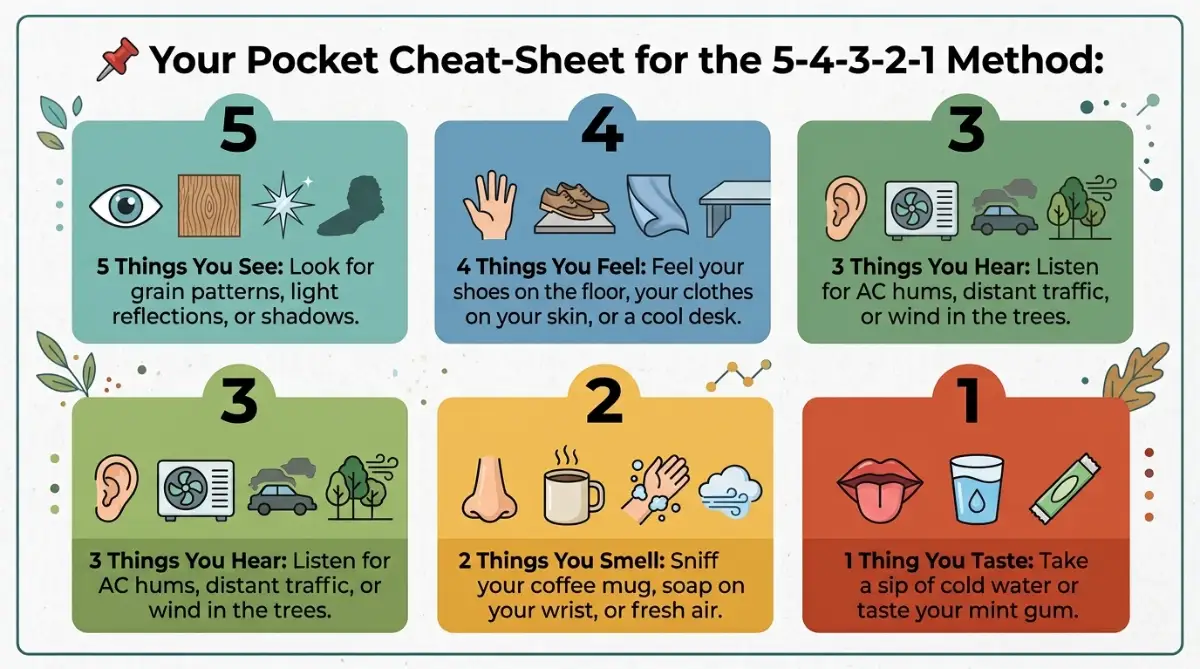
Bookmark this page or screenshot this box on your phone so you always have it ready during stressful moments!
Pro Tip: I used to try doing these sensory exercises in my head, but my racing thoughts kept distracting me. I found that speaking my observations out loud—even in a tiny whisper—made a massive difference in pulling my brain out of the panic storm.
Temperature Shifting for Rapid Panic Relief
Sometimes, your mental panic feels too strong for soft visual exercises to work immediately. When your heart is pounding fast, thermal grounding techniques provide a strong physical shift that snaps your attention back. Temperature changes trigger immediate physical responses that slow down high stress levels fast.
If you want to practice a guided, real-time sensory grounding session, I highly recommend watching this 15-minute follow-along video. It’s one of my favorite tools for immediate nervous system regulation:
Cold Water and Ice Interventions
Cold temperature interventions stimulate your mammalian dive reflex, which naturally lowers your heart rate. This physical reaction works automatically regardless of what your mind is worrying about at the moment.
- The Ice Cube Hold: Grab a single cold ice cube from your freezer and hold it tightly in your bare hand. Concentrate fully on the intense cold feeling and the water melting between your fingers.
- Cold Water Splash: Walk directly to your bathroom sink and splash ice-cold water onto your face and wrists three times. Feel the sharp contrast of cold liquid against your warm skin.
- The Frozen Cloth Trick: Keep a damp cloth in your freezer for high-stress moments. Press the frozen cloth gently against the back of your neck for twenty seconds.
Comforting Heat Applications
While sudden cold helps stop active panic attacks, warm temperature grounding provides comforting stability during quiet stress. Warm sensations tell your nervous system that you are resting in a cozy environment.
- Hold a hot mug of herbal tea with both hands and feel the steady warmth spreading into your palms.
- Wrap a warm, heated towel around your shoulders and notice the heavy, comforting weight.
- Take a slow warm shower and pay close attention to water droplets hitting your skin.
Proprioceptive and Body Movement Grounding
Your body has a hidden inner sense called proprioception, which tells your brain where your limbs are in space. Engaging your muscles and joints through proprioceptive grounding brings immediate stability when you feel lightheaded or dizzy from anxiety.
The Foot-Pressing Technique
Stand up tall or sit upright in a sturdy chair with your back resting straight against the support. Press both feet flat onto the floor surface beneath you with firm, steady physical pressure.
Imagine sturdy roots growing out from the bottoms of your feet deep down into the solid earth. Push your soles downward as if you are trying to leave deep footprints on the floor surface. Feel how incredibly solid and reliable the floor feels beneath your physical weight.
Hand-Squeezing and Physical Resistance
Another quick way to engage your physical muscles is through simple resistance exercises that you can do quietly anywhere.
- Clasp your hands firmly together in front of your chest and push your palms against each other for five seconds.
- Release the pressure slowly and feel the warm rush of blood returning to your fingers.
- Repeat this push-and-release pattern four times while taking slow, measured breaths.
You can also carry a small rubber stress ball inside your pocket or bag. Squeezing a dense object gives your hands a safe physical target for built-up nervous energy.
Auditory and Vocal Vibration Grounding
Sound creates real physical vibrations that travel deep inside your physical skull and chest areas. Using auditory and vocal grounding tools can settle a racing heart by vibrating your vagus nerve.
Humming and Vocal Resonance
When you feel anxious, your breathing tends to become shallow and fast in your upper chest area. Humming creates a steady physical vibration that forces your breathing to slow down naturally.
- Close your mouth gently and relax your facial jaw muscles.
- Take a deep breath in through your nose down toward your belly.
- Exhale slowly while making a low, steady "mmmm" humming sound in your throat.
- Feel the gentle buzz vibrating through your lips, teeth, and chest bone.
This low vibration stimulates deep relaxation pathways in your body within just two minutes of practice.
Ambient Sound Focus
Listening to natural white, pink, or brown noise can anchor an anxious mind during quiet work hours. Brown noise features deep, low frequency sounds that resemble heavy rain storms or deep ocean waves.
Put on headphones and listen to steady brown noise when your thoughts feel scattered or messy. The warm, heavy sound fills up your hearing space and blocks out unpredictable background distractions.
Common Mistakes to Avoid with Sensory Grounding
While sensory grounding tools are simple to learn, people often make a few common mistakes when starting out. Knowing these mistakes helps you get better results every time you feel stressed.
Mistake 1: Trying to Force Anxiety to Disappear Instantly
Grounding is not a magic eraser that wipes away all uncomfortable feelings in one second. Its real goal is to give you a safe physical anchor while your body processes stress hormones naturally.
Allow the uncomfortable feelings to exist in the background while you focus on real physical sensations. When you stop fighting the anxiety, it loses its power and fades away much faster.
Mistake 2: Waiting Until Severe Panic Strikes
If you only try grounding techniques during peak panic attacks, your brain will struggle to remember the steps. Practice your favorite sensory grounding tools on quiet, relaxed days when you feel completely fine.
Building these mental habits during peaceful times makes them automatic when real stress shows up later. Think of it like practicing swimming in a calm pool before jumping into rough ocean waves.
Mistake 3: Rushing Through the Senses
Moving through sensory steps too quickly prevents your brain from actually engaging with the physical input. Spending two full seconds looking at an object does not give your nervous system enough time to register safety.
Spend at least ten to fifteen seconds on each individual visual, tactile, or sound anchor. Look closely at textures, feel weight, and listen deeply until your focus fully settles on that single sensation.
Creating a Portable Sensory Grounding Kit
Having physical grounding objects ready in your bag or pocket builds confidence when traveling or working away from home. A portable sensory kit gives you familiar physical touchpoints wherever you go.
Here are helpful items to gather for your personal self-care kit:
- Tactile Items: A smooth sea stone, a piece of soft velvet cloth, or a rough wooden charm.
- Olfactory Items: A tiny travel roller bottle filled with lavender, peppermint, or sweet orange essential oil.
- Taste Items: A pack of strong peppermint candies, cinnamon gum, or sour candy drops.
- Visual Items: A small picture of a calm natural landscape, or a clear glass marble that catches light.
Keep these simple tools inside a small zippered pouch in your daily bag or desk drawer. Knowing you have physical comfort items nearby reduces the worry of getting overwhelmed in public spaces.
Simple Daily Routines for Nervous System Calm
Grounding techniques work best when you weave them directly into your daily self-care lifestyle habits. You do not need to wait for anxiety to appear to enjoy the relaxing benefits of sensory focus.
Morning Sensory Check-In
Start your day before looking at your phone screen or checking busy work emails. Sit on the edge of your bed and spend two quiet minutes noticing three physical sensations.
Feel the cool morning air on your face, touch the soft bed sheet under your hands, and listen to quiet morning sounds outside. This small morning habit sets a peaceful tone for your brain before busy daily tasks begin.
Mid-Day Workplace Reset
Use small daily breaks during your workday to reset your mental focus through touch and breath. When walking to get a glass of water, pay complete attention to the feeling of your feet striking the floor.
Notice the weight shifting from your heels to your toes with every slow step you take across the room. This simple walking grounding break clears mental fatigue and brings your energy back to the present moment.
Evening Unwinding Practice
Before going to sleep, turn off bright digital screens and practice quiet tactile grounding in bed. Notice the comforting heavy weight of your warm blanket pressing gently across your legs and chest.
Take slow breaths through your nose while focusing entirely on the feeling of your body sinking safely into the soft mattress. This simple practice signals to your brain that the active day is done and it is safe to rest deeply.
Using your natural senses is a powerful way to quiet anxiety and regain control of your day. By practicing these physical techniques regularly, you give yourself practical tools to navigate stressful moments with ease. Be patient with yourself, keep your focus simple, and let your body find its natural way back to steady calm.
Advanced Somatic Hacks to Anchor Your Mind During Severe Stress
Once you understand the basic sensory anchors, you can add advanced somatic techniques to your daily routine. These pro-level methods work directly with your nervous system to speed up emotional regulation.
When panic hits hard, combining sensory awareness with physical breathing patterns acts like an immediate emergency brake. Professional therapists often recommend pairing physical touch with specific breathing cycles to calm high physiological arousal.
The Double-Inhale Physiological Sigh
The physiological sigh is a natural breathing mechanism that your lungs use to pop open collapsed air sacs. You can consciously trigger this reflex whenever anxiety leaves you feeling breathless or lightheaded.
Take two quick sharp inhales through your nose without exhaling in between. The first inhale should fill most of your lungs, while the second quick breath tops them off completely.
Hold that full breath for just one second while pressing your thumb and forefinger together tightly. Then, release a long, slow exhale through your open mouth until your lungs feel completely empty.
According to research published by the National Institute of Mental Health (NIMH), controlled breathing exercises and sensory refocusing significantly reduce autonomic nervous system strain during acute stress spikes. Repeating this physiological sigh three times while focusing on finger pressure resets your heart rhythm fast.
Bilateral Tapping and the Butterfly Hug
Bilateral stimulation involves rhythmically tapping alternate sides of your body to engage both brain hemispheres. This simple motion helps process lingering emotional distress while keeping you connected to your physical skin.
Cross your arms over your chest so your right hand rests on your left shoulder. Your left hand should rest comfortably on your right shoulder in a soft embrace.
Slowly tap your shoulders back and forth in a steady rhythm, alternating left and right. Close your eyes or focus on a fixed point on the wall while taking slow, deep breaths.
As you tap, notice the steady physical rhythm vibrating gently through your collarbone area. This physical tapping pattern calms hyperactive brain signals and reduces sudden emotional intensity. If you want to build long-term psychological resilience alongside these physical exercises, I encourage you to explore our complete guide on building daily emotional self-care habits to protect your overall mental well-being. Combining daily emotional care with somatic grounding creates an unbreakable barrier against chronic anxiety.
Interoceptive Training and Sensation Mapping
Interoception is your ability to feel and interpret internal body signals like heartbeat, muscle tension, or stomach fluttering. People with high anxiety often misinterpret these normal internal signals as dangerous health emergencies.
Sensation mapping helps you observe internal feelings without judging them as good or bad. When you feel a sudden pulse spike or stomach knot, grab a notepad and draw a quick body outline.
Mark the exact spots where you feel physical tension using small dots or simple lines. Describe the sensation in plain physical terms like "warm pressure," "tight tightness," or "fast tapping."
By turning uncomfortable feelings into simple physical observations, you remove the scary emotional stories attached to them. Medical consensus detailed by the World Health Organization (WHO) highlights how incorporating somatic and psychological management techniques actively reduces physiological distress over time.
Sensory Distraction Through Creative Focus
Using creative mental tasks alongside physical touch can give your brain a complete break from worried thoughts. Engaging your visual and artistic processing centers leaves very little room for racing mental fear.
For instance, spending ten minutes learning visual creative hobbies like color grading trains your eyes to spot subtle changes in light and shadow. Focusing deeply on colors, tones, and visual contrast acts as an engaging sensory anchor.
Similarly, practicing hobbies like writing descriptive AI art prompts forces your mind to construct vivid physical scenes in rich detail. Describing textures, lighting, and shapes occupies your language brain so panic signals cannot take over.
Even if you run a small business or work online, creative focus can guard your peace. You can keep your work stress-free by avoiding marketing graphics mistakes and keeping your workflow simple.
Building Long-Term Consistency with Micro-Grounding
Grounding techniques are not just emergency tools for severe panic attacks; they are daily mental hygiene. Practicing small sensory resets throughout your normal day keeps your baseline stress levels low.
Set a quiet timer on your phone for three specific times during your typical workday. When the timer sounds, pause whatever you are doing for exactly thirty seconds.
Feel your feet flat on the floor, take one deep breath, and identify two textures around you. These micro-grounding breaks prevent subtle stress from accumulating into an explosive evening panic episode.
For a structured morning start, I suggest incorporating our simple 5-minute morning mindfulness routine before opening your work emails. Small, consistent daily practices train your nervous system to return to balance much faster when real challenges arise.

Advanced Pitfalls to Watch Out For (And How We Fix Them)
When we’re trying to manage sudden panic, it’s completely normal to fall into subtle mental traps. I’ve made every single one of these mistakes myself! Knowing what to avoid will help you practice sensory techniques effectively without adding extra frustration.
1. Constant Self-Monitoring During Anchoring
When panic hits, many of us get caught in a habit of checking our pulse, chest, or breathing every ten seconds to see if the grounding is "working."
Why it hurts us: This hyper-fixation sends a strong signal to your brain that you are still in danger.
The Expert Fix: Shift your entire awareness *outward*. Touch the physical chair beneath you, look at wall textures, or listen to distant traffic. Trust that your internal body knows how to calm down naturally without your constant inspection. Clinical studies indexed in the National Institutes of Health Database demonstrate that multisensory external stimulation actively balances autonomic heart responses when applied deliberately.
2. Using Grounding as an Avoidance Tool for Real-Life Problems
Grounding is a wonderful emergency anchor, but we shouldn’t use it to run away from underlying lifestyle stressors.
Why it hurts us: If chronic stress stems from unresolved life problems—like financial strain or digital fraud worries—grounding alone won't remove the root issue.
The Expert Fix: Use sensory grounding to calm your nervous system *first*, so you can think clearly. Once your mind is steady, take practical real-world steps to fix the root challenge.
3. Giving Up Too Soon Because It Feels Awkward
When you first try touching a cold mug or counting red objects, your anxious mind might whisper, This is silly; it won't solve my big problems.
Why it hurts us: Giving up after one or two attempts deprives your nervous system of building a resilient coping habit.
The Expert Fix: Treat grounding like learning a new language. Practice these steps on peaceful days when you feel totally fine. The more we practice in calm waters, the more automatic these survival tools feel when rough ocean waves arrive. Clinical guidance supported by the American Psychological Association (APA) emphasizes that repetitive somatic practice builds long-term neuro-pathways for anxiety management.
Taking Charge of Your Mental Well-Being Starting Today
Managing anxiety is not about reaching a state where you never feel stressed, worried, or overwhelmed again. Life will always bring unexpected challenges, busy workdays, and sudden emotional hurdles that test your inner balance.
True emotional resilience comes from knowing that you possess reliable physical tools to handle whatever comes your way. Sensory grounding gives you direct access to present-moment safety whenever your thoughts start to spiral out of control.
By engaging your eyes, skin, ears, nose, and mouth, you can interrupt fear signals and anchor yourself firmly in reality. Whether you use cold water splashes, textured objects, or simple breathing sighs, these physical practices bring fast relief.
Start small by choosing one simple sensory tool that feels easy and comfortable for you to practice right now. Keep practicing it on quiet days, build your personal grounding kit, and trust your body capacity to find calm.
I have spent plenty of quiet afternoons practicing these exact sensory tools whenever my own mind felt messy and loud. Taking just two minutes to touch a cold mug or feel my feet flat on the floor transformed my daily stress completely. I know with complete confidence that you can build that same steady inner peace starting with your very next breath.
### 💬 Let’s Talk: Which Grounding Tool Works Best for You?
We all have unique nervous systems, and what brings me rapid calm might feel different for you. I’d love to hear from you! Have you tried the ice cube hold, or do you prefer the 5-4-3-2-1 visual method?
Drop a quick comment down below and share your favorite physical anchor, or ask any questions you still have. I read and respond to every single message, and your experience might help another reader who is feeling anxious today!
Common Questions About Sensory Grounding
How long does it usually take for sensory grounding to work during panic?
Most people feel a noticeable drop in physical tension within two to five minutes of steady sensory focus. However, if your anxiety is intense, it may take up to ten minutes for your heart rate to cool down. Stay patient, keep your focus on physical sensations, and avoid rushing the steps.
Can I practice sensory grounding exercises in a crowded public place?
Yes, sensory grounding is completely invisible to people around you when done quietly in public settings. You can press your feet firmly into the floor, feel your watch strap, or name five red items in a room without anyone noticing. It is a completely private tool that you can use on buses, in meetings, or in crowded stores.
What should I do if a sensory grounding exercise makes me feel more anxious?
If focusing on your breath or body makes you feel trapped, immediately shift your attention to external physical objects instead. Focus on naming distant sounds, holding a cold ice cube, or describing colors across the room in detail. External anchors are often much safer for people who feel uncomfortable focusing on internal body signals.
Is sensory grounding safe to use alongside traditional therapy or medication?
Yes, sensory grounding is a completely safe, non-invasive physical practice that complements medical care, cognitive behavioral therapy, and prescribed anxiety treatments. It does not interfere with medications; instead, it offers an immediate somatic tool to manage daily stress spikes. Guidance provided by the American Psychological Association (APA) strongly supports combining somatic strategies with standard mental healthcare routines.
How many times a day should I practice sensory grounding?
You can practice sensory grounding as many times as you like throughout your normal day. Many people find it helpful to practice two or three times daily during quiet moments to build mental habit strength. Practicing regularly when calm ensures the steps feel natural and effective when unexpected panic appears.
Disclaimer:
The content provided in this article is created solely for educational, informational, and self-care reference purposes. It does not constitute formal medical advice, clinical diagnosis, or mental health treatment. Always consult a qualified physician, psychiatrist, or licensed mental health professional regarding any medical condition, panic disorder, or severe anxiety symptoms. Never disregard professional medical advice or delay seeking treatment because of information read on this website.