A $12,000 Lesson One Freelancer Wished She'd Learned Sooner
She built websites for small businesses. Her clients loved her work. Her income was growing steadily.
Then a client accused her of delivering a project that caused their business financial damage. They filed a legal claim.
Because she was operating as a sole proprietor, her personal bank account, her car, and her savings were all legally exposed in that dispute.
There was no legal wall between "her business" and "her life." The case eventually settled, but the experience cost her more than money. It cost her the confidence that her financial future was actually secure.
Nobody had ever told her that a simple LLC could have separated her personal assets from that risk, often for less than $150 in state filing fees.
This story isn't rare. It plays out quietly for thousands of small business owners and freelancers every year, not because they made bad business decisions, but because nobody explained the real difference between these two structures before they started.
Why Most New Business Owners Stay Confused About This Choice
The internet has no shortage of LLC vs. sole proprietorship articles. So why do so many people still feel uncertain after reading them?
- Most guides lead with legal jargon. Terms like "pass-through taxation," "piercing the corporate veil," and "self-employment tax treatment" stop most readers before they even reach the part that applies to them.
- Comparisons often assume a context that doesn't match yours. A guide written for a retail store owner reads very differently from the perspective of a freelance designer or a single-person consulting business.
- "It depends" is the most common answer, without explaining what it actually depends on. Vague advice forces you to hire an expert just to get a clear starting point.
- Some sources overstate how complicated an LLC is. Forming an LLC in most states takes one online form and a filing fee. It's not as bureaucratic as many guides imply.
- Others understate the risks of staying a sole proprietor. They mention liability protection in passing without making clear that your savings, property, and personal credit are actually at stake if something goes wrong.
None of this confusion makes you underprepared. It just means you haven't seen a clear, direct comparison yet.
The Emotional Weight of Getting This Wrong
Choosing the wrong structure for your business isn't just a legal or financial risk. It's an ongoing source of background anxiety for people who sense they might have made the wrong call but don't know how to fix it.
- You hesitate to market your business more aggressively because growing it feels riskier when you know your personal assets aren't protected.
- You feel underprepared compared to business owners who seem to "have everything set up." Watching someone else confidently talk about their LLC while you've never filed anything makes you feel behind.
- You delay bringing in clients or signing contracts because you're not sure what legal ground you're actually standing on.
- Every tax season feels more uncertain than it should. Sole proprietors often don't know what they owe, when they owe it, or how much of what they're earning is actually theirs to keep after taxes.
These feelings are valid, and they're completely fixable once you understand what you're actually comparing. Let's build that understanding now.

The Real Difference Between a Sole Proprietorship and an LLC
Before we tell you which is better, you need to understand exactly what each structure is and isn't. Most confusion comes from vague descriptions, so let's be specific.
What a Sole Proprietorship Actually Is
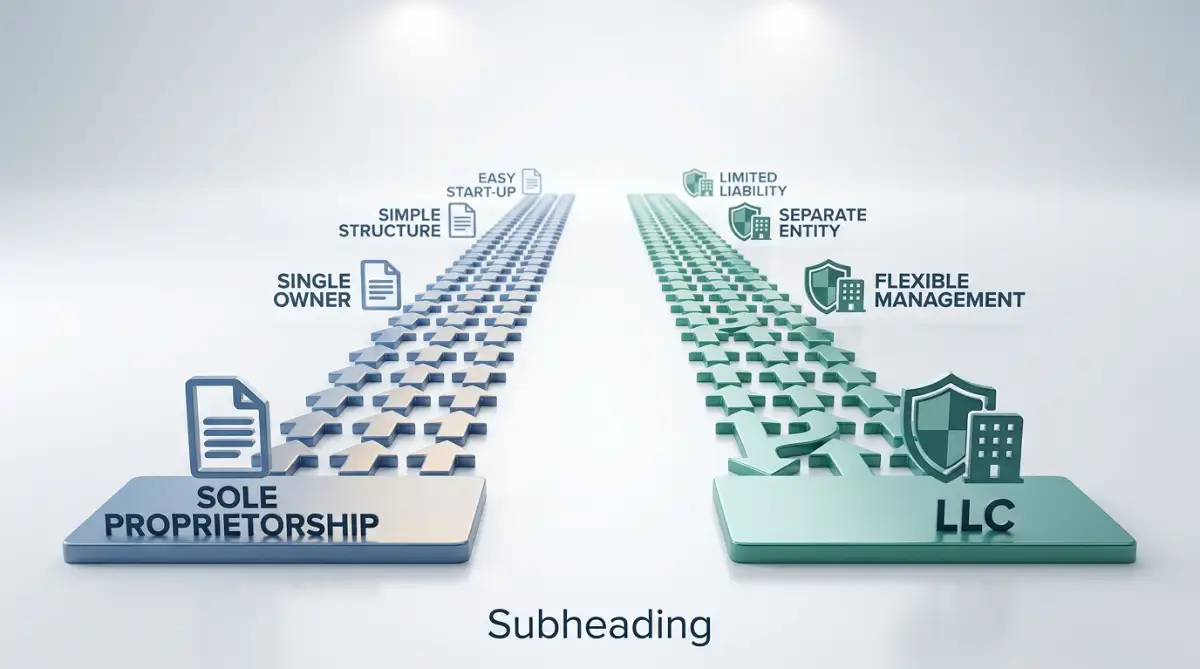
A sole proprietorship is the default business structure. If you start doing paid work without formally registering a business entity, you're automatically a sole proprietor in the eyes of the law and the IRS.
No state filing is required. You may need a business license or a DBA (Doing Business As) registration depending on your city and industry, but there's no separate legal entity created.
You are the business, and the business is you, legally, financially, and taxwise.
That simplicity is a genuine advantage when you're just starting out. But it comes with a cost most people underestimate.
What an LLC Actually Is
An LLC, or Limited Liability Company, is a separate legal entity. When you form one, your state recognizes your business as its own legal "person," distinct from you personally.
This distinction has two main practical effects:
- Your personal assets, like your savings, your car, and your home, are generally protected from business debts and legal claims. A lawsuit against your LLC is a lawsuit against the business, not against you personally.
- For tax purposes, a single-member LLC is typically treated the same as a sole proprietorship by default, meaning the IRS taxes your income directly, not the entity, so there's no double taxation.
An LLC gives you liability protection without adding the full complexity of a corporation. That's why it's become the most popular structure for small businesses, freelancers, and independent professionals.
A Quick Reality Check on LLC Costs (State by State)
Before we jump into our side-by-side comparison, I want to share a crucial detail that many generic guides overlook.
I often hear from folks who read online that starting an LLC only costs $50 to $150. While that is indeed true in states like Kentucky or Colorado, other states play by vastly different financial rules.
For instance, if you are planning to form your LLC in California, you will need to pay an $800 annual franchise tax, regardless of whether your business makes a single dollar of profit that year.
In Massachusetts, the annual report filing fee alone is $500. On the flip side, states like Texas or Ohio have much more budget-friendly maintenance fees.
Because of these massive differences, I highly recommend visiting your specific state's Secretary of State website before making your final decision.
We want to make sure you are not blindsided by unexpected yearly maintenance costs when you are simply trying to protect your hard-earned savings.
This table is meant as a starting point, not a complete legal guide. The right choice always depends on your specific situation.
Three Questions That Tell You Which Structure You Actually Need
Instead of giving you a blanket recommendation, let's work through this the way a business advisor would: by asking the right questions about your specific situation.
Question 1: How Much Personal Financial Risk Are You Comfortable Carrying?
This is the most important question in the entire comparison, and it's the one most people skip.
As a sole proprietor, if a client sues you, if a contract dispute turns legal, or if your business takes on debt it can't repay, your personal finances are exposed.
That means your savings account, your car, your home equity, and anything else in your name is fair game in a legal dispute.
This risk is genuinely low for some types of work. A person who writes blog posts for businesses, teaches online courses, or sells handmade crafts at local markets is unlikely to face a lawsuit that puts personal assets at risk.
But the risk is meaningfully higher in other situations. If you give advice that clients act on (consulting, coaching, financial guidance), provide services where mistakes can cause financial or physical damage (construction, tech development, healthcare-adjacent work),
or sign contracts with businesses that have legal teams, the liability gap between a sole proprietorship and an LLC is worth taking seriously.
A simple analogy: Operating as a sole prop is like driving without a seat belt. Most of the time, nothing goes wrong. But when something does, the absence of that one simple protection becomes very significant, very fast.
Question 2: Are You Testing an Idea, or Running an Established Business?
Here's a practical truth that most comparison guides skip: if you're still in the earliest testing phase of an idea, starting as a sole proprietor is completely reasonable.
Sole proprietorships are essentially free to start, require zero administrative overhead, and let you test whether your idea generates income before investing in formation paperwork. If the idea doesn't work, you simply stop, with no entity to dissolve.
The time to form an LLC is when:
- You have consistent paying clients or customers.
- You're signing contracts with other businesses.
- You're putting real money into the venture (inventory, equipment, software subscriptions).
- You're earning enough that tax planning starts to matter.
- You're starting to worry about what would happen if something went wrong.
That last point is the clearest signal. The day you start thinking about protecting yourself is the day you're ready to form an LLC.
Question 3: Does Your Industry or Client Base Expect a Formal Business Entity?
This point doesn't come up often, but it's worth naming directly: some clients and industries expect to work with a formal business entity, not an individual operating informally.
Large corporations, government agencies, and mid-sized businesses often have procurement policies that require vendors to be registered legal entities.
If you want to work with them, a sole proprietorship can quietly close that door without you ever realizing why the contract didn't go through.
Beyond procurement, there's a credibility factor. A contract from "Jane Smith LLC" reads differently to a client than a contract from "Jane Smith."
The LLC signals that you're serious about your business, that you've done the work to set it up properly, and that there's a formal structure behind what you're delivering.
This isn't a reason to form an LLC on day one if you're still figuring out your business model. But it's a reason to factor in where you want your business to be in the next twelve months before deciding to stay a sole proprietor indefinitely.
Your Quick Decision Matrix: Which Path to Choose?
To make things as simple as possible for you, Iโve put together a quick, text-based roadmap. Think of this as your immediate guide to choosing your direction today:
Choose a Sole Proprietorship If:
- You are in the absolute "testing phase" of a low-risk side hustle (e.g., writing articles, basic graphic design, or selling low-cost crafts).
- You do not have significant personal assets (like a home or large savings account) that you need to protect.
- Your startup budget is virtually zero, and you just want to see if people will pay for your ideas before doing any paperwork.
Transition or Choose an LLC If:
- You are actively signing service contracts with corporate clients or managing client data.
- Your business involves giving professional advice (consulting, financial planning, coaching) where errors could cause financial damage.
- You have accumulated personal savings, a home, or a car that you absolutely cannot afford to risk in a legal dispute.
- Your business is growing, and you want to look established, professional, and ready for bigger contracts.
MYTH vs. REALITY: Common Misconceptions That Keep People From Making the Right Choice
Myth: An LLC means paying higher taxes. Reality: A single-member LLC is taxed exactly like a sole proprietorship by default. You pay self-employment taxes on your net profits either way. The tax treatment is identical unless you actively elect to change it.
Myth: Forming an LLC is complicated and time-consuming. Reality: In most states, forming an LLC takes one online form, a state filing fee, and anywhere from a few hours to a few days for processing. Many states allow same-day filing.
Myth: A sole proprietorship is fine as long as you have insurance. Reality: Business insurance covers many things, but it doesn't cover every type of legal claim. An LLC and proper insurance used together provide stronger protection than either one alone.
Myth: You need a lawyer to form an LLC. Reality: For a simple single-member LLC with no investors, no partners, and standard operations, most people can file through their state's business registration website without legal help. Complex multi-member LLCs or businesses with funding plans are a different story.
Myth: Once you choose, you're stuck. Reality: You can transition from a sole proprietorship to an LLC at any time. There's no deadline, no penalty for switching, and no requirement to restart your business. You simply file the LLC, open a new business bank account, and update your contracts.
What Most Guides Don't Tell You About Running an LLC Properly
Forming an LLC is one decision. Protecting the LLC's legal advantages long-term is a completely different skill, and this is where most new business owners quietly lose the ground they gained at formation.
The three insights below are what separate people who formed an LLC and actually kept it working correctly from those who formed one, ignored it for a year, and ended up just as exposed as they were as sole proprietors.
Keep Your Personal and Business Finances in Completely Separate Accounts
This sounds obvious. In practice, it's the single most commonly violated rule among small LLC owners, and the consequences are serious.
According to the SBA's guide to choosing a business structure, a key element of maintaining limited liability protection is treating your LLC as a genuinely separate financial entity.
When you mix personal and business funds in the same account, courts can disregard your LLC's liability protection entirely through a legal concept called "piercing the corporate veil."
Here's what commingling looks like in practice:
- Paying a personal grocery bill from your business account "just this once"
- Depositing a client payment into your personal checking account because the business account wasn't handy
- Paying yourself by transferring random amounts whenever you need cash, with no record of the transaction
And here's the fix: Open a dedicated business checking account the same week you form your LLC. Every business dollar goes in, every business expense comes out.
Pay yourself on a regular, documented schedule. Keep receipts. This single habit protects the "limited liability" part of your LLC from ever being questioned.
The good news is that most business bank accounts are free or very low cost for single-person operations. There's no real financial barrier to doing this correctly.
Learn the S-Corp Tax Election โ Even If You're Not Ready to Use It Yet
This is the piece of LLC knowledge that most beginners never encounter until an accountant brings it up years later, usually while calculating how much unnecessary self-employment tax they've paid in the meantime.
By default, a single-member LLC pays the same self-employment taxes as a sole proprietor, which means you pay both the employee and employer portions of Social Security and Medicare taxes on your full net profit.
At lower income levels, this is manageable. As your revenue grows, the amount becomes significant.
What many LLC owners eventually discover is that they can elect to have their LLC taxed as an S-Corporation. Under this structure,
you pay yourself a reasonable salary as an employee of your own company, and only that salary is subject to self-employment taxes. Additional profit distributions above that salary are not.
The IRS explains LLC tax election options in detail, and the short version is this: this election doesn't make sense for everyone, particularly at lower income levels where the accounting costs may outweigh the tax savings.
But understanding it exists, and knowing when it becomes worth exploring, is a piece of financial awareness that can save a growing business owner meaningful money over time.
A real-life scenario: A graphic designer earning $40,000 net profit pays self-employment tax on all $40,000 as a single-member LLC. At $120,000 net profit, the math on an S-Corp election starts to shift significantly in her favor.
She doesn't need to act on this right now, but knowing it exists means she won't be surprised when it becomes relevant.
Write an Operating Agreement Even If Your State Doesn't Require One
Most states don't legally require a single-member LLC to have an operating agreement. This has led many solo business owners to skip it entirely, which is a mistake that can become costly in very specific situations.
An LLC operating agreement is an internal document that defines how your business is owned, how decisions are made, how profits are distributed,
and what happens if the business is ever sold, dissolved, or transferred. Even for a one-person operation, this document does three important things:
- It proves to banks, courts, and potential business partners that your LLC is a real, functioning entity, not just a name on a filing.
- It protects your liability shield if your LLC is ever challenged in court.
- It gives you a clear record of your own business intentions, which matters more than most people realize when business situations become complicated.
Keep it simple. A single-member operating agreement for a basic consulting, freelance, or service business doesn't need to be a legal masterpiece.
A clean, one-to-two-page document covering ownership percentage, management authority, profit distribution, and dissolution terms is usually enough to accomplish all three of the goals above.
Keeping Your Business Structure Right as Your Business Grows
The structure that fits your business today may not fit it in two or three years. Here's a simple schedule for reviewing your setup:
- At formation: Open a business bank account, get your EIN from the IRS, create a simple operating agreement.
- Annually: File your state's annual report (if required), check your registered agent details are current, review whether your structure still matches your revenue, team size, and risk profile.
- When things change: Adding a partner, taking on investors, hiring employees, or expanding to new states are all triggers to revisit your structure with a qualified business advisor.
Treating your LLC like a "set and forget" setup is one of the most common reasons people end up with inadequate protection despite having technically formed a business entity.

Q&A: The Business Structure Questions People Are Too Embarrassed to Ask
These are the questions that come up again and again but rarely make it into formal guides, because they sound too basic. They're not basic at all. They're exactly the right questions.
Q: Can I switch from a sole proprietor to an LLC after I've already been running my business?
A: Yes, and there's no penalty for doing it later. You simply file your LLC formation documents, open a new business bank account, and update any contracts or invoices going forward to reflect the new entity name.
Your prior income as a sole proprietor stays on your personal tax return for that year. The switch doesn't erase past work โ it just protects your future work.
Q: Does forming an LLC actually change anything about how I find clients or do my work?
A: Not directly. You still market yourself the same way, deliver work the same way, and get paid the same way. The difference is in the legal layer underneath โ who's responsible if something goes wrong, and how your income flows for tax purposes.
Your clients won't notice a difference, except that your contracts and invoices will now say "Your Business Name LLC" instead of your personal name.
Q: I've been a sole proprietor for two years with no problems. Do I still need to switch?
A: No legal or financial problem showing up in the past doesn't mean the exposure isn't there. It means you've been fortunate. Liability risk doesn't scale with how long you've operated successfully โ it scales with the types of clients, contracts, and services you provide.
The question isn't whether anything has gone wrong yet. It's whether you could afford the consequences if it did.
Q: What's the worst that can actually happen to a sole proprietor if something goes wrong?
A: Because there's no legal separation between you and your business, a judgment against your business is a judgment against you personally. That can mean wage garnishment, liens against personal property, forced sale of assets, and long-term credit damage.
The Investopedia overview of sole proprietorship risks covers this clearly, and the picture it paints is one of the strongest arguments for taking the LLC step seriously.
Q: Is a Delaware or Wyoming LLC better than filing in my home state?
A: For most small business owners who operate locally or online and don't have investors, filing in your home state is almost always simpler and cheaper. The "Delaware advantage" is real for large corporations and venture-backed startups,
but for a solo freelancer or small service business, filing in Delaware and then registering as a foreign LLC in your home state (which you'd likely still need to do) often costs more and adds unnecessary complexity.
The Investopedia breakdown of LLCs explains the state-filing considerations in plain terms.
Q: Do I need a separate business credit card, or is the bank account enough?
A: A dedicated business bank account is the baseline requirement. A business credit card is the next step, and it's worth doing for two reasons: it builds your business credit history separately from your personal credit, and it makes end-of-year tax preparation significantly easier.
If you want to understand how improving your credit score affects your ability to access better business banking and financing tools, that applies to your business credit-building journey as well.
The Do's and Don'ts of Choosing and Maintaining Your Business Structure
DO:
- Choose your structure based on your actual risk profile, not what someone else chose
- Open a business bank account the same week you form your LLC
- File your annual state report on time โ a dissolved LLC offers zero protection
- Update your contracts and invoices to reflect your LLC name once formed
- Review your structure any time your revenue, team size, or service type changes significantly
DON'T:
- Assume your LLC protects you if you're still mixing personal and business finances
- Skip the operating agreement just because your state doesn't legally require it
- Stay a sole proprietor indefinitely because switching "feels complicated"
- Form an LLC in a state you don't operate in just because you heard it was cheaper
- Treat formation as a one-time task with no ongoing maintenance
The Wikipedia overview of limited liability companies is a solid reference for understanding the formal legal foundation of what an LLC is and why the structure matters, if you want to read deeper into the mechanics.
Your 48-Hour Action Plan
You've now read more about LLC vs. sole proprietorship than most people learn in their first two years of running a business. The only thing left is to move from reading to deciding. Here's a concrete, time-boxed plan:
Tonight (or this evening):
- Look up your state's business filing website and check the LLC formation fee and process.
- If you're already a sole proprietor, write down three honest answers: Do you have personal assets worth protecting? Are you signing contracts with clients? Have you ever worried about what would happen if a client took legal action?
Tomorrow:
- If your answers point toward an LLC, begin the filing. Most states process same-day or within 48 hours online.
- If you're still testing an idea with no clients and minimal risk, write a 90-day checkpoint into your calendar to revisit the question once your business has more shape.
- Whether you choose an LLC now or later, tracking your business spending from day one is a habit that pays off at tax time regardless of your structure.
This week:
- Open your business bank account.
- Draft a simple one-page operating agreement (templates are available on the SCORE small business resource library).
- Update any invoices or contracts to reflect your entity name.
The best business structure isn't always the most complex one. It's the one that matches where your business actually is right now, protects what matters most to you, and gives you a clean, confident foundation to grow from.
You already know more than enough to make that call. The only question is when you'll act on it. Building a strong financial foundation for your business has a lot in common with building an emergency fund from scratch โ the best time to start was earlier, and the second-best time is today.
Both the SBA's free business resources and the IRS small business center offer reliable, free guidance if you want to confirm any of the details in this guide before you file. Use them. They're built exactly for this moment.
About the Author:
Kamal Uddin is a small business consultant and financial writer with over a decade of experience helping freelancers, independent contractors, and solo entrepreneurs launch their businesses safely. Kamal specializes in breaking down complex legal and tax frameworks into practical, step-by-step guides. When he isn't helping clients structure their businesses, he writes about financial literacy, budgeting, and legal compliance for modern digital professionals.
Disclaimer:
This article is for general informational and educational purposes only and does not constitute legal, tax, or financial advice. Business structure requirements, tax rules, and liability protections vary by state, business type, and individual circumstances. Always consult a licensed attorney, CPA, or qualified business advisor before making decisions about your business structure or tax elections.