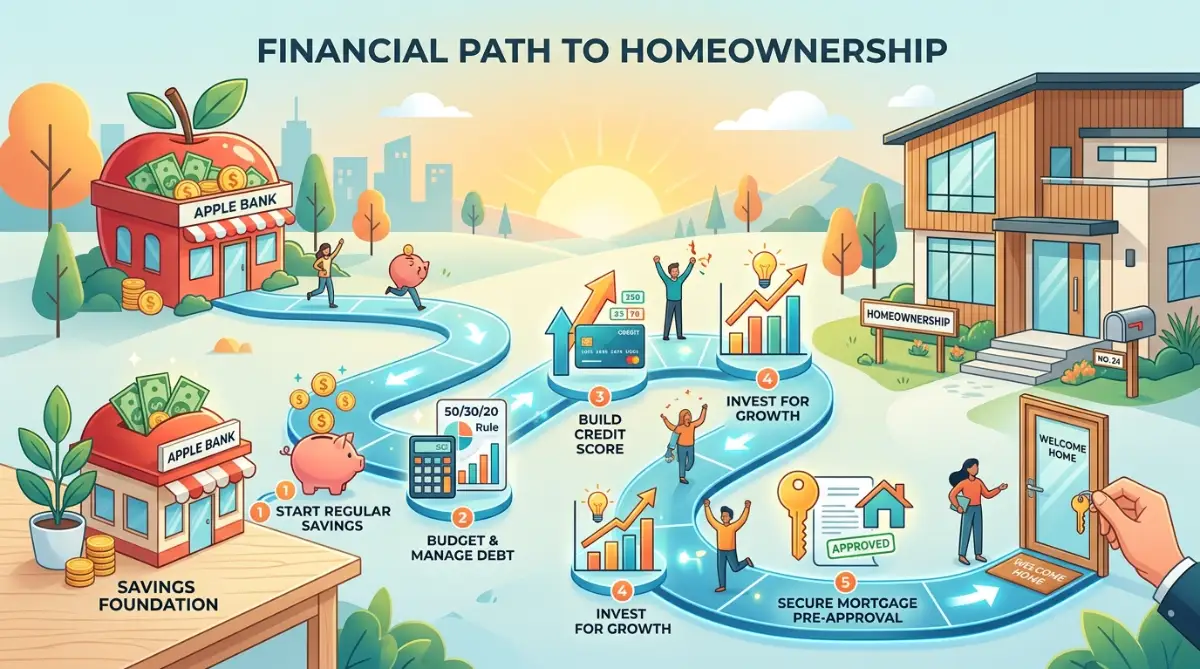
Why Saving for Your First Home Never Seems to Add Up
You check your savings account, and the number barely moved from last month. Meanwhile, home prices in your area keep climbing.
You see friends posting photos of their new front door, and you wonder how they got there first. It's not always because they earned more than you.
Most of the time, it's because they avoided a few simple mistakes that quietly drain a down payment fund without anyone noticing.
Why So Many First-Time Buyers Stay Stuck for Years
A lot of the advice floating around about saving for a home is outdated or just plain wrong.
- Many people assume they need a full 20% down payment, which often isn't true at all
- Down payment savings frequently sit in the same account as everyday spending money, where they slowly get spent
- People save without ever calculating a real, specific target number for their situation
- Rising rent quietly eats into the exact budget that was supposed to go toward saving
- Generic advice like "just save more" never explains the actual mechanics of how to make saving automatic and painless
This combination of bad assumptions and vague advice is why so many first-time buyers feel stuck for years longer than they need to be.
How a Stalled Down Payment Fund Wears on Your Confidence
Watching your savings grow slowly while home prices grow faster isn't just frustrating. It changes how you see your own progress.
- It creates a constant feeling of falling behind, even when you're actually saving consistently
- It makes you compare yourself to others, which chips away at confidence over time
- It can lead to giving up on saving altogether, since the goal feels too far away to bother chasing
- It adds quiet stress to every rent renewal, since rent increases feel like they're stealing your future down payment
- It can push people into rushed decisions, like buying a home before they're financially ready, just to stop the waiting
None of this means you're bad with money. It usually means your saving plan has a few fixable gaps.
What a Slow Down Payment Really Costs You Over Time
Here's the part most people don't think about. While you're saving, home prices and interest rates can move too, and not always in your favor.
Real-life example: If home prices in your area rise by even a modest amount each year, a home that costs $300,000 today could cost noticeably more in just a couple of years. That means your savings target isn't standing still either.
Rent adds another layer to this. If your rent goes up annually, that's less money available to put toward saving every single month, even if your income stays exactly the same.
This is why speed and structure matter just as much as the total amount you save. A focused plan can get you to your goal meaningfully faster than scattered saving ever will, even with the same monthly income.
What It Actually Takes to Build a Down Payment Fund That Works
Building a real down payment fund isn't about saving harder. It's about saving with a system that doesn't rely on willpower alone.
Step 1: Separate Your Down Payment Money From Your Everyday Cash
If your house fund lives in the same account as your grocery money, it will get spent. Not because you're careless, but because that's exactly how shared accounts work.
Open a dedicated savings account just for this goal, ideally one that earns interest. Give it a name like "House Fund" so every time you check your banking app, you see your goal staring back at you.
Practical tip: Treat this account like it's invisible for daily spending. If you have to think twice or transfer money manually to use it, you've already built in a helpful pause.
Step 2: Set a Real Target Number Based on Actual Loan Options
Many first-time buyers stall out simply because they're saving toward the wrong number.
Several loan programs allow down payments far lower than 20%, sometimes as low as 3% to 5% depending on the loan type and your situation. Research the actual options available where you live before assuming you need a massive lump sum.
Real-life example: Saving toward a 20% down payment on a $300,000 home means a $60,000 goal. Saving toward a 5% down payment on that same home means a $15,000 goal, which is a completely different timeline.
Once you know your real number, break it down into a monthly target. A specific number like "$500 a month for 30 months" feels far more achievable than a vague goal like "save as much as possible."
Step 3: Automate Your Savings the Same Day You Get Paid
This is the step that turns saving from a daily decision into something that just happens.
Set up an automatic transfer from your checking account to your house fund for the same day your paycheck lands. This follows a simple idea sometimes called "paying yourself first," where your savings goal gets treated like a non-negotiable bill instead of leftover money at the end of the month.
Behavioral finance research consistently shows that automatic transfers lead to higher savings rates than manual saving, mainly because automation removes the moment-to-moment temptation to spend instead.
Think of it like a gym membership payment that comes out automatically. You don't have to feel motivated every month, because the system handles the habit for you.
Why This Approach Actually Works, Not Just in Theory
Separating your money, setting a real number, and automating the transfer all attack the same problem from different angles: decision fatigue.
Every time you have to manually decide to save, there's a chance life gets in the way and that decision gets skipped. Removing the decision removes the risk.
This is the exact same principle behind how retirement savings plans work so well when contributions come straight out of a paycheck automatically. People save more consistently when saving requires zero ongoing effort.
Your down payment fund can work the same way. Build the structure once, and the system carries the weight from there.
Two Smart Moves That Get You to Closing Day Faster
Once your basic system is running, these next two moves can shave months off your timeline without changing your lifestyle.
Stack Extra Income Streams Without Touching Your Lifestyle
You don't need a second full-time job to speed things up. You just need a rule: any money that wasn't already part of your normal budget goes straight to the house fund.
This includes tax refunds, work bonuses, cash gifts, and money from selling things you no longer use. None of it was part of your regular spending plan anyway, so it won't feel like a sacrifice to redirect it.
Real-life example: A $1,200 tax refund and $300 from selling old furniture adds $1,500 to your fund in a single month, without changing a single thing about your everyday spending.
If you have a skill you can turn into occasional freelance work, even a few hours a month, treat that income the same way. Keep it completely separate from your regular paycheck and send it directly to your savings goal.
Use a High-Yield Account So Your Money Works While You Wait
Where you store your down payment fund matters more than most people realize.
A standard checking account often earns close to nothing in interest. A high-yield savings account can earn meaningfully more, simply for holding the exact same money.
Practical tip: Compare a few accounts before choosing one. Look specifically at the interest rate, any monthly fees, and how quickly you can transfer money out when you're ready to buy.
Over a year or two of saving, that extra interest adds up to real money, essentially free progress toward your goal just for picking the right account type.
How to Protect Your Down Payment Fund Once It's Built
Building the fund is one challenge. Protecting it until closing day is a separate one.
Once your savings start to grow, resist the urge to move that money into something riskier, like stocks, hoping for faster growth. A down payment fund needs to be stable and accessible, not exposed to market swings right when you need it most.
This is different from long-term investing for retirement, where market ups and downs have decades to smooth out. A house fund usually has a shorter timeline, so stability matters more than chasing extra growth.
It also helps to avoid any major purchases or new credit accounts in the months leading up to applying for a mortgage. Lenders look closely at your financial picture right before approval, and unexpected changes can complicate that process.
Think of this stage like training for a race. You don't change your shoes the week before the event. You stick with what's already working until you cross the finish line.
The Most Common Ways People Slow Down Their Own Savings Goal
Even with a solid plan, a few avoidable habits can quietly stretch out your timeline. Here are the ones that trip up first-time buyers most often.
Mistake 1: Opening New Credit Right Before Applying for a Mortgage
Applying for a new credit card or car loan while saving for a home might seem unrelated, but it isn't.
The cost: New credit accounts can affect your debt-to-income ratio and credit score right when a lender is reviewing your application, sometimes resulting in a higher interest rate or a delayed approval.
Mistake 2: Keeping the Fund in Risky Investments
Putting down payment savings into stocks or other volatile investments can feel like a smart way to grow your money faster.
The cost: If the market dips right before you're ready to buy, your fund can shrink at the exact moment you need it to be stable, pushing your home purchase further away instead of closer.
Mistake 3: Forgetting About Closing Costs and Moving Expenses
Many first-time buyers save only toward the down payment itself and forget everything else that comes with buying a home.
The cost: Closing costs alone can add up to a noticeable percentage of the home price, and moving expenses or immediate repairs add even more. Without planning for this, buyers can find themselves short on cash right at the finish line.
Mistake 4: Withdrawing From Retirement Accounts Without Understanding the Rules
Pulling money from a retirement account to speed up a down payment can come with penalties, taxes, or both, depending on the account type and your age.
The cost: What looks like extra down payment money on paper can shrink significantly once penalties and taxes are taken out, and it also sets back your long-term retirement progress.
Mistake 5: Receiving Gift Money Without the Right Paperwork
If family or friends are helping with your down payment, lenders typically require a formal gift letter confirming the money is a gift, not a loan you owe back.
The cost: Showing up to closing with undocumented gift funds can delay or even derail your mortgage approval, since lenders need to verify exactly where every dollar of your down payment came from.
Your Down Payment Goal Is Closer Than It Feels
Saving for your first home was never about being perfect with money. It's about avoiding a handful of avoidable slip-ups and letting a simple system do the heavy lifting.
You now know how to separate your fund, set a realistic target, automate your saving, and protect that money until closing day. You also know the mistakes that quietly add months, or even years, to other people's timelines.
None of this requires a six-figure income or a perfect credit score. It requires a plan, a little consistency, and the choice to start today instead of waiting for the "right" moment.
Open that dedicated savings account this week, even if you can only put in a small amount at first. The habit matters more than the starting number.
That one small step is how every first-time homeowner's story actually begins.