Five years ago, I walked into a health store and handed over 60 USD for a shiny black bottle labeled "Extreme Fat Melter." The front showed shredded abs and promised to melt belly fat in ten days flat. Two hours after taking my first pill, my hands were shaking so hard I could barely type on my keyboard, and my heart was pounding like a drum. The worst part? After three weeks of feeling miserable, I had not lost a single pound.
That painful wake-up call taught me a hard lesson: supplement companies spend millions on flashy front labels to play with our hopes, while hiding cheap, useless, or even dangerous junk on the back. When you flip the bottle around, the tiny text feels like reading an alien language. But once you know what three or four basic numbers mean, you can spot a scam in under ten seconds. Let me show you exactly how to read these bottles so you never throw your hard-earned money away again.
⚡ 60-Second Smart Shopper Cheat Sheet
Your Simple Guide to Understanding the Supplement Facts Panel
You do not need to be a doctor or a chemist to understand what you are putting in your body. We are going to break down the label into easy, bite-sized parts so you can shop with confidence.
Let us look at the exact steps you can take today to become a smart and safe shopper.
1. Start with the Serving Size and Servings Per Container
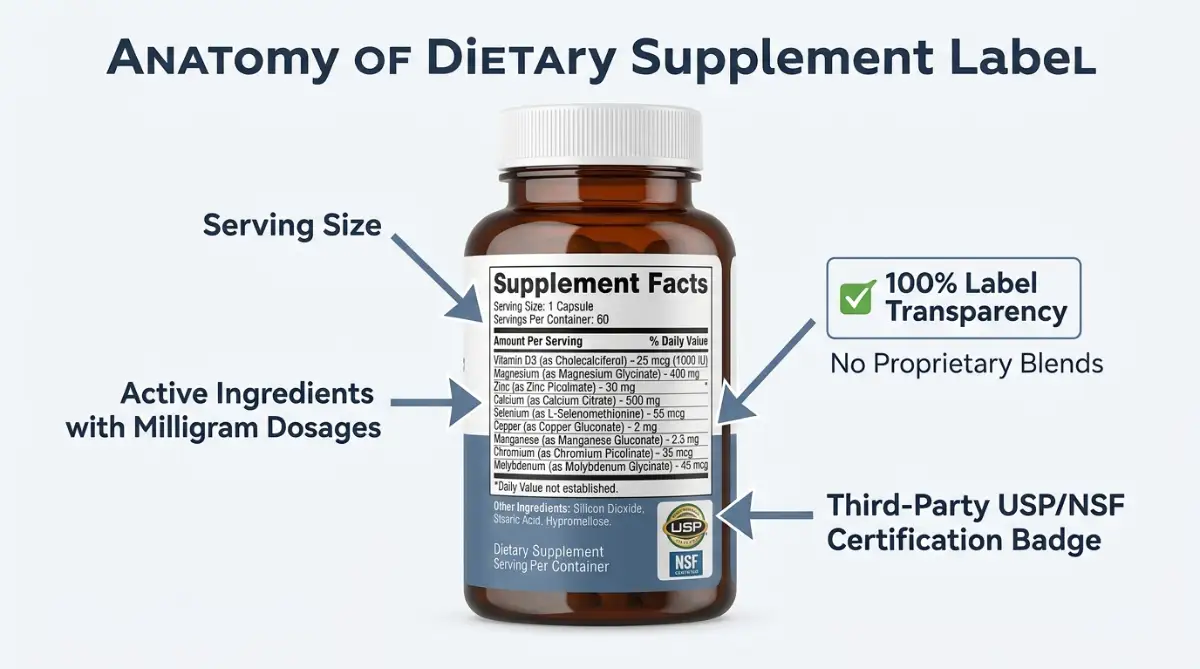
The very first thing you must check is the serving size listed at the top of the panel. This is the foundation of the entire label.
Many people make the mistake of looking at the ingredient amounts without checking how many pills they need to swallow to get that dose.
For example, a bottle might say it has 500 milligrams of a helpful herb. But when you look closely, you realize that is the amount for a serving size of four large capsules.
If you only take one capsule, you are getting only a fraction of the ingredient.
Also, look at the servings per container to see how long the bottle will actually last.
Imagine you buy a bottle with 60 capsules, thinking it will last you two whole months.
If the serving size is four capsules a day, that bottle will actually be completely empty in just fifteen days.
Always calculate the daily cost based on the serving size, not just the price of the bottle. This simple habit will save you from spending more money than you planned.
💡 Real-Life Shopper Case Study: The "Cheap Bottle" Math Trap
The Situation: My client Sarah found two competing green tea supplements on the shelf.
• Brand A: Costs 18 USD with 60 capsules on the front.
• Brand B: Costs 32 USD with 60 capsules on the front.
The Hidden Label Truth:
• When Sarah checked the back of Brand A, the serving size was 4 capsules per day to get 300 mg of extract. That bottle only lasted 15 days, costing her 1.20 USD per day (36 USD per month).
• Brand B used a concentrated 50% EGCG extract with a serving size of just 1 capsule per day. That single bottle lasted 60 full days, costing only 0.53 USD per day (16 USD per month).
The Takeaway: Brand A looked half the price on the shelf, but it was actually more than twice as expensive per day! Always calculate the price per single serving before heading to the register.
2. Check the Active Ingredients and Their Exact Dosages
Active ingredients are the substances in the product that actually do the work to help you. These are the ingredients that are supposed to help support your metabolism or energy levels.
When you look at this section, you need to see exactly how many milligrams or micrograms of each active ingredient are in one serving.
This is where you must compare the label to actual scientific studies.
For example, if you are looking at green tea extract, studies show it is often most effective at certain daily amounts.
If your supplement only contains a tiny fraction of that amount, it likely will not do anything for you.
Myth vs. Reality on Active Ingredients
Let us look at a common belief that many shoppers have when buying these products.
- Myth: A supplement with thirty different active ingredients is much better than one with only three or four.
- Topic Reality: Often, products with too many ingredients have tiny, useless amounts of each one. A simple product with a few fully - dosed ingredients is usually much safer and more effective.
To give you a real-world example, let’s talk about Green Tea Extract (specifically its active compound, EGCG) and Caffeine.
When I search through clinical trials on PubMed, I find that green tea extract is usually effective for mild metabolic support at doses around 250 to 500 mg of EGCG per day.
If a bottle only gives you a tiny 20 mg per serving, you are essentially paying for an expensive placebo.
On the flip side, we know caffeine is a decent thermogenic, but daily doses above 400 mg can trigger serious jitters and heart racing.
When you compare these proven numbers to what's actually on the label, you can spot a useless or dangerous product in seconds.
By focusing on a few well-studied ingredients, you keep your body safe from unnecessary chemical mixes.

3. Unmask the Mystery of "Proprietary Blends"
Here is a mistake I made for years: I used to assume that if a product had twenty different ingredients listed, it was automatically high quality. I learned the hard way that companies often use tiny, useless amounts of each ingredient just to put them on the label. Always stick to products that show the exact milligram amounts for every single active compound.
This is one of the most important parts of reading a supplement label correctly.
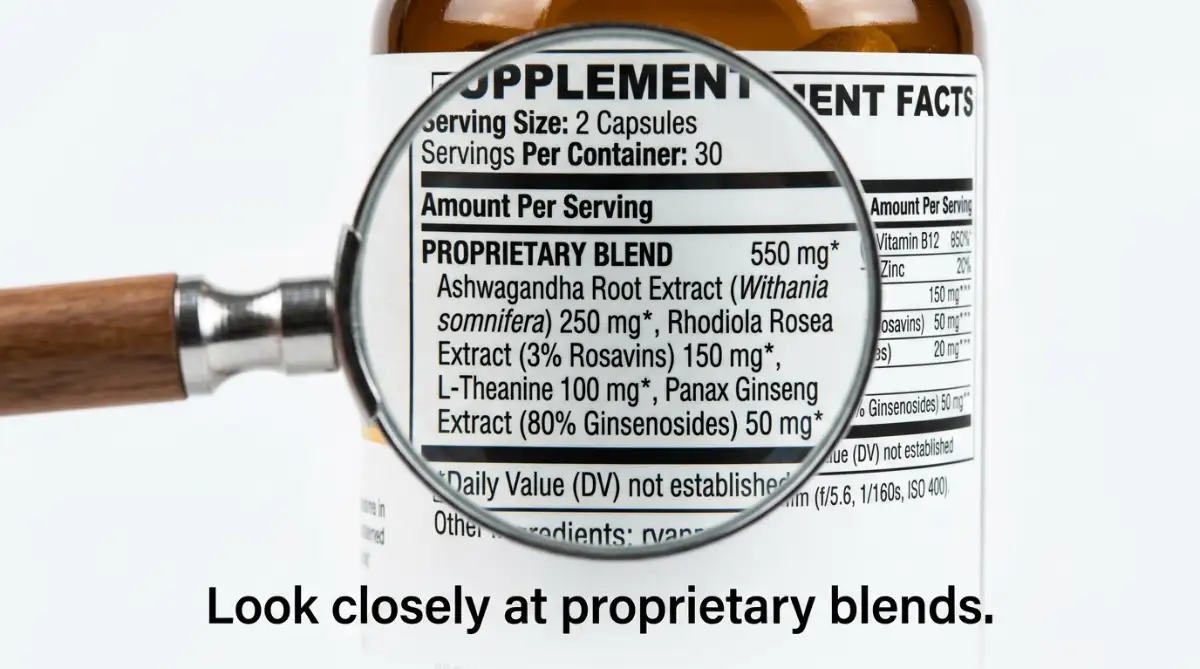
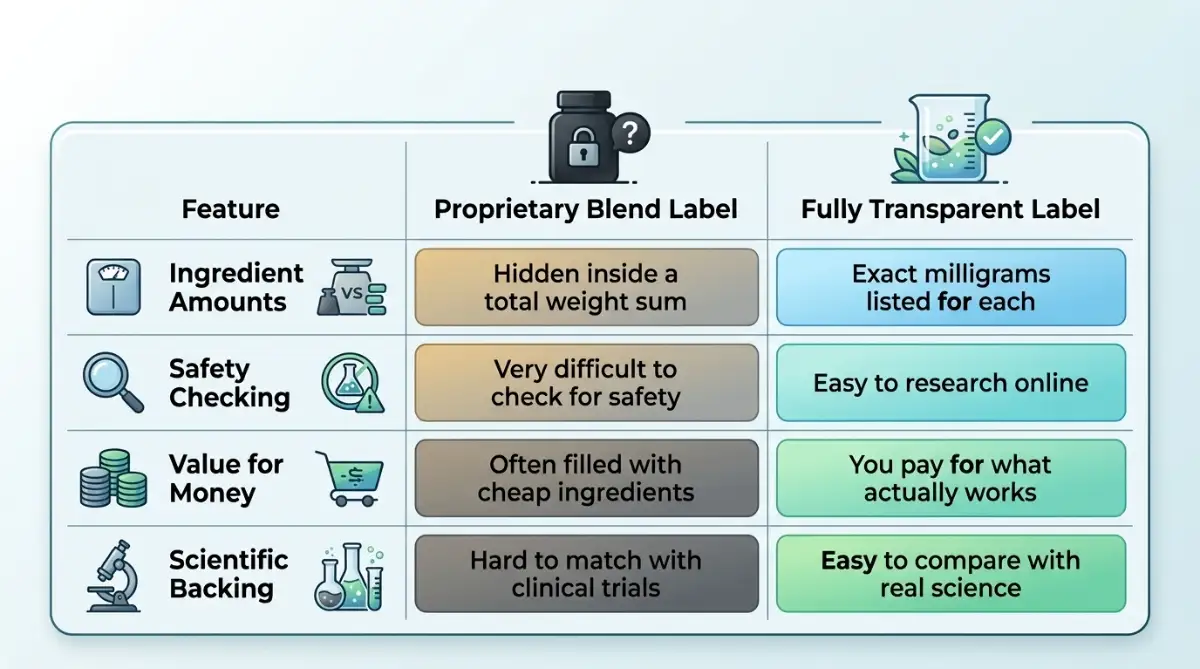
A "proprietary blend" is the oldest trick in the supplement playbook. A brand takes five or six ingredients, clumps them together under a fancy name like "Ultra Lean Matrix," and only lists the total weight (say, 1,000 mg). They claim this protects their trade secret from copycats. But here is what really happens: they load up 980 mg of dirt-cheap caffeine powder and add a 20 mg pinch of expensive green tea extract just so they can brag about it on the front. In the industry, we call this "fairy dusting." If a company refuses to show you the exact milligrams for every single ingredient, walk away. You deserve to know what you are putting in your body.
4. Scan the "Other Ingredients" Section for Fillers
Below the main facts panel, you will see a smaller section labeled other ingredients.
This is where the manufacturer lists the ingredients that are not active, such as binders, colorings, flavorings, and preservatives.
Some of these are necessary to hold the pill together or keep it from spoiling too quickly.
However, you should look closely to make sure you are not consuming things you want to avoid.
Common inactive ingredients include:
- Magnesium stearate: This is just a harmless flow agent that manufacturers use so that raw ingredients don't stick to the big machinery during processing.
- Silicon dioxide: Think of this as a safe anti-caking agent that keeps moisture away so your powders don't clump up into solid bricks inside the capsules.
- Gelatin: We use this to make the outer capsule shell, which is incredibly important for you to spot if you are trying to stay vegetarian or vegan.
- Microcrystalline cellulose: Simply put, this is a wood pulp derivative that we use as a safe filler to pack out the remaining space in a capsule.
- Artificial colors and dyes: These serve absolutely no health purpose and are used purely to make the pills look pretty, which I suggest avoiding if you have sensitive skin, allergies, or food sensitivities.
If you have allergies or dietary restrictions, this is the most critical section of the label to read.
Some products use wheat, soy, or dairy as fillers, which can cause real issues if your body cannot tolerate them.
A clean supplement should have a very short list of other ingredients.
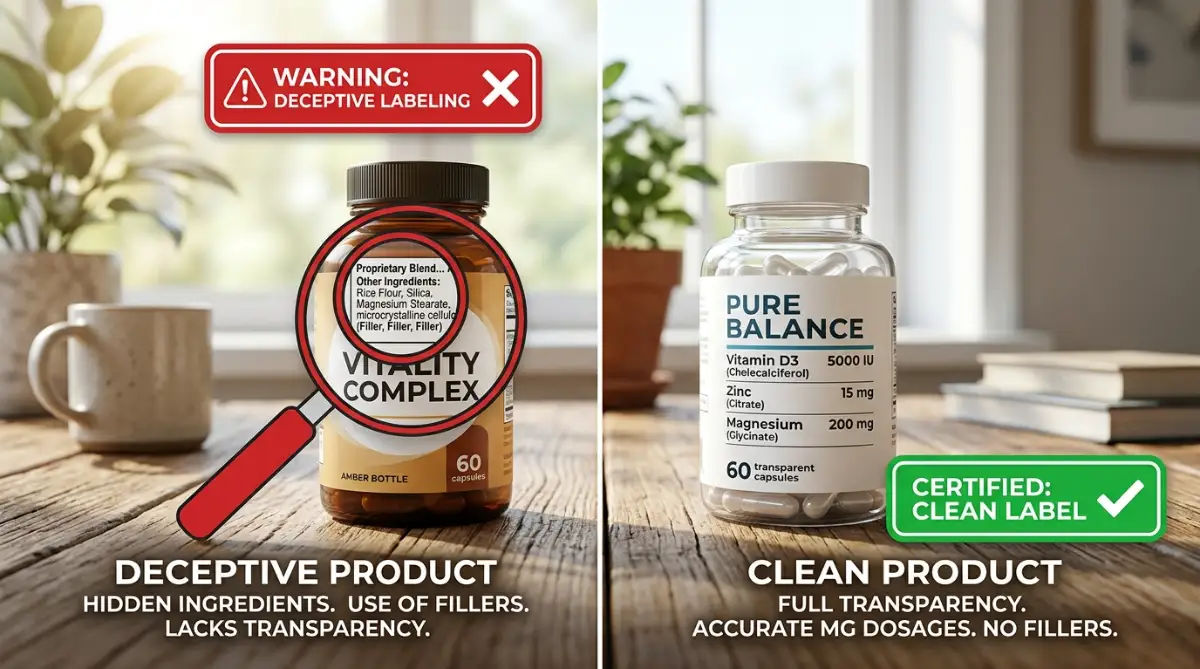
5. Decode the Daily Value Percentage (% DV)
The Percent Daily Value (% DV) column tells you how much of a nutrient one serving of the supplement adds to your daily diet.
These percentages are based on a standard daily diet of two thousand calories.
If a label says a vitamin has a 100% Daily Value, it means one serving gives you all of that vitamin you need for the day.
Be highly careful with ingredients that show extremely high percentages, like 5000% of your daily limit.
While some water-soluble vitamins are safe in high amounts because your body flushes out the extra, others can build up in your system and cause harm.
You will also see an asterisk (*) next to many weight loss ingredients with the note "Daily Value not established."
This simply means that there is no official daily recommended amount set by health agencies for that specific herb or compound.
It does not mean the ingredient is bad, but it does mean you need to do your own research to find a safe amount.
6. Spot the Red Flags in Weight Loss Supplements
Want to see how science actually ranks common dietary supplements and fat burners? Watch this detailed guide by evidence-based experts to help you spot scams and pick what really works before reading the rest of our safety tips below!
When you are looking for a weight loss aid, you must watch out for ingredients that could cause unwanted side effects.
Many weight loss supplements rely heavily on strong stimulants to temporarily boost your energy and suppress your appetite.
While a little caffeine is fine for most people, excessive amounts can cause shaking, anxiety, and heart issues.
Look out for these common stimulant-heavy ingredients on the label:
- Caffeine anhydrous: A highly concentrated powder form of caffeine that is absorbed very quickly by the body.
- Yohimbine: An active compound from tree bark that can cause jitters and high blood pressure in sensitive individuals.
- Synephrine (Bitter Orange): A stimulant that is structurally similar to older, banned substances and can put stress on your heart.
- Guarana: A plant seed extract that contains high levels of natural caffeine, which adds to the total stimulant count.
If you see several of these stimulants grouped together, especially in a proprietary blend, be very careful.
Your body might react strongly to the combined stimulant effect, leading to a crash later in the day.
7. Search for Independent Testing and Quality Stamps
Here is a scary truth most people do not know: the FDA does not test or approve dietary supplements before they hit store shelves. A company can mix powders in a warehouse, slap a label on a bottle, and sell it tomorrow. That is why I never buy a bottle unless it carries a third-party testing seal. Independent labs like USP (United States Pharmacopeia) and NSF International test random batches off store shelves. They verify that the bottle actually contains what the label claims and test for dangerous heavy metals like lead and arsenic. If you do not see a USP, NSF, or ConsumerLab badge on the bottle, you are taking a blind gamble with your health.
8. Use Free Scientific Databases to Verify Claims
When a label makes a claim that sounds too good to be true, you can easily check the facts yourself using free online resources.
You do not have to trust the marketing team of the supplement company.
Instead, look up the active ingredients on scientific websites designed for the public.
The National Institutes of Health (NIH) Office of Dietary Supplements has a free database with simple fact sheets for consumers.
You can search for almost any herb, vitamin, or mineral to see what the scientific consensus actually says about its safety and effectiveness.
Another great resource is PubMed, where you can search for human clinical trials on specific ingredients.
If you search for an ingredient and find only studies done on mice, or no studies at all, you should probably keep your money in your pocket.
Being an informed buyer is your greatest shield against empty promises and wasted money.
Practical Scenario: Reading a Real Label
Let us put this knowledge into action with a quick imaginary scenario.
Imagine you are holding a bottle of "Super Fat Burner Extreme."
The front of the bottle says "Burn fat fast with natural green tea!"
You turn the bottle around to look at the facts panel:
- Serving Size: 3 Capsules
- Servings Per Container: 10
- Proprietary Fat Burning Blend (Total Weight 1500mg): Caffeine anhydrous, Green tea extract, Cayenne pepper powder, L-theanine.
- Other Ingredients: Gelatin, FD&C Red No. 40, Magnesium stearate.
Let us analyze what is actually happening with this label:
To start, we should calculate the servings per container. With only ten servings in this entire bottle, you are looking at buying three separate bottles just to get through a single month.
Next, let's look closer at that proprietary blend. Because the dosages are hidden under a single total weight, you have zero idea how much actual green tea extract you are getting.
Since caffeine anhydrous is listed first, it is the most dominant ingredient in the mix.
This means you might be paying a premium price for what is mostly cheap caffeine powder with just a tiny, useless pinch of green tea.
Finally, don't forget to scan the 'Other Ingredients' section. This particular formula uses gelatin, which makes it a no-go for vegetarians.
It also contains an artificial dye (Red No. 40) that serves absolutely no purpose for your health.
Pro Tip: Keep an Ingredient Journal
When you start taking a new supplement, it can be incredibly helpful to keep a small journal on your phone or in a notebook.
Write down the name of the product, the active ingredients, and the exact dosage you are taking.
Over the next few weeks, jot down how you feel throughout the day.
Are you feeling more energetic, or are you feeling anxious and having trouble sleeping?
Did your digestion change after starting the new routine?
If you experience any negative side effects, you can look at your journal to see which ingredients might be causing the issue.
This simple practice helps you connect the dots between what is written on the label and how your body actually responds in real life. If you want to track your workout and nutrition habits alongside your supplements, check out our guide to tracking your daily health and fitness.
Mastering the Fine Print: Advanced Label Secrets
Now that you know the basic layout of a facts panel, we can look at the deeper secrets that separate cheap formulas from high-quality products.
Understanding these advanced details will keep you from throwing your money away on ineffective options.
The Hidden Difference in Chemical Forms
Pay close attention to the small chemical names printed in parentheses next to each ingredient. Cheap brands love using low-grade forms because they cost pennies to make. Take magnesium as an everyday example: cheap bottles use magnesium oxide, which has an absorption rate below 5% and often causes severe stomach cramps and diarrhea. High-grade brands use magnesium glycinate or magnesium citrate, which your gut absorbs smoothly. The same rule applies to weight loss compounds: always check the tiny letters in parentheses. If a label simply says "Zinc" or "Magnesium" without stating the exact compound type, they are cutting corners.
Understanding Extract Ratios versus Raw Powders
Another secret that premium brands use is standardized plant extracts instead of simple raw plant powders.
When a brand uses a raw herb powder, they simply grind up the leaf or root of a plant and put it in a capsule.
While this sounds natural, the actual active compounds in that plant can vary wildly depending on the soil, weather, and harvest time.
You might get a capsule that is very weak, or one that is unexpectedly strong.
To solve this problem, high-quality manufacturers use standardized extracts to guarantee a consistent dose every single time.
You will see this on the label written as an extract ratio, such as "10:1 extract."
This ratio means that ten grams of the raw plant were concentrated down into one gram of highly potent powder.
This process makes the ingredient much stronger than simple raw powder, meaning you need to swallow fewer capsules to get results.
Standardization also guarantees that a specific percentage of the active compound is present in every batch.
For instance, a label might show that a green tea extract is standardized to contain 50% EGCG, which is the specific antioxidant that supports health.
If you only see raw, unstandardized powders on the label, you cannot be sure of the strength or quality of the product.
Decoding Specialized Dietary Fiber Sources
Many premium weight loss products include various types of dietary fibers to help you feel full and satisfied between meals.
However, not all fibers are created equal, and some can cause gas or bloating if they are not the right fit for your system.
You want to look for soluble fibers like glucomannan, inulin, or psyllium husk on the label.
To understand how these ingredients expand in your stomach to help you eat less, you can explore these science-backed fiber options for controlling hunger to see what actually works.
Choosing the right type of fiber ensures you get the benefit of appetite support without the unwanted digestive discomfort.
Always drink plenty of water when taking any supplement that contains high amounts of dietary fiber to help it move smoothly through your system.
How to Build a Long-Term Strategy for Supplement Safety
Getting great results from your wellness routine is not just about what you take today, but how you manage your health over time.
Your body is highly adaptable, which means it can get used to certain ingredients if you take them every day without a break.
This is especially true for herbal ingredients and stimulants like caffeine or green tea extract.
Over time, you might find that you need to take more of the product to feel the same effects you did during the first week.
To prevent this build-up, many fitness experts recommend a practice called cycling.
Cycling means you take the supplement for a set period, such as four to six weeks, and then take a complete break for one to two weeks.
This break allows your body to reset its natural balance so the ingredients can work effectively again when you restart.
It also reduces the strain on your organs; you can read our guide on how your liver and kidneys really work to process waste to understand why taking regular supplement breaks is so important for your body.
Always listen to your body during your breaks and pay attention to how your natural energy levels recover.
Keeping a simple calendar reminder to start and stop your cycles is an excellent way to maintain your health safely.

Dangerous Missteps to Watch Out for on Your Journey
Even with the best intentions, it is easy to make simple errors when buying and using weight loss aids.
Let us look at some common scenarios that can lead to wasted money, disappointment, or health issues.
The Danger of Combining Multiple Stimulant Products
We have all had those chaotic days where we feel we need an extra push to get through a workout.
I remember talking to a client of mine who was struggling with severe heart palpitations and anxiety during her afternoon gym sessions.
When we looked at her daily routine, we realized she was drinking a strong morning coffee, taking a 'thermogenic' weight loss pill at lunch, and then sipping a pre-workout powder on her way to the gym.
Without even realizing it, she was stacking multiple stimulants and consuming over 600 mg of caffeine in just a few hours.
That is way above the safe daily limit. When we read supplement labels, we have to calculate our total stimulant intake from all sources—including our favorite coffee or tea.
If your weight loss pill is already packed with stimulants, I highly recommend cutting back on your daily cups of joe to protect your heart.
Falling for the "All-Natural" Marketing Trap
Many shoppers believe that if an ingredient comes from a plant, it must be completely safe to use in any amount.
This is a dangerous misunderstanding that can lead to severe health consequences.
Nature produces many incredibly strong compounds, and some of them can put a heavy strain on your internal organs.
For example, certain natural herbs used in weight loss products have been linked to liver irritation when taken in high doses.
Just because an ingredient is grown in the ground does not mean your body can handle unlimited amounts of it.
Always respect the recommended serving sizes on the package, even if the product claims to be 100% natural and organic.
Your liver has to filter everything you swallow, so treating natural ingredients with the same care as medicine is highly important.
Letting the Price Tag Guide Your Quality Beliefs
It is easy to assume that a bottle costing eighty dollars must work better than a bottle costing twenty dollars.
However, in the health and wellness industry, high prices are often just a result of expensive marketing campaigns and fancy packaging.
A company might spend millions of dollars paying celebrities to post about their product, and then raise the price of the bottle to cover those costs.
Conversely, some excellent, transparent brands offer high-quality, third-party tested ingredients for a very reasonable price.
Never judge a product by its price tag or the beauty of its bottle design.
Instead, turn the bottle around and let the facts panel do the talking.
If the ingredient dosages do not match up with real scientific studies, the product is not worth your money, no matter how expensive it is.
Substituting Real Food with Dietary Pills
Another common error is relying on capsules to do the hard work of a healthy diet and lifestyle.
Some people believe they can eat whatever they want as long as they take a fat-burning pill before their meals.
This approach will always lead to disappointment because supplements are designed to assist your efforts, not replace them.
Think of your diet and exercise routine as the engine of a car, and supplements as the polish on the hood.
If the engine does not work, polishing the hood will not help the car move down the road.
Focus on building a solid foundation of whole foods, regular physical movement, and quality sleep first.
Once those daily habits are solid, you can use carefully selected supplements to support your hard work.
Neglecting to Consult with a Healthcare Professional
Many people feel embarrassed to tell their doctor that they are taking or planning to take a weight loss aid.
This mistake can be highly dangerous, especially if you are already taking prescription medications for other health conditions.
Many active herbs can change how your body processes your prescription medicines, making them either too strong or completely useless.
For example, certain natural ingredients can interact with blood pressure medications, thyroid treatments, or depression medicines.
Your doctor has access to professional databases that can instantly check for these dangerous interactions.
To protect your health, you can also review the official dietary supplement advice provided by government health agencies to stay informed.
Always bring your supplement bottles with you to your next doctor appointment so they can look at the labels for you.
A simple five-minute conversation with a medical expert can save you from a major health crisis.
Frequently Asked Questions (FAQ)
1. Does the FDA approve weight loss supplements before they are sold?
No. Under U.S. law, dietary supplements do not require FDA safety approval before hitting the market. The FDA only steps in after a product reaches stores if consumers report severe illness or if an unlisted drug is found in the mix. That is why checking for independent third-party certifications like USP or NSF is your best safety step.
2. How much caffeine is considered safe in a fat burner?
Most medical guidelines suggest a maximum daily limit of 400 mg of caffeine from all sources combined for healthy adults. A single serving of a weight loss pill should ideally stay under 200 mg. Remember to factor in your morning coffee and pre-workout drinks to avoid dangerous heart racing or sleep disruption.
3. What does "Standardized Extract" mean on an herbal label?
A standardized extract guarantees that a specific percentage of the active compound is present in every single pill. For example, "Green Tea Extract standardized to 50% EGCG" means you get exact, proven levels of the active antioxidant rather than random crushed tea leaves with unpredictable strength.
4. Why do many supplement labels say "Daily Value (% DV) Not Established"?
This simply means that health authorities have not set an official daily nutrient requirement for that specific herb or plant extract (such as ashwagandha or cayenne pepper). It does not mean the ingredient is unsafe, but it means you must verify the clinically studied dose on your own.
5. Are "All-Natural" weight loss supplements always safe?
No. "Natural" does not mean harmless. Natural stimulants like bitter orange (synephrine) and high-dose green tea extracts can put stress on your liver, raise blood pressure, and interact with prescription medications. Always follow the exact serving size and consult your doctor before starting any new herbal product.
Your Personal Blueprint for Daily Shopping Success
To help you put this knowledge into action immediately, we have created a simple plan you can use the next time you go shopping.
You can save this checklist on your phone to keep yourself on track and avoid impulse purchases.
Your Next Store Visit Action Plan
- Step 1: The Front Label Ignore Rule
- When you pick up a bottle, ignore the big words, pictures of fit models, and exciting promises on the front.
- Turn the bottle around immediately to look at the actual facts panel on the back.
- Step 2: The Serving Size Verification
- Find the serving size and calculate how many pills you must swallow each day.
- Check how many days the bottle will last to make sure it fits your monthly budget.
- Step 3: The Blend and Fillers Scan
- Look for proprietary blends and see if they hide the actual ingredient dosages.
- Scan the "other ingredients" list to identify any artificial colors, common allergens, or unnecessary fillers.
- Step 4: The Quality Certification Check
- Look for trusted third-party testing stamps like USP, NSF, or GMP on the packaging.
- If you do not see a quality stamp, search the brand's website to see if they share their testing reports publicly.
A Final Message of Support for Your Wellness Journey
Taking control of your health can feel overwhelming at times, especially with so much conflicting information out there.
But by learning how to read ingredient labels, you are taking a massive step toward becoming an empowered and safe shopper.
You no longer have to rely on guesswork, flashy advertisements, or the opinions of online influencers.
You now have the knowledge and the tools to look inside any bottle and see the absolute truth for yourself.
Remember that your body is unique, and what works for someone else might not be the right choice for you.
Be patient with yourself, focus on building sustainable habits, and treat your body with the respect and care it deserves.
You have the power to make smart, informed decisions that support your long-term health, starting with the very next label you read.
About the Author: Kamal Uddin
I am a certified nutrition writer and wellness advocate with over eight years of experience helping people make sense of the confusing world of dietary supplements.
My mission is simple: to cut through the marketing noise, expose hidden fillers, and give you the science-backed truth so you can make safe and informed decisions for your health.
When I am not decoding supplement panels, you will find me researching clinical studies on PubMed or coaching clients on sustainable lifestyle habits.
You now hold the exact knowledge needed to see right through fancy labels and deceptive marketing claims. Take this new skill with you on your very next shopping trip and make safe, confident choices for your body. Your health is worth every second you spend checking the facts!
Disclaimer:
The information provided in this article is for educational and informational purposes only and should not be considered medical advice. Dietary supplements are not intended to diagnose, treat, cure, or prevent any disease. Always consult with a qualified healthcare professional or your primary care doctor before starting any new supplement routine, especially if you have pre-existing health conditions, are taking prescription medications, or are pregnant or nursing. Individual results may vary, and supplements should always be used in conjunction with a healthy diet and regular physical exercise.