Why Word Lists Fail You (And What I Learned the Hard Way)
Three years ago, I bought three thick, colorful notebooks and promised myself I would master Spanish. Every single evening after work, I sat at my desk and hand-wrote 40 new words over and over until my fingers cramped up. I honestly believed that filling pages meant I was building a sharp memory.
Then came my first real test. I walked into a small bakery in Madrid to order breakfast, and my brain went completely blank. I could not pull up the simple word for "fork" or "napkin." I stood there stuttering like a deer in headlights while the line grew behind me.
That awkward moment made me feel like quitting language learning forever. But the problem was not my brain or my talent. The real issue was that I was using an outdated, broken study method. Once I discovered how human memory actually locks in fresh words, everything turned around. Here is the exact system that finally fixed my memory leak.
You sit across from native speakers or open a foreign film, and the sudden hesitation sets in. You freeze because the word you studied yesterday is sitting on the tip of your tongue, completely locked away.
Every failed conversation feels like a personal defeat, turning what should be a joyful journey into an exhausting chore. Your study sessions begin to feel like punishment rather than progress.
When you invest endless hours only to get zero results, your enthusiasm quickly dies out. You begin to dread opening your textbook because you know the review session will only remind you of what you forgot.
That constant frustration robs you of your peace of mind and makes fluency seem like an impossible dream. But the truth is simple: your brain is not broken; your study method is just outdated.
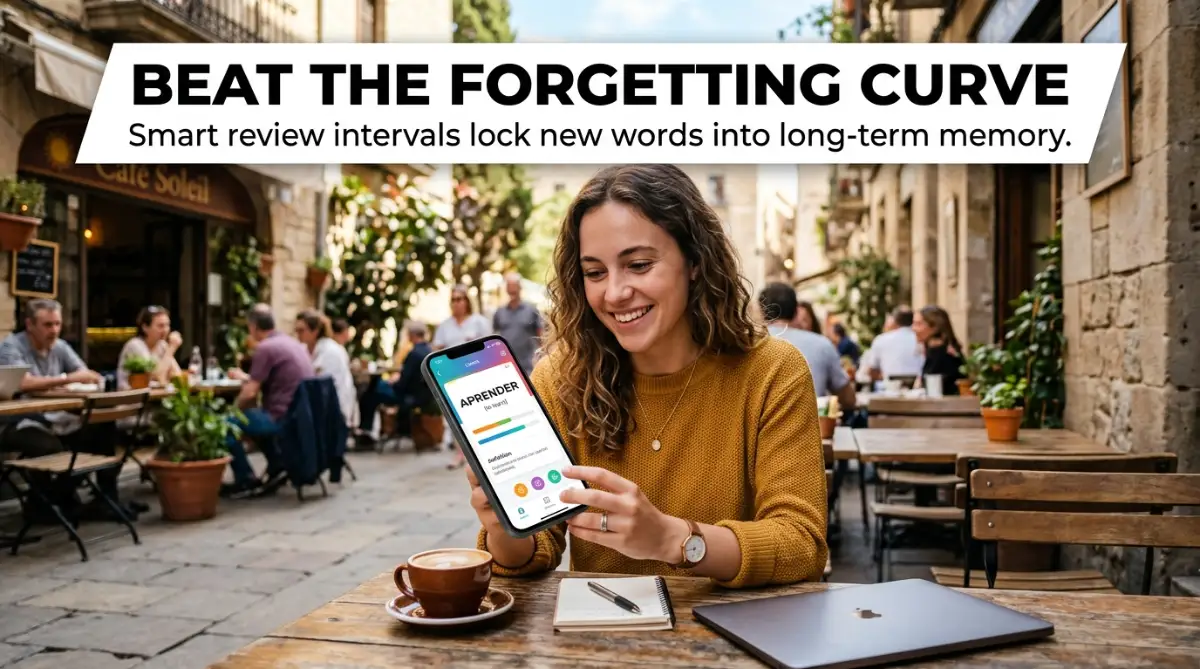
⚡ Quick Takeaways: Why Smart Spaced Practice Wins
- Rote cramming erases fast: Your brain deletes up to 70% of new vocabulary within 24 hours if you don't test yourself at the right moment.
- Active recall beats passive reading: Forcing your mind to pull up a word creates far stronger connections than re-reading notes 20 times.
- Keep flashcards tiny: Simple "atomic" cards with one word, one clear picture, and short audio prevent mental overload.
- 15 minutes daily is plenty: Reviewing 10 to 15 targeted words every morning produces better results than an exhausting 3-hour weekend cram session.
The Brain Science Behind Why You Forget Words So Fast
Your brain is designed to forget information that it thinks you do not need. This survival mechanism keeps your mind clean and stops you from getting overwhelmed by useless daily details.
When you learn a new foreign word once, your brain marks it as temporary data. If you do not test your mind on that word again soon, your brain simply deletes it.
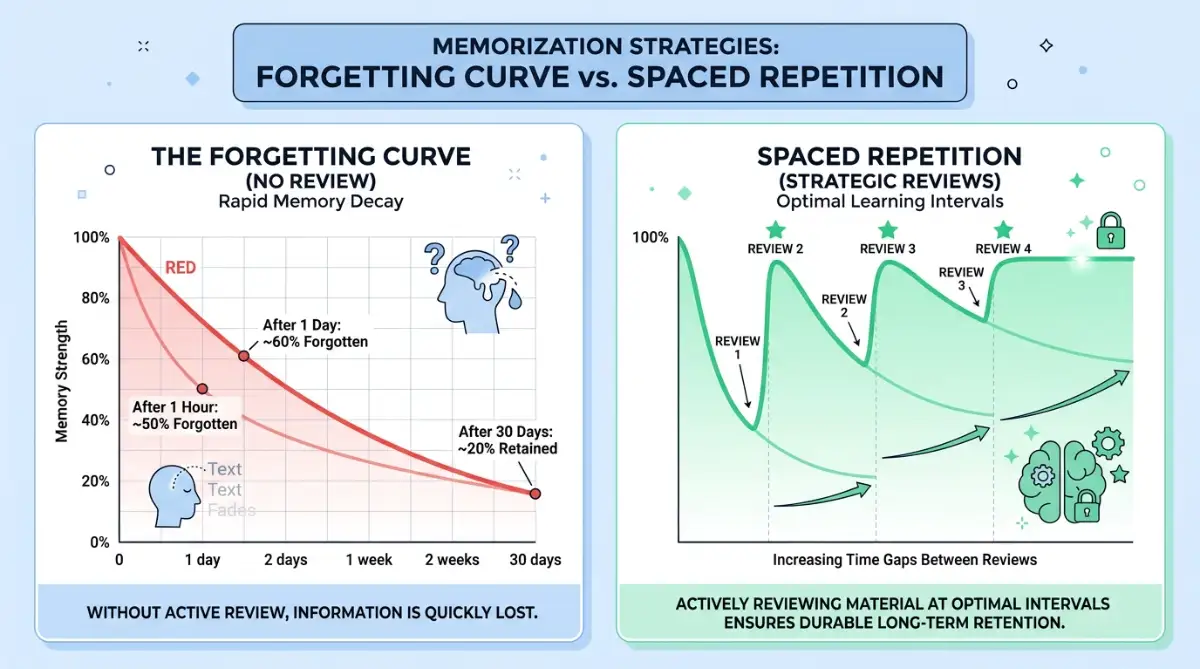
Scientists call this psychological drop-off the forgetting curve. Studies show that you forget nearly seventy percent of new information within twenty-four hours unless you review it actively.
Imagine drawing a line in the sand on a windy beach. If you do not trace over that line again, the blowing wind will erase it completely in a matter of hours.
Traditional cramming fails because it tries to trace that line fifty times in a single minute on day one. But after three days of silence, the wind erases the line anyway.
To build long-term memory, you must refresh the memory right before it fades completely. Every time you pull a word back from the edge of forgetting, your brain strengthens the neural pathway.
This process transforms fragile short-term data into permanent long-term memory. That simple scientific insight is the power behind spaced repetition.
Typical Forgetting Curve vs. Spaced Repetition
Without review, memory drops sharply. Spaced reviews push it toward 100% retention.
Day 1
(Cramming)
Day 3
(SRS Review 1)
Day 7
(SRS Review 2)
Day 30
(Permanent)
How Spaced Repetition Systems Fix Your Memory Leak
A spaced repetition system (SRS) is a modern smart study tool that tracks how well you know every word. It automatically calculates the exact moment you are about to forget a word and prompts you to review it.
Instead of studying the exact same list of fifty words every single day, an SRS space out your reviews based on your personal performance.
If you remember a word easily today, the system will wait four days to show it to you again. If you get it right again, the algorithm expands the gap to ten days, then thirty days, and then six months.
However, if you struggle with a difficult word, the software brings it back tomorrow so you can reinforce it. This dynamic spacing saves hundreds of hours of wasted review time.
You spend your valuable effort only on the words that actually need your attention. This active retrieval process tricks your brain into realizing that these specific foreign words are needed for your survival
By shifting your study strategy to an SRS, you can easily memorize dozens of fresh words every single day without feeling burned out.
📊 My Real 30-Day Memory Retention Test (Notebook vs. SRS)
To see if spaced practice really worked, I ran a personal experiment. I studied 100 new Spanish words using traditional notebook lists and another 100 words using an SRS app with active recall. Here is what happened:
Takeaway: While writing words in a notebook felt productive on Day 1, my brain dumped almost all of them within a month. The SRS app saved me over 15 hours of study time while keeping 80%+ of the words fresh in my head.
Myth vs. Reality in Vocabulary Learning
- Myth: You must study vocabulary for three hours every day to build a strong mental dictionary.
- Reality: Just fifteen minutes of smart spaced reviews beats three hours of massive cramming every single time.
- Myth: Writing down words twenty times on paper creates solid long-term memory retention.
- Reality: Passive re-writing only creates false recognition, while active recall forces your brain to actually store the word.
- Myth: You need to memorize whole dictionary definitions to talk like a local native speaker.
- Reality: Learning short natural phrases with simple context builds instant real-world speaking power.
Transform Your Vocabulary with Atomic Flashcards
The biggest mistake language learners make with digital flashcards is making them too complicated. They pack five different dictionary meanings, and three massive example sentences onto a single card side.
When you clutter your flashcard, your brain gets confused about what it is supposed to remember. This creates cognitive overload and slows down your review speed significantly.
Instead, you should always create atomic flashcards. The word atomic means tiny, focused, and impossible to break down further.
Each card must test you on exactly one single word or concept at a time. If a foreign word has three different meanings, create three separate cards instead of combining them into one mega-card.
Keep the front of your flashcards super clean and minimal. Display the target word clearly in bold text or use a simple visual picture that instantly represents the meaning.
On the back side, list only the direct translation and one short three-word context phrase. Keeping your cards small makes daily reviews quick, fun, and easy to finish without mental strain.
Add Visual and Audio Anchors to Every Word
Your brain does not remember plain black text on a white screen very well. It is naturally built to remember vivid images, clear sounds, and personal strong emotions.
When you create digital flashcards, always try to attach a dynamic image alongside the text. A quick picture of a bright red apple triggers your brain faster than reading the plain translation word.
You should also add clear audio recordings of native speakers pronouncing the exact word. Hearing the correct audio while viewing the text builds strong auditory connections in your memory bank.
Whenever possible, connect the target word to a personal memory or a funny physical image in your head.
For example, if the foreign word for cat sounds like your friend's name, picture your friend wearing cat ears. These strange mental connections act as shortcuts that help your brain pull up the correct word during live conversations.
Pro Tip: I used to make the silly mistake of putting giant paragraph definitions on the back of my flashcards. My brain got lazy and started recognizing the shape of the text block instead of learning the actual foreign word! Once I switched to single clear images and tiny three-word example sentences, my daily review speed doubled overnight.
Build an Unstoppable Daily Review Routine
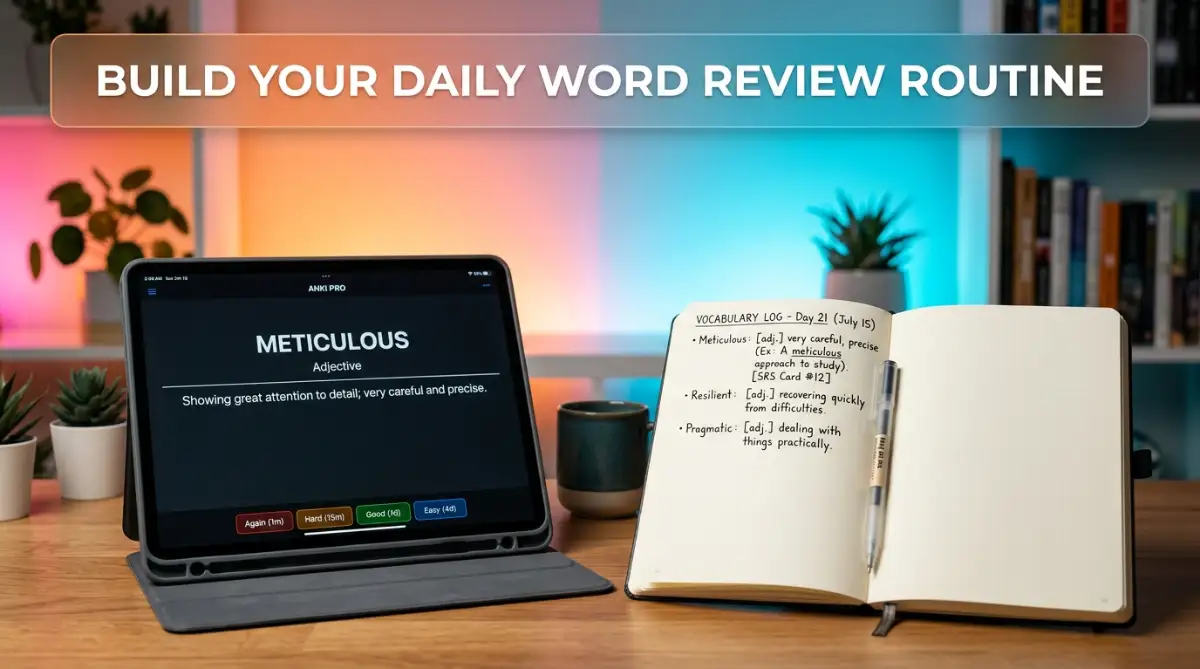
Consistency is the secret ingredient that makes spaced repetition work its magic. Skipping your reviews for three days causes cards to pile up into an overwhelming stack that destroys your motivation.
You must view your daily flashcards like brushing your teeth. It is a tiny, non-negotiable daily habit that works best when done in short bursts.
Set aside ten minutes every morning right after you wake up to clear your active card reviews. Morning reviews hit your brain when your mental energy is completely fresh and sharp.
You can also use lost time throughout your normal day to clear quick card stacks. Open your spaced repetition app while waiting in line at the grocery store or sitting on public transit.
Never create more new cards than you can review comfortably every day. Adding ten to fifteen new words daily is the sweet spot for most language learners.
If you add fifty new words every single day, your future review volume will burst into hundreds of cards daily. Keep your incoming card rate low so your habit stays light and pleasant.
Master Active Recall Before Looking at Answers
When a flashcard appears on your screen, do not flip it over immediately. You must force your brain to pause and attempt to retrieve the answer actively first.
This tiny mental struggle is where the real learning magic happens. The physical effort of trying to pull the definition out of your memory signals your brain to build stronger neural bridges.
Even if you guess incorrectly, that small mental effort makes the correct answer stick much deeper once you turn the card over.
Give yourself at least five seconds of quiet thought before tapping the screen to reveal the answer. Say the word out loud with strong confidence whenever you are in a quiet room.
If you answered correctly within two seconds, rate the card as easy. If you struggled or took a long time to recall it, mark it as hard so the algorithm brings it back sooner.
Be completely honest with your self-grading score every single time. Lying to your study algorithm only hurts your own speaking fluency down the road.
Traditional Cramming vs. Spaced Repetition Systems
This clear comparison shows why modern language learners are dropping old-school notebooks for digital spaced repetition tools.
While traditional cramming feels productive during late-night sessions, it fails to move words into your permanent memory storage.
Spaced repetition relies on cognitive science to deliver vastly superior results while saving you precious study time every single week.
How to Beat the Dreaded Flashcard Backlog
Life happens to all of us, and sometimes you will miss a few days of vocabulary practice. When you open your spaced repetition app after a break, you might find a scary stack of five hundred overdue cards.
Seeing a massive backlog of cards can instantly crush your motivation and make you want to delete the app completely.
Do not panic or give up on your language journey when this inevitable delay happens to you. First, temporarily set your new daily incoming words to zero until you fix the pile.
This stops the backlog mountain from growing bigger while you process the old reviews. Next, split your backlog into tiny manageable chunks of twenty cards at a time.
Do one small review session in the morning, another quick session at lunch, and one before bed. You do not need to clear the entire overdue stack in a single stressful day.
If the backlog feels completely hopeless, use your app's options to reset the due dates evenly across the coming week. Keeping your mental state calm is far more important than maintaining a perfect study streak.
Mingle Sentence Mining with Spaced Repetition
Never learn random words from massive pre-made flashcard decks downloaded from strangers online. Pre-made decks lack personal real-life connections, making them boring and tough for your brain to hold onto.
Instead, collect fresh words directly from native content that you personally enjoy consuming. This simple, effective technique is widely known as sentence mining.
When you watch a foreign movie, read a local news article, or listen to a song, write down unfamiliar words that catch your attention.
Take the whole sentence where you found that mysterious word and copy it straight onto your flashcard. Learning words inside real sentences gives your brain built-in context clues and natural grammar rules.
You will remember the word much faster because your brain links it directly to the cool movie scene or story where you first found it.
Personalized cards created from your real-world media consumption are ten times more effective than dull words pulled out of a dictionary.
Simple Daily Action Plan for Fast Vocabulary Growth
- Morning Session (10 Minutes):
- Clear all due card reviews on your smart SRS app right after waking up to start your day with a study win.
- Mid-Day Session (5 Minutes):
- Open your app during short breaks, such as standing in line or riding public transport, to review difficult cards.
- Evening Session (10 Minutes):
- Mine five to ten fresh words from foreign media you enjoyed today and build atomic cards with simple context.
- Weekly Strategy Review:
- Check your learning retention stats inside the app once a week and tweak your review limits if you feel overwhelmed.
By sticking to this effortless action plan, you will steadily store thousands of useful vocabulary words in your long-term memory every single year.
You no longer have to struggle with dusty word lists or embarrassing speech freezes during conversations. Spaced repetition gives you full control over your language journey, turning fast word recall into a simple automatic daily habit.
🔍 Flashcard Troubleshooting: The "Leech Card" Rule
We all run into that one stubborn word that refuses to stick no matter how many times we review it. In the flashcard world, this is called a "Leech Card."
- The Mistake: Forcing yourself to review the exact same difficult card 15 times a week, which only builds anger and wastes time.
- The Fix: Delete or suspend the card immediately. Rebuild it from scratch by attaching a funny personal picture, adding a funny sound effect, or turning it into a three-word fill-in-the-blank sentence. If a word feels stubborn, change the hook!
Expert Flashcard Engineering for Maximum Memory Retention
Mastering a new language requires moving beyond basic word-for-word translations. To truly unlock fast recall, you must engineer your flashcards like a seasoned learning expert.
One powerful secret is using fill-in-the-blank sentences, also known as cloze deletions. Instead of showing a single isolated word, display a full sentence with the target word removed.
When you put a missing word inside a real sentence, your brain picks up the grammar naturally without heavy study. I learned this the hard way after spending months memorizing dry verb tables that never worked in real conversations. Testing a word inside a real-life phrase gives your mind three or four built-in memory hooks at once, making speaking feel totally natural.
When you see a missing word inside a real sentence, your brain forms multiple memory hooks at once. You learn grammar rules, word order, and context without spending extra time studying textbooks.
CLOZE DELETION CARD EXAMPLE:
Front Side:
She bought a fresh [...] from the market.
(Hint: fruit)
Back Side:
She bought a fresh APPLE from the market.
🔊 Audio: "She bought a fresh apple..."
The Power of Mental Palaces and Image Association
Combining spaced repetition algorithms with ancient memory techniques creates a massive boost in recall speed. The human mind evolved to remember physical locations and vivid pictures much better than abstract letters.
Try connecting tricky vocabulary words to specific rooms inside your childhood home. If a foreign word for bread sounds like a toaster, picture a giant glowing toaster sitting on your old living room couch.
When the flashcard appears, recall that funny scene in your mind before flipping the card. I know it sounds a bit silly at first, but this weird visual method is backed by serious science. According to research published by the NCBI on spaced learning memory retention, actively spacing out your study intervals strengthens the long-term synaptic connections in your brain. You are literally rewiring your mind for fluency!
This strange visual connection acts as a bridge that brings the word straight out of your memory banks. Over time, as the review interval grows longer, the visual image fades away naturally.
What remains is automatic speech recognition, allowing you to say the word during conversations without hesitation.
Taming Synonyms and Words That Sound Alike
Language learners often stumble when two foreign words share nearly identical meanings. You might mix up subtle differences between terms for small, tiny, and microscopic.
To solve this problem, never create flashcards that ask for a generic synonym. Always add a small hint or clarification on the front side of the card.
Specify whether the word is formal, informal, or used mainly in slang speech. If two words sound almost identical, place them on the back of the card together to highlight the tiny sound difference.
Managing these confusing linguistic hurdles can be mentally draining during late-night study sessions. If study fatigue starts setting in, try using your five senses to calm stress before jumping back into reviews.
Adding tiny phonetic markers on your cards eliminates confusion before it starts. This simple habit keeps your memory clean and prevents your brain from mixing up related terms.
SYNONYM CLARIFICATION CARD:
Front Side:
Small
(Formal / Used for objects)
Back Side:
Petit / Little
Note: Do not confuse with "Miniature" (Microscopic).
Long-Term Deck Maintenance and Variable Interval Tweaks
As your digital flashcard deck grows past three thousand words, default app settings might stop working well. Most modern software lets you customize how fast review intervals expand over time.
If you find yourself forgetting older words too quickly, decrease the interval modifier setting slightly. This small tweak forces the app to show cards a bit sooner, strengthening fragile memories.
Conversely, if your reviews feel far too easy, boost the interval multiplier by ten percent. This stretches out review dates, cutting down your total daily workload significantly.
Never hesitate to delete or suspend cards that continue to annoy you after weeks of practice. Some words are simply poorly constructed or unnecessary for your current speaking goals.
Pruning your card collection keeps your flashcards lean, clean, and highly effective. Treating your deck like a growing garden ensures that only healthy, useful words remain in your system.
Tricky Pitfalls That Ruin Your Vocabulary Progress
The biggest danger when using spaced repetition software is getting caught in the over-creation trap. Enthusiastic learners often add fifty or one hundred new cards to their app every single day.
For the first week, everything feels smooth, exciting, and full of effortless progress. But exponential review curves catch up fast, leaving you facing hundreds of overdue cards within a month.
Studies in the Journal of Psychological Science on the spacing effect demonstrate that over-cramming short intervals reduces recall accuracy.
When your daily review count turns into a mountain, study burnout becomes almost inevitable. I've been there myself—staring at 500 overdue cards and just wanting to close the app forever. But don't panic! You can easily avoid getting overwhelmed by applying simple ways to save time through batch planning to your daily study sessions. Breaking your reviews down into bite-sized chunks will absolutely save your sanity.
Keep your daily addition of new cards small and strictly controlled. Slow, steady progress always beats massive waves of unsustainable flashcard creation.
⚠️ The Dreaded Over-Creation Trap:
Adding too many cards daily leads to exponential reviews and inevitable burnout.
Week 1: 50 Reviews daily (Easy & Fun)
Week 2: 250 Reviews daily (Getting stressful)
Week 3: 800+ Reviews daily (BURNOUT! You quit the app)
The Passive Swiping Mistake
Another quiet trap is turning your review session into a mindless, passive game. When you get tired, it becomes easy to tap the screen rapidly without actually trying to recall the answer.
You glance at the word on the front, instantly flip the card, and convince yourself that you knew it all along. This illusion of knowing trick your brain into feeling productive while building zero long-term memory.
Passive swiping completely ruins the core principle of active recall. You must force your brain to pause, do the mental work, and attempt the answer out loud first.
If you catch yourself swiping mindlessly, put your phone down and step away for five minutes. Take a deep breath. You can quickly reset your lost focus by building a daily mindfulness practice in five minutes to clear out that mental fatigue before diving back into your reviews. Always remember, having high-quality mental engagement during ten sharp reviews does far more good for you than mindlessly flipping through fifty cards.
Treat every single flashcard like a real mini quiz that demands your full attention.
❌ Passive Reviewing
Glance at card ➔ Flip instantly ➔ "Oh yeah, I knew that."
Result: Zero long-term storage built.
✅ Active Recall
Look at card ➔ Pause for 5s ➔ Attempt answer out loud ➔ Flip
Result: Deep neural connection forged!

The Vacuum Trap: Studying Flashcards in Isolation
Flashcards are incredible tools for vocabulary building, but they are not a complete language course on their own. Relying entirely on digital software while ignoring real-world books, podcasts, and conversations creates serious gaps.
Words memorized purely in isolation often feel clumsy and unnatural when you try using them in live speech. You might know what a word means but fail to catch it when a native speaker says it fast.
Think of quick flashcard reviews like lifting weights in the gym. Doing short daily reps builds your core memory strength, but you still need to get out onto the field to play the real game. That is why I always pair my morning review sessions with a foreign podcast or a short TV episode. When you hear a word you just studied pop up in an actual scene, your brain locks it in for good.
Always pair your daily card reviews with at least twenty minutes of immersive listening or reading. Seeing your newly learned words appear in real movies or podcasts cements them into your brain forever.
Ignoring Pronunciation and Speech Audio
Memorizing how a foreign word looks on a screen without knowing its exact audio sound is a recipe for trouble. You risk building bad pronunciation habits in your head that are difficult to correct later.
When you finally speak to a native, they might not understand you because your mental pronunciation is completely off. Even worse, you will fail to recognize the word when someone speaks it to you at normal speed.
Hearing how a native speaker says a word changes everything. Early on, I tried memorizing foreign words purely from text, and my pronunciation ended up so messy that locals could barely understand me. Do yourself a favor and attach a crisp, one-second audio clip to every digital card you build. Repeating that sound out loud turns awkward pauses into smooth, confident speech.
Repeat the pronunciation out loud, matching the cadence and tone of the native speaker. Connecting sound, spelling, and meaning creates a bulletproof three-part memory anchor in your brain.
❓ Frequently Asked Questions (PAA)
How many new vocabulary words should I add each day?
Sticking to 10 to 15 new words a day is the sweet spot. If you add 40 or 50 cards daily, your future review pile will explode into hundreds of overdue cards within two weeks, leading straight to study burnout.
Is Anki better than Quizlet for serious language learning?
Yes, Anki is better for long-term memory because it uses a true spaced repetition algorithm that calculates review intervals based on how easily you answered. Quizlet is fun for quick classroom quizzes, but it lacks dynamic spacing for thousands of words.
What should I do when I come back to 300 overdue cards?
First, set your new daily cards to zero so the stack stops growing. Next, break your backlog into small 20-card sessions across the day. Never try to clear 300 cards in one sitting; spread the catch-up over three to four days.
Why do I forget words during live conversations even if I know my flashcards?
This happens when you learn words in pure isolation without real-world context. To bridge this gap, practice saying the word out loud in short sentences and spend at least 20 minutes a day listening to native podcasts or watching movies.
How long does it take for a word to stick permanently in my memory?
With spaced repetition, a word usually becomes permanent after 4 to 6 successful reviews over three to four months. Once your app pushes the next review out past 90 days, you own that word for life.
Your Personal Roadmap to Permanent Vocabulary Retention
Building a massive foreign vocabulary does not require luck, genius-level talent, or hours of exhausting daily cramming. It simply requires understanding how human memory operates and using smart tools that work with your brain.
Spaced repetition systems take the painful guesswork out of vocabulary practice. They automatically schedule reviews at the exact ideal moment, ensuring maximum long-term storage with minimum daily effort.
Start small by picking a user-friendly flashcard app and setting a simple goal of ten new words per day. Keep your cards clean, attach vivid images, add native audio, and focus on active recall.
Pair your daily flashcard habit with real-world reading and listening to see your fresh vocabulary come alive. Stay consistent through short daily reviews, be patient with yourself, and watch your language fluency soar to heights you once thought impossible.
I personally spent years feeling frustrated by constantly forgetting foreign words until I completely embraced spaced repetition systems in my own daily routine. Once I made that simple shift to active recall, my vocabulary grew faster than I ever thought possible, and live conversations suddenly became fun and effortless. I know with absolute certainty that if you apply these simple steps starting today, you will transform your memory power and master your target language much faster than you think!
Disclaimer:
This article is provided strictly for educational and informational purposes. The study strategies, memory techniques, and software recommendations discussed are intended to help readers improve their personal language learning habits based on general cognitive research. Individual learning speeds and memory retention outcomes may vary depending on personal consistency, prior linguistic experience, and total study effort. This website does not guarantee specific fluency levels or academic test scores. Always choose software tools and study schedules that fit your personal health, lifestyle, and educational requirements. All third-party software names mentioned belong strictly to their respective trademark owners.