
The Hidden Struggle of Staying Relevant in an Evolving Digital World
Have you ever felt completely overwhelmed by how fast new technology changes every single day?
You wake up to a new app, a new tool, or a completely new way of doing business, and suddenly your existing knowledge feels obsolete.
This rapid shift leaves millions of hard-working people feeling left behind, frustrated, and deeply uncertain about their personal and professional future.
Many creative individuals and business owners fall into the trap of believing they must master every single new tool instantly.
- They spend endless hours jumping from one online trend to another without a clear strategy.
- They trust hyped-up shortcuts that promise instant success but deliver zero long-term stability.
- They waste valuable energy fixing symptoms instead of understanding the core patterns of growth.
- They ignore historical context, repeating the same basic mistakes early tech creators solved decades ago.
When you constantly feel like you are chasing a moving target, your confidence takes a severe hit.
- Persistent confusion creates deep decision fatigue, making you doubt your creative instinct.
- Constant comparison with online highlight reels leaves you feeling inadequate and stressed.
- The pressure to adapt instantly drains your daily focus, replacing deep work with superficial reacting.
I have spent years studying how digital systems grow, and I can assure you that you do not need to learn every tool.
I still remember standing in your exact shoes back in 2014. I was sitting in front of my laptop at 2 AM, utterly paralyzed by anxiety because three brand-new software frameworks had launched in a single week. I felt like I was falling behind, doubting if I belonged in this fast-paced space at all. But over the years, as I worked directly with expanding networks and digital systems, I discovered a deeply comforting truth: you don't need to master every shiny new gadget that hits the market. You just need to master the timeless human patterns behind them, and everything else falls into place.
When you understand how human beings built the web from scratch, you gain a timeless playbook for solving complex problems.
Let us look closely at how the birth and expansion of digital connectivity can transform your approach to creativity and work.

Why the Story of the Web is Actually a Story About Human Nature
When we talk about digital networks, we often picture cold servers, long lines of code, and complex wires under the ocean.
However, the global network was not created by machines; it was sculpted by humans trying to solve basic human needs.
Every protocol, browser, and search box exists because someone wanted to share thoughts, speed up work, or connect across vast distances.
When you look back at early computing, the main motivation was never to create massive digital industries.
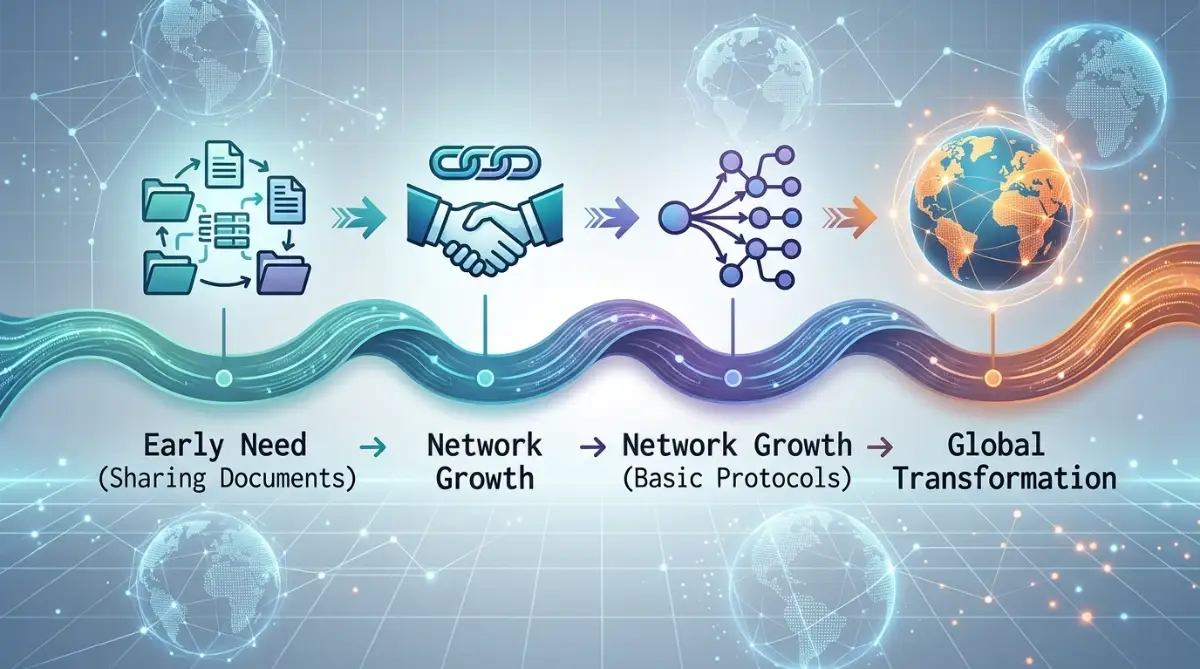
Instead, it was about connecting research teams who wanted to share file directories without driving across town.
Think about it—when Sir Tim Berners-Lee created the World Wide Web proposal at CERN in 1989, he wasn't trying to build a multi-trillion-dollar digital empire. He simply wanted to help fellow scientists share research papers without having to walk across different buildings or reformat text files manually. Even earlier, the brilliant minds behind ARPANET and early network protocols just wanted basic data packets to move from one node to another without crashing the whole system. They focused on solving a small, immediate headache, and that personal friction point laid the groundwork for our entire modern digital life.
This simple fact gives us our first major lesson: true innovation starts with solving small, personal friction points.
Early Need (Sharing Documents) ➔ Simple Solution (Basic Protocols) ➔ Network Growth ➔ Global Transformation
The Power of Open Collaboration
In the early days of global connectivity, early creators made a choice that changed history forever.
They decided that the core rules of transmission should remain public and accessible to everyone.
Because no single company owned the fundamental structure, thousands of independent builders could add their own ideas without asking for permission.
If those early visionaries had locked their transmission protocols behind high paywalls, the web as we know it would have choked in its infancy. We saw this exact lesson play out again when Linus Torvalds freely shared the source code for the Linux operating system with the world. Instead of hoarding his creation, he opened the doors to thousands of passionate developers who tested, fixed, and improved it together. Today, that open collaboration quietly powers almost every cloud server, Android phone, and supercomputer on Earth.
Your own creative projects work the exact same way.
When you share your core process and collaborate openly, you create room for rapid growth and unexpected ideas.
Myth vs. Reality: Debunking Common Ideas About Creative Breakthroughs
We often celebrate massive technological breakthroughs as if they happened overnight inside a single genius mind.
The history of online connectivity proves that narrative completely wrong.
Let us compare common creative myths with the actual reality of how digital progress unfolds.
- Myth: Great ideas arrive fully formed in a flash of sudden brilliant inspiration.
- Reality: Ideas evolve slowly through trial, error, and constant feedback over long periods.
- Myth: You need massive resources and huge teams to launch something transformative.
- Reality: The groundwork for global tools started in modest university basements with basic gear.
- Myth: Competitors destroy your progress by copying your public methods.
- Reality: Shared standards build entire ecosystems that end up growing the total market for everyone.
Understanding this dynamic takes immense pressure off your shoulders.
You do not need to invent a flawless product on your very first try.
You simply need to launch a basic version, listen carefully to feedback, and improve it step by step.
Step-by-Step Guide: Five Timeless Innovation Lessons from Digital History
To make these principles actionable in your daily life, I have broken down the history of web development into five core mindsets.
You can apply these exact principles to personal projects, business growth, or creative problem-solving today.
Step 1: Prioritize Simplicity Over Feature Bloat
The earliest communication protocols were intentionally light and straightforward.
They were designed to do one simple job exceptionally well: pass data packets from one computer to another without crashing.
- Focus on solving one primary problem for your audience before adding secondary features.
- Strip away extra steps that add friction to your daily workflow or product setup.
- Measure your success by how clearly your solution works, not by how complex it looks.
When you start simple, your project becomes resilient against unexpected failures.
Complex systems break easily because they have too many moving parts.
Keep your foundation minimal so you can expand cleanly whenever necessary.
Step 2: Build Flexible Frameworks Instead of Rigid Rules
Early network designers did not know how millions of people would use their creation decades later.
They could not foresee streaming video, cloud platforms, or remote work tools.
Because of this uncertainty, they designed adaptable frameworks instead of fixed, rigid systems.
- Avoid locking your daily routines into inflexible, ultra-strict schedules that break during chaos.
- Create modular working systems where individual parts can be swapped without destroying the whole.
- Leave space in your strategic plans for unexpected opportunities and sudden market shifts.
Flexibility is the ultimate insurance policy for your career and projects.
When you build adaptable habits, sudden changes in your industry become exciting opportunities rather than terrifying threats.
Step 3: Shift Focus from Connectivity to Curation
In the first phase of the web, the main challenge was simply getting connected.
Once millions of pages went online, a new problem quickly emerged: finding accurate, high-quality information in a sea of noise.
This led directly to the creation of index directories and intelligent search tools.
The value shifted entirely from producing raw data to curating clear meaning.
I remember when the web first exploded in the late 90s—suddenly, the challenge was no longer finding information, but surviving an avalanche of low-quality data. Early web directories like Yahoo! manually indexed sites, but when the web grew too massive, smart curation algorithms changed everything. They proved that the real value wasn't in hoarding raw documents, but in filtering and ranking what truly mattered. As creators today, we face that exact same dynamic: your audience doesn't need more random noise; they are desperately searching for trusted filters who can curate meaningful clarity for them.
- Do not clutter your audience with endless, unorganized details; offer well-structured takeaways.
- Clean up your personal information diet by cutting out low-value noise and distraction.
- Focus on becoming a trusted filter in your niche by highlighting only what truly matters.
Today, attention is the scarcest resource on earth.
If you can organize complicated information into simple, actionable steps, you will immediately stand out from the crowd.
Step 4: Rely on Decentralized Resilience
If a single central computer controlled the early network, any hardware crash could have shut down worldwide communication.
Engineers avoided this risk by spreading node responsibilities across thousands of independent locations.
If one server failed, data traffic simply rerouted through another active path automatically.
You should design your own career and creative life with the exact same decentralized resilience.
- Avoid relying on a single source of income or one primary client for your livelihood.
- Store your knowledge across accessible digital notes rather than trusting your memory alone.
- Cross-train your skills so you can pivot smoothly if your industry changes directions.
When you build multiple points of strength, external disruptions cannot knock you off balance.
You gain peace of mind knowing that your foundation is supported by multiple stable pillars.
Step 5: Embrace Imperfect Launches and Rapid Iteration
The first online web pages were plain text with blue underline links.
They lacked fancy design, rich media, and complex features, yet they changed the world because they were usable immediately.
If early creators waited until the technology was polished and perfect, modern digital life would have been delayed by decades.
- Release your creative projects into the world before you feel entirely ready.
- Treat user feedback as direct guidance for your next batch of improvements.
- Celebrate small, continuous daily gains over infrequent, perfect releases.
Perfectionism is often just fear wearing a sophisticated mask.
By prioritizing action over perfection, you speed up your learning curve dramatically.
Practical Scenarios: Applying Digital Evolution Mindsets to Daily Work
Let us examine how these theoretical concepts apply to actual everyday situations.
Here are three practical scenarios showing how adopting an internet-inspired growth mindset solves common professional hurdles.
Scenario A: Building a Content Brand
- The Old Approach: Waiting six months to write a full-length book in complete isolation without showing anyone your rough drafts.
- The Internet Approach: Posting short daily observations, gathering immediate reader responses, and compiling popular ideas into a focused guide.
- The Outcome: You build an engaged, loyal audience while creating a product you already know people want.
Scenario B: Streamlining Team Workflows
- The Old Approach: Enforcing a top-down, 50-page employee manual that restricts individual initiative and slows down simple approvals.
- The Internet Approach: Setting up clear core principles, providing open shared tools, and giving team members authority to solve local problems.
- The Outcome: Projects move faster, communication friction drops, and employee morale increases noticeably.
Scenario C: Developing Personal Skills
- The Old Approach: Trying to master an entire industry topic by reading heavy textbooks from cover to cover without practical application.
- The Internet Approach: Learning small micro-skills on demand to complete real, hands-on mini-projects immediately.
- The Outcome: You gain practical, retainable experience while keeping your motivation consistently high.
Overcoming Creative Blocks Through Networked Thinking
When you hit a mental wall, you might feel like your mind has completely run out of creative juice.
However, human brains work remarkably like interconnected digital servers.
Ideas rarely pop up out of thin air; they emerge when existing pieces of information connect in novel ways.
If you are struggling to generate fresh solutions, try these simple connection-building exercises:
- Cross-Pollinate Fields: Read material completely outside your core industry, such as architecture, biology, or history.
- Map Ideas Visually: Draw physical lines between distant topics on paper to reveal unexpected relationships.
- Engage in Open Discussions: Talk through your rough concepts with colleagues, allowing their feedback to reshape your perspective.
- Store Raw Notes Openly: Maintain an organized digital repository of interesting quotes, charts, and observations for future projects.
By treating your brain as a node within a larger network of human wisdom, you eliminate creative dry spells for good.
Key Real-World Principles for Long-Term Growth
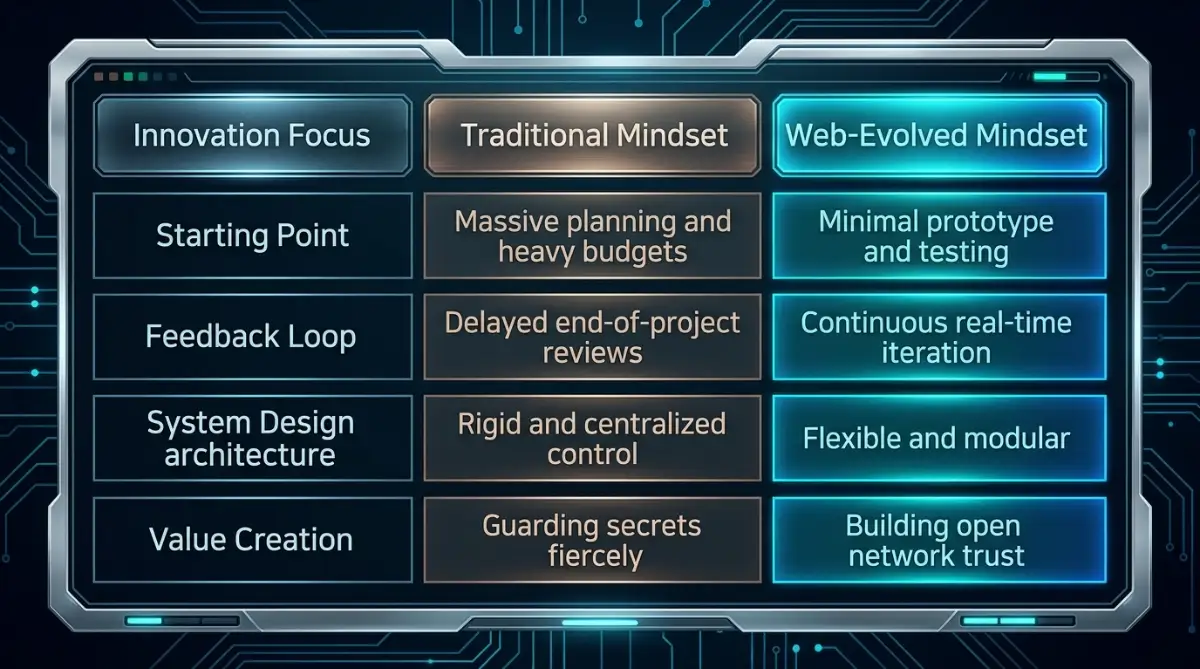
To keep these ideas front and center, review this clear summary matrix whenever you launch a new project.
+-------------------+------------------------------------+----------------------------------+
| Innovation Focus  | Traditional Mindset                | Web-Evolved Mindset              |
+-------------------+------------------------------------+----------------------------------+
| Starting Point    | Massive planning and heavy budgets | Minimal prototype and testing   |
| Feedback Loop     | Delayed end-of-project reviews     | Continuous real-time iteration   |
| System Design     | Rigid and centralized control      | Flexible and modular architecture|
| Value Creation    | Guarding secrets fiercely          | Building open network trust      |
+-------------------+------------------------------------+----------------------------------+
Building Your Personal Innovation Ecosystem
Creating long-term success is not about waiting for a single lightning bolt of luck.
It is about creating a personal routine that encourages exploration, feedback, and constant refinement.
- Set Up a Experiment Space: Dedicate two hours every week to test new tools or creative mediums without pressure.
- Document Your Process: Share your step-by-step progress publicly to invite valuable community insights.
- Refine Your Tooling: Regularly clear away redundant applications and habits that clutter your daily workflow.
When you treat your life as a living, evolving network, every setback becomes valuable data that helps you upgrade your system.
What the Next Era of Human Creativity Looks Like
As digital systems become smarter and more integrated into our lives, human creativity remains our most valuable asset.
Machines can process data at incredible speeds, but humans supply the context, empathy, and artistic judgment that give work meaning.
The evolution of technology proves that every major leap forward expands human potential rather than replacing it.
- Early publishing tools gave voice to independent writers who lacked traditional media deals.
- Basic search systems leveled the playing field for curious self-directed learners everywhere.
- Cloud collaboration allowed remote teams to build global enterprises from home offices.
Your ability to adapt, learn from history, and remain open to collaboration will define your journey.
Do not fear technological shifts; embrace them as new canvases for human ingenuity.
Summary Strategies for Everyday Success
Let us gather the key takeaways from our exploration of digital history into five daily actions:
- Start with the simplest workable version of your project and refine it steadily over time.
- Build open, modular working habits that adapt easily to unpredictable changes.
- Focus on curating clear, actionable answers rather than adding to world noise.
- Decentralize your skills and income so you remain resilient during industry shifts.
- Action drives clarity, so launch your ideas into the real world as early as possible.
By grounding your creative process in these time-tested network principles, you position yourself to thrive through every wave of modern change.
Advanced Network Mindsets for Long-Term Mastery
Now that we have covered the foundational ideas of how digital networks developed, let us explore advanced strategies that industry leaders use to stay ahead.
These high-level concepts will help you build systems that grow stronger under pressure instead of falling apart when market demands shift.
Individual Focus
➔ Systemic Collaboration
➔ Modular Scaling
➔ Long-Term Resilience
When you examine how the digital world expanded beyond simple document sharing, you see distinct patterns of structural growth.
Understanding these advanced mechanisms gives you a clear edge in managing personal projects, leading creative teams, or scaling a business.
Building Asynchronous Work Loops
In the early eras of global networking, computers could not stay online simultaneously without draining heavy bandwidth.
Engineers created asynchronous protocols like email and store-and-forward messaging to allow smooth data exchanges without requiring both parties to respond at the exact same second.
- You do not need to answer every notification or message instantly to remain productive.
- Group your deep work into uninterrupted blocks, allowing your brain time to solve complex tasks.
- Design your project workflows so team members can contribute without waiting for live meetings.
When you remove the demand for instant real-time reactions, your deep concentration improves dramatically.
Asynchronous systems give your mind the peaceful room required to formulate truly original ideas.
Embracing Modular Product Architecture
When software developers realized that single massive code files were impossible to maintain, they shifted entirely to modular architecture.
Instead of writing one huge program, they created independent, self-contained modules that communicate through standardized interfaces.
If one module fails or needs an upgrade, the rest of the application continues running without missing a beat.
You can structure your creative output and personal career in this exact same modular fashion.
- Break your large annual goals into tiny, self-contained monthly projects.
- Build individual skill sets that function independently but create huge value when combined.
- Create flexible asset libraries for your work so you can repurpose materials across different channels.
For instance, when designing modern visual content, creators often focus on blending custom art styles effectively to construct reusable, modular graphic templates.
This approach saves massive amounts of time while maintaining a consistent visual presence across platforms.
Establishing Real-Time Systemic Feedback Loops
Networks survive because they constantly monitor their own traffic conditions and adjust routes automatically.
If a primary data cable experiences heavy lag, intelligent routers instantly redirect information along clearer pathways.
Without these continuous self-correcting mechanisms, digital communication would collapse under heavy user demand.
You must embed similar diagnostic routines into your weekly work patterns.
- Review your project metrics every Friday to see which efforts produced actual results.
- Cut out activities that consume heavy energy while yielding minimal positive outcomes.
- Ask your readers or clients direct questions to gather honest, unfiltered feedback.
By turning feedback into a continuous daily habit, small course corrections keep you moving toward your long-term goals without major detours.
Guidelines for Maintaining Relevance Over Decades
Achieving quick success on a single project is relatively easy, but maintaining momentum over decades requires intentional systemic design.
The platforms that survived digital transitions over the decades shared specific structural habits that you can mirror.
Focus on Core Human Motivations
While technologies evolve constantly, human psychology remains remarkably consistent across generations.
People always desire clearer communication, faster access to knowledge, reliable connection, and personal recognition.
- Build your projects around timeless human needs rather than temporary tech hypes.
- Instead of burning your precious energy chasing short-lived trends on social media, I always encourage my team to anchor their strategy in solid human data. I often dive into the workforce and skills reports published by the World Economic Forum alongside deep analytical research from the Harvard Business Review. These trusted sources consistently highlight one crucial truth: while software tools come and go, fundamental human needs—like empathetic communication, adaptability, and critical thinking—remain the true pillars of long-term career success.
- Use new digital tools simply as faster engines to deliver timeless human value.
When you align your work with deep human desires, your career remains stable regardless of which software tool dominates headlines.
Build Personal Redundancy and Safety Nets
In networking terminology, redundancy means having backup power sources, extra storage servers, and secondary routing options ready at a moment's notice.
When main systems encounter unexpected errors, backup mechanisms trigger smoothly without user disruption.
- Keep a dedicated rainy-day fund to cover unexpected personal or business dry spells.
- Develop broad complementary skills so you never rely on a single specialized task.
- Maintain strong personal relationships outside your immediate work environment for emotional stability.
Building structural redundancy keeps sudden industry shocks from throwing your life into chaotic turmoil.

Critical Pitfalls That Sabotage Modern Innovation
Even the most dedicated creators frequently stumble into predictable traps when trying to build innovative systems.
By identifying these common mistakes early, you save yourself years of wasted effort, financial loss, and severe emotional exhaustion.
Trap Identified
➔ Root Cause Diagnosed
➔ Corrective Action Applied
➔ Growth Restored
Pitfall 1: Premature Optimization and Over-Engineering
One of the most frequent errors is attempting to build a perfect, scalable system before proving that anyone actually wants your product.
Engineers call this premature optimization, and it wastes enormous amounts of time and financial capital.
- The Problem: Spending months perfecting complex features for a service that lacks an active user base.
- The Damage: You drain your energy reserves and cash reserves before getting real market feedback.
- The Solution: Focus on launching a basic prototype to validate demand before investing in complex infrastructure.
I've personally fallen into this exact trap earlier in my career, spending three painful months trying to build the "perfect" automated website dashboard before I had even earned my first ten regular visitors. It was an exhausting waste of time and money. Learn from my mistake: never build a high-tech fortress until you know people actually want to step inside. Put your simplest ideas into the world today, talk directly with your early readers, and let their real-world feedback tell you what features are worth building next.
If you are expanding your brand presence online, start small with simple visual designs.
You can easily learn about creating social media graphics with modern tools to launch quick campaigns without overthinking initial designs.
Pitfall 2: Ignoring Legal and Ethical Guidelines
In the rush to adopt cutting-edge methods, many entrepreneurs skip basic legal compliance, copyright checks, and privacy principles.
They assume small details do not matter during early stages, only to face severe penalties later when their business grows.
- The Problem: Using unverified assets, ignoring intellectual property rights, or neglecting user data privacy.
- The Damage: Ruined brand reputation, legal penalties, and complete loss of audience trust.
- The Solution: Audit your operational tools and media assets continuously to ensure total compliance with copyright standards.
For instance, modern creators using automated media tools must carefully review commercial image usage mistakes to avoid to protect their long-term business operations.
Pitfall 3: Centralizing Control and Creating Single Points of Failure
When a leader insists on approving every single decision, they create a bottleneck that slows down the entire organization.
Just like a centralized server network, a single point of failure guarantees total operational paralysis whenever the bottleneck is unavailable.
- The Problem: Refusing to delegate tasks or share operational knowledge with team members.
- The Damage: Extreme personal burnout, slow project execution, and frustrated collaborators who feel micromanaged.
- The Solution: Document your processes clearly and empower team members to make decisions within defined boundaries.
When you distribute responsibility, your organization grows exponentially while keeping your workload manageable.
Pitfall 4: Chasing Shiny Tools Without Strategy
It is easy to get enchanted by every new software platform, automation tool, or trendy methodology that hits the market.
However, collecting tools without a clear strategic goal leads to chaotic distraction rather than real progress.
- The Problem: Constantly switching platforms before mastering existing workflows or seeing initial results.
- The Damage: High subscription costs, fragmented team communication, and complete loss of operational focus.
- The Solution: Adopt new software only when it solves a specific, pre-existing bottleneck in your routine.
Here is a simple rule I personally use with my own team: whenever we are tempted to adopt a shiny new software tool, we institute a mandatory 14-day waiting period. We ask ourselves, "What specific bottleneck in our current routine is this tool solving right now?" If we can't point to a clear, measurable pain point that we are experiencing today, we skip it. This single habit has saved us thousands of dollars in unused app subscriptions and kept our daily focus razor-sharp on deep, meaningful work.
If it does not address an immediate problem, set it aside and stay focused on your primary objective.
Practical Do's and Don'ts for Modern Creators
To keep your growth trajectory steady, reference this straightforward checklist whenever you plan new initiatives.
What You Should Do (The Do's)
- Do test small hypotheses quickly in public view to gather genuine user feedback.
- Do study past historical patterns to understand how similar systems evolved over time.
- Do invest time in mastering descriptive communication, such as writing descriptive creative prompts to maximize digital tool output.
- Do build open, collaborative networks that encourage shared learning and mutual support.
What You Should Avoid (The Don'ts)
- Don't assume that high technological complexity automatically equals better quality or higher value.
- Don't isolate yourself from user critiques in a bid to protect your artistic ego.
- Don't abandon proven foundational principles whenever a flashy new trend appears.
- Don't compromise long-term brand trust for brief, temporary short-term gains.
Action Plan for Tomorrow: Turning Digital History Into Personal Mastery
As we finish our deep exploration into how the growth of the web informs human progress, remember that knowledge without action remains purely theoretical.
You now possess a structured framework inspired by the very systems that connected our modern world.
The evolution of digital connectivity proves that massive global transformations start with modest, imperfect steps.
You do not need an extraordinary budget or a giant organization to create meaningful, lasting work.
➔ Day 1: Audit Current Workflows
➔ Day 2: Simplify Key Friction Point
➔ Day 3: Launch Small Test
➔ Day 4: Gather & Apply Feedback
Your Immediate Step-by-Step Starter Guide
Here is a simple action plan you can implement starting tomorrow morning to upgrade your creative strategy:
- Audit Your Tools: Write down every tool, app, and system you currently use in your daily routine.
- Remove Friction: Identify one over-complicated step in your workflow and simplify it immediately.
- Share an Imperfect Draft: Publish or present a small project you have been hesitating to finish due to perfectionism.
- Seek Constructive Inputs: Ask three trusted peers or customers for direct feedback on how you can improve your core offering.
- Document Lessons Learned: Log your observations in a clear, searchable digital note file for future reference.
Innovation is not a rare genetic talent granted to a select few individuals.
It is a repeatable, learnable habit built on curiosity, trial, adaptation, and open connection.
By applying these timeless network principles to your daily life, you turn everyday challenges into stepping stones for continuous personal expansion.
Real Reader Questions Answered (Q&A)
How do I overcome the constant anxiety of falling behind on new tools?
Focus entirely on understanding core concepts rather than memorizing specific button layouts.
Tools change rapidly, but foundational principles like clear communication, user empathy, and modular design remain unchanged for generations.
When you master core principles, adapting to any new software interface takes only a few hours of practice.
What is the fastest way to validate a new creative project idea?
Create a minimal prototype in under forty-eight hours and put it in front of a real audience.
You can use basic landing pages, short social posts, or simple surveys to gauge genuine interest before building full features.
If people actively engage with your basic idea, you have a green light to invest more resources.
How can small teams compete with massive, well-funded companies?
Small teams hold a massive advantage in speed, flexibility, and direct connection with their audience.
While large organizations spend months in committee meetings approving simple text changes, small teams can test three different ideas in a single afternoon.
Leverage your speed and authentic human voice to build deep relationships that large corporations cannot replicate.
According to leadership studies published by the Harvard Business Review, smaller decentralized units consistently outperform centralized corporate teams in adaptiveness and innovation speed.
A Final Word of Encouragement
Every digital network node you rely on today exists because someone chose to connect two points together despite technical uncertainty.
Your creative journey operates under those exact same principles of connection and growth.
Stop waiting for ideal conditions, flawless tools, or complete certainty before taking your next big step.
Embrace the messy, iterative process of human progress and build your vision piece by piece.
Start where you are, use the tools you have, and share your unique contributions with the world today.
Disclaimer:
This content is provided strictly for educational, informational, and inspirational purposes. The strategies and historical insights discussed reflect general principles of systems thinking and personal productivity. Readers should perform their own research and exercise professional judgment when applying these concepts to specific business, financial, or technical scenarios.

