
The Shocking Reality Behind the Keys of Your First Home
Six years ago, I proudly held the keys to my first house. The monthly payment on my loan approval letter was exactly 1,200 USD. I smiled, did some quick math on a napkin, and thought, "I can easily afford this!"
Boy, was I wrong.
Three weeks after moving in, the water heater leaked all over the garage floor. Then came the city utility bill, which was twice what I paid in my tiny apartment. By week six, I had a pile of unexpected bills on my kitchen counter: local trash pickup fees, storm water taxes, and a surprise HOA assessment for neighborhood road repairs.
My actual monthly housing bill was not 1,200 USD—it was closer to 2,350 USD. I spent the next six months eating cheap ramen noodles and stressing over every paycheck.
I do not want you to make the exact same mistakes I made. In this guide, I will break down the real, unhidden costs of owning a home so you can plan your budget with total confidence and zero nasty surprises.
📌 Quick Takeaways: What You Need to Know in 30 Seconds
- The "Hidden 40%" Rule: Your real monthly cost is usually 30% to 45% higher than your basic loan payment once you add taxes, insurance, and utilities.
- Property Taxes Rise Fast: Your property tax bill will likely jump within the first 12 months as local counties update the home's value based on your purchase price.
- The 1% Maintenance Buffer: Always save at least 1% of your home's purchase price every single year into a dedicated repair account (e.g., 3,000 USD per year on a 300,000 USD home).
- Escrow Shortages are Real: Lenders often underestimate first-year tax bills, leading to sudden monthly payment increases of 150 USD to 300 USD later on.

A Practical Blueprint to Uncovering Your Actual Monthly Housing Expenses
Beyond the Base Price: The Real Cost of a Mortgage
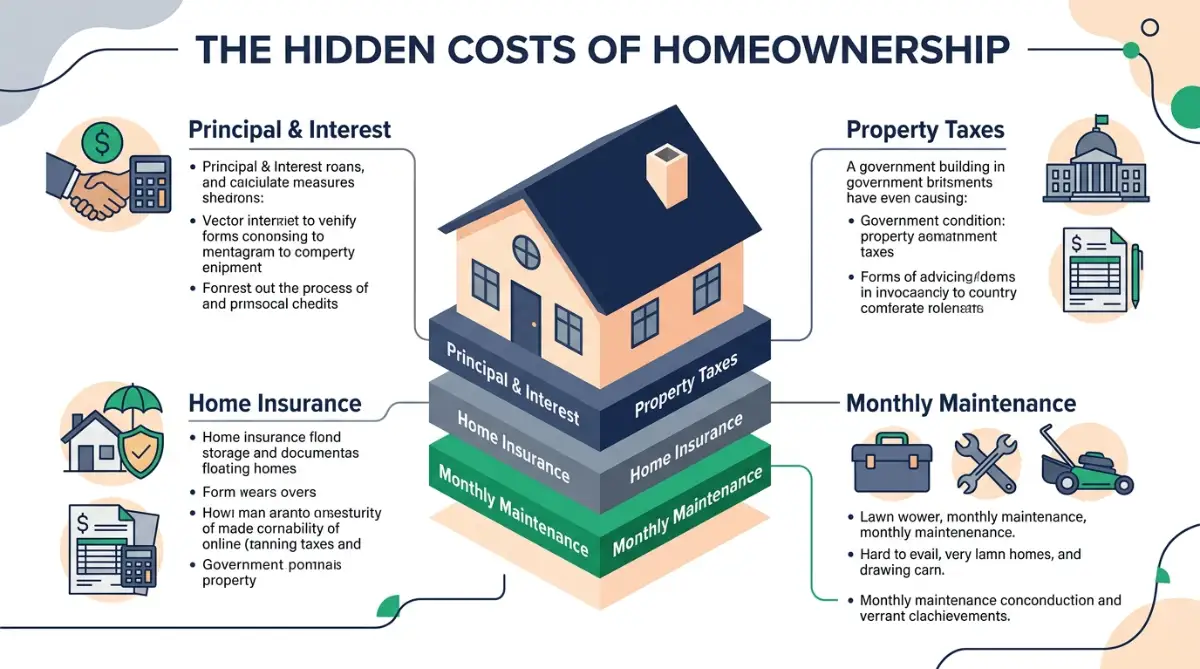
Most people think a mortgage is just paying back the money you borrowed plus bank interest. In reality, your monthly bill is made of four moving parts: principal, interest, local property taxes, and home insurance. When you look at free online payment calculators, they usually only show you the principal and interest numbers. This gives you a false sense of security because it leaves out hundreds of USD in required monthly taxes and insurance costs. Always ask your loan officer to give you the full payment breakdown with estimated escrow from day one.
The Unseen Escalation of Property Taxes and Home Insurance
Property taxes are one of the most unpredictable parts of homeownership because they do not stay the same forever. When you buy a house, the local government will eventually reassess its overall value based on the purchase price. This reassessment almost always leads to a higher tax bill than what the previous owner was paying.
You should research the local tax rates in your specific neighborhood to see how often they adjust. A good practice is to look at the tax history of similar homes in the area over the last few years. This research helps you estimate how much your taxes might rise in the future.
Home insurance is another cost that keeps going up due to inflation and weather events. If you buy a home in an area prone to storms, floods, or wildfires, your insurance rates will be significantly higher. You must get real insurance quotes before you close the deal, rather than relying on generic online estimates.
The Real Cost of Keeping Your Home Running
When you rent an apartment, your landlord often pays for trash, water, and sometimes even heating. When you buy a house, every single utility bill becomes your personal responsibility from the very first day. Houses also require much more energy to heat and cool than small apartments do.
You must prepare yourself for utility bills that could easily double or triple compared to what you paid as a renter. It is highly recommended to ask the seller for their utility bills from the past year. This will show you how much it actually costs to run the house during the coldest and hottest months.
The Maintenance Trap: Planning for When Things Break
Everything in a house has a limited lifespan, from the roof above your head to the water heater in the basement. As a homeowner, you are now the repair person, which means you must pay for every fix. If your heating system breaks down in the middle of winter, you cannot just call a landlord.
Many financial experts suggest saving 1% to 2% of your home's total value each year for ongoing maintenance. For a house worth 300,000 USD, this means saving between 3,000 USD and 6,000 USD annually just for repairs. This money needs to be set aside in a separate account so you are always ready for emergencies.
I once made the mistake of ignoring our old water heater because it looked fine from the outside. It burst three months after we moved in, costing us 2,000 USD that we did not have saved in our budget. Now, I always inspect the age of major appliances before making any financial plans.
HOA Fees and Special Assessments: The Unpredictable Bills
If you buy a home in a planned community or a condo building, you will likely have to pay monthly HOA fees. These fees pay for shared spaces, neighborhood security, and community amenities like pools or parks. However, these fees are never locked in and can rise at any time if the community board decides to increase them.
Even worse are special assessments, which are one-time fees charged for major community repairs. If the neighborhood road needs repaving and the HOA does not have enough savings, they will bill every homeowner. This can result in an unexpected bill of thousands of USD that you must pay immediately.
Want to see a real-life breakdown of how these hidden fees creep up on homeowners? Watch this simple video to learn how to prepare your budget for the unexpected.
Calculating Your Real Monthly Costs: The Complete Breakdown
To calculate your actual monthly homeownership cost, you need to put all these different expenses into one simple worksheet. Do not rely on mental math or rough estimates when you are dealing with such large amounts of money. You must write down every single category to see the complete picture clearly.
As you can see, a house with a basic mortgage payment of 1,400 USD actually costs 2,620 USD per month to run. This is why so many new homeowners find themselves struggling to pay their bills each month. They only planned for the mortgage payment and ignored the other 1,220 USD in monthly expenses.
Estimated Listing Payment vs. Real Total Monthly Cost (Real Comparison)
Note: Calculations are based on standard 30-year fixed loans at average rates, including national averages for local county taxes, basic property coverage, and average maintenance allocations.
How to Avoid the House-Poor Trap and Enjoy Your Life
Being "house poor" means that almost your entire monthly income goes toward paying for your home. This leaves you with very little money for food, clothing, travel, or saving for retirement. It is a highly stressful way to live and can quickly turn your dream home into a financial prison.
To avoid this trap, you should keep your total housing expenses below 28% of your gross monthly income. This 28% limit must include your taxes, insurance, HOA fees, and maintenance savings, not just the basic mortgage. If the total cost goes over this percentage, you should look for a more affordable property.
You should also make sure you have a solid emergency fund before you purchase any property. This fund should cover at least three to six months of your total living expenses in case you lose your job. Having this financial cushion will give you peace of mind and protect you from unexpected repairs.
💡 Myth vs. Fact: First-Time Homebuyer Budgeting
- Myth: "My home inspection report caught everything, so I will not need major repairs for at least two years."
- Fact: Inspectors only check what is visible on inspection day. Deep underground sewer lines, older air conditioning units, and roof leaks can fail without warning within your first 90 days. Always keep an emergency fund of at least 3,000 USD ready.
- Myth: "If my loan payment is approved for 2,000 USD, I can comfortably buy that house."
- Fact: Lenders base loan limits on your gross income before taxes, ignoring your food, fuel, health insurance, and lifestyle costs. You should set your own housing budget based on your actual take-home paycheck.
Smart Financial Tactics to Control Your Long-Term Housing Budget
Keeping your home running without breaking the bank requires some smart planning. Once you move in, you need strategies that keep your monthly expenses predictable. Let us look at some professional secrets that can help you manage your housing budget over the long term.
Locking in Your Energy Rates to Prevent Spikes
Utility bills can shock your bank account if you are not ready for winter freezes or summer heatwaves. My first January electric bill was nearly 420 USD, which almost threw my entire budget off track. To stop this from happening, call your power and gas companies and ask to sign up for "Balanced Billing." They take your average yearly energy use and split it into twelve equal payments every month. This means no wild surprises in July or January—just one steady, predictable bill every single time.
Another smart move is to pay for a home energy audit from a local professional. These experts inspect your home to find where heated or cooled air is escaping. Making simple improvements like adding weather stripping can save you hundreds of USD every single year.
Appealing Your Property Tax Assessment
Many homeowners do not know that they can challenge their annual property tax bills. If your local government values your home higher than similar houses nearby, your tax bill will be unfair. You have the legal right to appeal this valuation and ask for a lower rate.
To do this, you need to look up the tax records of similar properties in your direct neighborhood. If you find houses with the same square footage that have lower tax values, you have a solid case. You can submit this evidence to your local tax assessor to request an official review.
Winning a tax appeal can permanently lower your monthly escrow payment by hundreds of USD. This simple check is worth doing every few years to keep your expenses low. If you need help preparing your budget before taking this step, consider reading our guide on saving for a home downpayment to understand basic home finances.
Creating an Automatic Home Reserve Account
The absolute best way to handle sudden home repairs is to make saving completely automatic. You can set up your bank account to move a small amount of money into a savings account every payday. This ensures you are constantly building a safety net without having to think about it.
Treat this savings transfer just like a monthly utility bill that you are required to pay. If you save even 150 USD every month, you will have a nice cushion when something breaks. This fund will protect you from having to use high-interest credit cards for emergency repairs.
To learn more about how mortgage structures affect these savings, you can start by reading our guide to mortgage pre-approvals. Knowing your numbers early makes it much easier to decide how much extra cash you can save.
Performing Annual DIY Home Checkups
You do not need to hire a professional for every single maintenance task around your property. Taking care of small things yourself can prevent massive repair bills down the road. For example, changing your heating filters every three months keeps your system running efficiently.
You should also clean your gutters every autumn to prevent water from damaging your roof and foundation. These quick chores only cost a few USD but save you thousands of USD in future structural repairs. Making a seasonal checklist will help you keep track of these simple tasks.
If you ever feel unsure about how to inspect your property, you can consult housing counselors approved by the government for local educational resources. They offer workshops that teach basic home maintenance to new buyers.

Dangerous Blind Spots That Drain Your Bank Account After Buying
Nothing stings quite like getting a surprise "Escrow Shortage" letter from your lender after your first year. This happens when your local property tax or home insurance rates increase faster than the bank predicted. When this occurs, your lender gives you two painful options: write a check for 1,500 USD to 2,500 USD immediately, or pay an extra 200 USD every month for the next year to make up the difference. You can protect yourself by checking county tax reassessment schedules before you make an offer on any home.
To prepare for this, you should always keep a close eye on local tax rate changes. You should also shop around for new homeowners insurance quotes every single year. For tips on managing these specific costs, review official guidelines on choosing home insurance policies from government resources.
Another common mistake is spending your entire life savings on the initial down payment. People get so focused on reaching that 20 percent mark to avoid extra fees. They forget that a house needs immediate care, furniture, and ongoing financial support.
If you drain your bank account completely, you are leaving yourself open to financial disaster. A single broken pipe or a job loss could put your home ownership in serious danger. You must keep some cash reserves untouched, even if it means paying a slightly higher initial rate.
If you do put down less than 20 percent, make sure you understand the rules for calculating private mortgage insurance. This extra fee will be added to your monthly bill until you build enough equity in your property.
Lastly, do not make the mistake of ignoring minor warning signs around your property. A tiny brown spot on your ceiling or a slow-running drain might seem like a small issue today. However, ignoring water damage or plumbing leaks will always lead to massive repair bills later.
Address every single problem as soon as you notice it to protect your financial health. Small repairs are cheap, but major structural rebuilds can ruin your personal savings. Taking action early is the ultimate secret to keeping your monthly expenses stable and manageable.

Frequently Asked Questions About Hidden Housing Costs
1. What hidden cost surprises first-time homebuyers the most?
The biggest surprise is usually the jump in property taxes after the first year. When a house sells, the county resets its taxable value to match the new purchase price, which can increase your monthly escrow payment by 150 USD to 350 USD without warning.
2. How much cash should I keep in savings after closing on a house?
Never spend every penny on your down payment. You should keep at least three to six months of total living expenses in an accessible savings account. This protects you if an appliance breaks or if your work hours change right after moving in.
3. Are utility bills really that much higher in a house than in an apartment?
Yes. Houses have more exterior walls, larger roofs, and more square footage to heat and cool. On average, expect your heating, cooling, water, and trash bills to be 50% to 100% higher than what you paid in a standard apartment.
4. How much should I set aside each month for home maintenance?
A proven rule of thumb is saving 1% of your home's total value each year for repairs. If your home costs 300,000 USD, you should save roughly 3,000 USD per year, or 250 USD each month, in a dedicated home repair fund.
5. Can I lower my monthly property taxes if they get too high?
Yes, you can file a property tax assessment appeal with your local county office. If you can show that your home is valued higher than similar homes in your neighborhood, the county may lower your taxable value and reduce your monthly payment.
Your Practical Action Plan for Confident Homeownership
Managing your monthly homeownership costs does not have to be a source of constant stress. By taking control of your budget today, you can enjoy your property with complete peace of mind. Let us look at a simple plan you can follow to keep your finances in order.
First, track your actual home spending for at least three consecutive months to see where your money goes. Compare your actual utility and maintenance bills against your original budget estimates. This comparison will show you exactly where you need to make adjustments to stay on track.
Second, establish your home emergency fund and protect it from everyday spending temptation. Keep this money in a completely separate high-yield savings account that you do not touch for regular purchases. This fund is your personal shield against the unpredictable nature of owning a house.
Remember that homeownership is a long journey that requires constant attention and care. Your budget is a living document that needs to change as your life and property change. Staying proactive will keep your home as an asset rather than a financial burden.
If you need a reliable tool to estimate your monthly principal and interest, try trusted mortgage tools from the official Consumer Financial Protection Bureau. This tool will give you highly accurate calculations to use in your monthly sheet.
I know how scary it can be to face the real numbers of owning a home for the first time. I spent many sleepless nights worrying about unexpected bills before I finally created a real budget. Once I started tracking every single utility and tax dollar, that heavy weight completely lifted off my shoulders.
You have the power to take control of your financial future and protect your family's home today. Do not wait for an expensive repair to force you into action; start building your emergency fund tonight. Your future self will thank you for taking these simple, smart steps toward true financial peace of mind.
Disclaimer
This article is for informational and educational purposes only. The financial calculations, tax advice, and general suggestions provided here do not constitute official financial or legal advice. Home values, tax rates, and utility costs can vary greatly depending on your specific location and local market conditions. Always consult with a licensed financial advisor, mortgage professional, or tax expert before making any major real estate purchases or financial decisions.