The Hidden Stress of the Rent vs. Buy Debate: My Personal Story
I still remember sitting in my tiny, drafty kitchen on a freezing Tuesday evening. I had just made a fresh cup of tea when my phone buzzed with an email notification. It was from my landlord. My rent was going up by three hundred USD starting next month. My stomach dropped instantly, and I felt a heavy weight in my chest. It felt like I was running on a treadmill, spending all my energy just to stay in the same spot while helping someone else pay off their asset.
That night, I could not sleep. I sat up with a notebook and a calculator, trying to figure out if I could finally buy a place of my own. I was caught between two massive fears. On one hand, I was scared of getting locked into a thirty-year mortgage that would eat up my life savings. On the other hand, I was tired of watching my money disappear into my landlord's pocket every single month. It was a stressful choice that kept me awake for weeks.
If you are staring at your housing options right now and feeling that exact same pressure, I want you to know you are not alone. Let us sit down together, look at the real numbers, and figure out the best path for your life.
📌 Quick Summary: Rent vs. Buy at a Glance
Before we dig into the details, here is the quick summary to help you make the right move:
- The 5-Year Rule: If you plan to move in less than five years, renting is almost always the cheaper and safer bet.
- The Math Checklist: Use the Rent-to-Price ratio. A ratio under 15 favors buying; a ratio over 20 strongly favors renting.
- The Hidden Costs: When buying, your mortgage is just the starting price. Always plan for property taxes, insurance, and maintenance costs.
- Financial Readiness: Only buy if you have a credit score above 700 and at least six months of emergency savings left after paying your down payment.

Unmasking the True Cost of Your Living Space
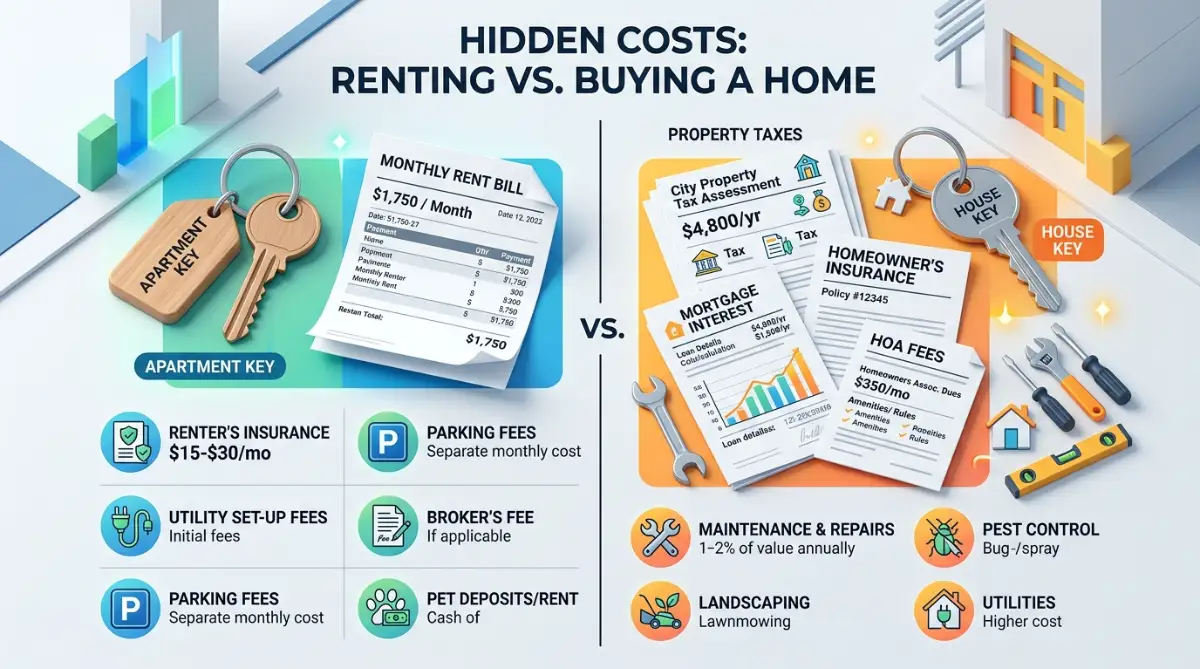
To make a smart choice, we must look past the simple monthly payments. Both paths have hidden fees that most people do not think about until it is too late. Let us look at what you are actually paying for when you sign a lease or a mortgage.
The True Cost of Rental Living
When you rent, your monthly payment is the maximum amount you will pay each month. This gives you a clear budget and peace of mind. You do not have to worry about a leaking roof or a broken water heater.
However, you must remember that rent is a continuous expense. You are paying for shelter, but you are not building any equity in the property. If you want to know how this value accumulates, check out our guide on what is home equity and how to calculate it the smart way. Once the lease is over, that money is gone forever.
Also, you have very little control over rent increases. A landlord can raise your rent at the end of your contract. This makes long-term financial planning much harder for young families.
The Quiet Expenses of Owning Property
When you buy, your mortgage is just the minimum amount you will pay each month. Many new buyers forget to calculate the extra costs of owning a house. These costs can add up very quickly and shock your budget. Reading our post on the hidden expenses of owning a home and how to calculate them can help you avoid these surprise bills.
You have to pay home insurance, learn how to calculate property taxes without losing your peace of mind, and understand community fees. Before you buy, make sure you are understanding HOAs and how rules and fees affect your daily peace.
You also become the sole person responsible for every single repair. If the heating system breaks, you must pay thousands of USD to fix it.
Calculating the Rent-to-Price Ratio
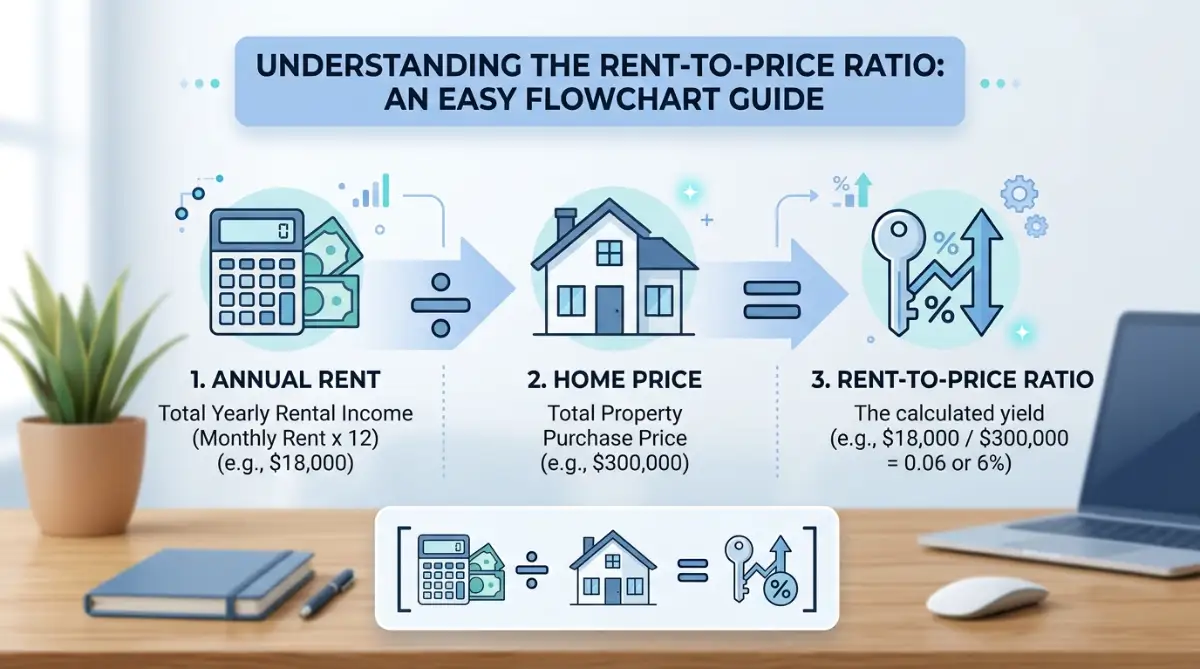
There is a simple math formula that can help guide your decision. It is called the rent-to-price ratio. This tool compares the cost of buying a home to the cost of renting a similar home in your area.
To find this ratio, you take the purchase price of a house and divide it by the total annual rent of a similar home. The resulting number gives you a clear indicator of which path makes more financial sense.
Let me show you how this actually works with a quick, real-life example so you can easily do the math yourself.
Imagine you are eyeing a cozy home priced at 300,000 USD. If you are flexible on where you want to live, checking the best cities for real estate investment in the US might open up much more affordable options.
To find a comparable rental, you look around and find that a similar house in the same area rents for 1,500 USD per month.
First, let's calculate your total annual rent:
1,500 USD × 12 months = 18,000 USD.
Now, we divide the purchase price by the annual rent:
300,000 USD / 18,000 USD = 16.6.
With a ratio of 16.6, you fall right into the middle zone. It tells us that while renting is still highly reasonable, buying becomes a very viable long-term option if you plan to stay put. This simple calculation gives you the confidence to make decisions based on cold, hard data rather than emotional stress.
If you want to play with your own numbers right now without doing the manual math, I highly encourage you to use the interactive Rent vs. Buy Calculator. It will do the heavy lifting for you in seconds!
I highly recommend taking some time to watch this deeply insightful video, Should You Buy Or Rent In 2026? (The Numbers SHOCKED Us!), from The Money Guy Show. It breaks down the exact formulas, opportunity costs, and current market shifts in a clear, easy-to-understand way that will help you make the right choice.
If the ratio is fifteen or lower, buying is usually the better choice. If the ratio is twenty or higher, renting is often much smarter. This math helps take the emotion out of your housing decision.
The Rule of Five Years for Housing Decisions
One of the most important factors in this choice is time. Buying a home involves high transaction costs, like agent fees and closing costs. These fees can easily consume your savings if you move too soon.
If you plan to stay in one place for less than five years, renting is almost always cheaper. This gives you the freedom to move without taking a big financial loss. It keeps your money liquid and your lifestyle flexible.
My Personal Realization: I made the mistake of buying a small condo when I only planned to stay in the city for two years. I lost thousands of USD in closing fees when I had to sell. My advice is to only buy if you can see yourself in that home for at least five seasons.
If you plan to stay for a long time, buying starts to make sense. Over many years, the value of your home will likely grow. This growth helps offset the initial costs of purchasing the property.
Evaluating Your Personal Financial Readiness
Before you look at houses, you must look at your own financial health. Buying a home requires a strong financial foundation. Without it, homeownership can quickly turn into a nightmare.
Your Debt-to-Income Ratio Explained
Lenders look closely at your debt-to-income ratio. This is the percentage of your monthly income that goes toward paying off debts. It includes student loans, car payments, and credit cards.
To get a great deal on a mortgage, banks want to see that you are not drowning in bills. If a huge chunk of your monthly paycheck already goes toward car loans or credit cards, adding a house payment can easily break your budget. From my own experience, it is much smarter to stay in a rental for a bit longer while you aggressively pay down those debts. Your future self will thank you when your mortgage application gets approved with an incredibly low rate.
The Emergency Fund Cushion
A down payment is not the only cash you need when buying. You also need a healthy emergency fund. This fund should be separate from your down payment money.
If you spend all your cash on the purchase, you are vulnerable. One major home repair could push you into debt. Keep at least six months of living expenses in a safe account.
The Psychological Side of the Housing Choice
We must also talk about how your housing choice affects your mind. Money is not the only thing that matters in this decision. Your daily comfort and peace of mind are just as important.
The Pride of Owning Your Space
For many, owning a home brings a deep sense of security. You can paint the walls any color you want. You can plant a garden, make permanent changes to the space, or do simple DIY upgrades to boost your home value fast.
This stability is wonderful for raising a family. You do not have to worry about moving because of a landlord's decision. It creates a true sense of belonging in a community.
The Freedom of Being Able to Walk Away
Renting offers a different kind of peace. It gives you incredible lifestyle flexibility. If you get a new job offer in another state, you can easily pack up and go.
You also avoid the mental load of home maintenance. When something breaks, you simply call the manager. This freedom is highly valuable for many people.
Advanced Strategies to Secure Your Financial Future
Making a choice between renting and buying a home is not just about today's expenses. It is about setting up a financial plan that protects you for decades. Let us explore some advanced strategies that can help you make a highly profitable housing decision.
The Sandbox Trial of Homeownership Costs
One of the best ways to test your readiness for buying is to run a budget simulation. If your current rent is one thousand USD but your estimated mortgage will be one thousand five hundred USD, do not guess if you can afford it. Instead, start transferring that five hundred USD difference into a separate savings account every single month.
Do this for at least six months without touching that cash for any reason. This trial will show you exactly how a higher payment affects your daily life and your stress levels. If you struggle to make ends meet, you know that buying at that price point is too risky right now.
On the bright side, if you succeed, you will have proved your budget works. You will also have saved an extra three thousand USD to help with your future purchase. This is a practical way to build confidence before making a major financial commitment.
Mastering the Art of Lease Term Negotiations
If renting makes the most sense for you right now, do not just sign the first contract the landlord hands you. Most people do not realize that rent prices and lease rules are often negotiable. Landlords hate empty apartments because it costs them a lot of money to find new tenants. You can use this to your advantage to secure a better deal, like asking for a rent freeze in exchange for a longer lease. You can use your strong rental history and stable income as leverage to get better terms.
For example, you can offer to sign a two-year lease instead of a one-year lease in exchange for a rent freeze. Landlords dislike empty apartments because turn-over costs are very high. By offering stability, you protect yourself from sudden rent hikes while saving the landlord money.
You can also look into your local consumer protection guidelines to understand your tenant rights. Knowing your rights prevents unfair fees and protects your security deposit. It is a simple step that can save you thousands of USD over time.
Tracking the True Opportunity Cost of Cash
When you buy a home, you must lock up a massive amount of cash in the down payment. This money is no longer liquid, meaning you cannot easily use it for other opportunities. We must compare how that same money would grow if it were invested in the financial markets instead.
Imagine you have fifty thousand USD cash ready for a down payment. If you decide to rent and invest that money in a low-cost index fund, it has the potential to grow significantly over ten years. Historically, the stock market has offered competitive long-term returns compared to average residential real estate.
By understanding this trade-off, you can see that renting is not a financial waste. If you are diligent about saving and investing the difference, you can build substantial wealth without owning property. If you do decide to buy properties later, you can check out our real estate investing step-by-step rental property guide and learn about tax savings with our guide on 1031 exchanges in real estate investing. This perspective takes the emotional pressure off the need to buy a home immediately.
Establishing an Independent Maintenance Escrow
For those who are ready to buy, you must change how you think about home repairs. Many new owners are shocked by how quickly small home issues can drain their savings. To avoid this stress, you should create a dedicated savings account specifically for home maintenance.
A good rule of thumb is to save one percent of your home's total value every single year for repairs. For a three hundred thousand USD home, this means setting aside three thousand USD annually, or two hundred fifty USD every month. You must treat this savings goal just like a utility bill that must be paid.
This habit ensures you always have cash ready when the roof leaks or the water heater breaks. Learn how to properly maintain your HVAC system to prevent costly repairs to protect your wallet from emergency situations. It keeps you from relying on high-interest credit cards during an emergency. This financial cushion is what separates happy homeowners from those who feel trapped by their property.
To learn more about preparing your bank accounts, read our complete guide on how to prepare your finances before applying for a mortgage. Having a higher credit score will save you thousands of USD in mortgage interest. It is one of the most effective ways to lower your monthly housing payments.

Destructive Missteps That Can Ruin Your Financial Peace
Even with the best intentions, it is easy to make mistakes when choosing your housing path. These errors can cost you your hard-earned savings and cause years of emotional distress. Let us look at the most common pitfalls so you can avoid them completely.
Allowing Your Heart to Dictate Your Wallet
Buying a home is a deeply emotional process that can easily cloud your judgment. You walk into an open house, see the beautiful finishes, and immediately start imagining your future life there. This emotional attachment can make you ignore serious issues with the property or the price.
You might find yourself offering more money than you can comfortably afford just to win a bidding war. This mistake leads to being house-poor, where all your income goes toward your housing payment. You will have a beautiful house but no money left for travel, hobbies, or emergency savings.
To protect yourself, you must set a strict financial limit before you start looking at properties. Promise yourself that you will walk away if the price goes even one USD over your budget. This simple rule will keep your emotions in check and protect your long-term peace of mind.
Underestimating the True Cost of Commuting
When searching for an affordable home to buy, many people look far outside the city center. They find larger houses for lower prices, which seems like a fantastic deal on paper. However, they often forget to calculate the time and money spent on a long daily commute.
A long drive to work means spending more money on fuel, car maintenance, and road tolls. More importantly, it steals hours of your free time every single week. This lost time can lead to higher stress levels and less quality time with your family.
Before you buy a home far from your job, calculate the actual cost of your daily travel. Sometimes, paying a bit more to live closer to work is actually the cheaper and healthier option. Your daily happiness is closely tied to how you spend your morning and evening hours.
Relying on the Advice of Biased Parties
During your housing journey, you will receive a lot of advice from different professionals. Real estate agents, mortgage brokers, and lenders will all offer their opinions on what you should do. While many of them are helpful, you must remember that their income depends on you making a transaction.
A lender might tell you that you qualify for a loan of four hundred thousand USD. This does not mean you can actually afford the monthly payments comfortably. Also, if the bank's assessment does not match, you should prepare for why your home appraisal came in low and how to fix it before you get stuck in the middle of a purchase.
Lenders do not consider your personal lifestyle costs, travel plans, or child care expenses when calculating your loan limit.
It is wise to seek neutral advice from independent financial planners who do not earn commissions from your choice. You can also consult with local housing counseling agencies for objective guidance. Taking this step ensures you are making a decision based on facts, not sales pitches.
If you are currently saving up, you can read our detailed article on saving for a down payment to speed up your progress. Knowing how to budget effectively is the key to reaching your goals faster. It helps you build a solid foundation before you take the leap.
Skipping the Independent Home Inspection Process
When houses are selling fast, you might feel tempted to skip the home inspection just to make your offer look better to the seller. Please, do not do this! It is one of the biggest mistakes you can make. A professional home inspection is your shield. It can expose massive hidden problems like a cracked foundation, bad wiring, or dangerous mold. If you skip this, you will have to pay for these expensive fixes out of your own pocket.
Always make your purchase offer contingent on a professional, independent home inspection. Our ultimate guide to inspecting a house before making an offer explains exactly what major problems to check for. If the seller refuses to allow an inspection, you should view this as a massive warning sign and walk away. Protecting your wallet is far more important than winning any specific property.
Your Housing Action Plan for Tomorrow
Now that we have covered the advanced strategies and common mistakes, it is time to create a clear action plan. You do not have to make this huge decision in a single day. Instead, focus on taking small, manageable steps to prepare your finances and clarify your goals.
To help you organize your thoughts, let us look at a daily task comparison for both paths. This table will help you understand what to focus on depending on the direction you want to take.
If you decide that renting is the best fit for now, focus on optimizing your budget. Use this time to build your savings and invest in your career or the financial markets. Renting is a highly effective tool for wealth building when you are disciplined with your extra cash.
For those planning to buy, use our guide on calculating your debt ratio to see where you stand with lenders. Knowing your numbers beforehand will make the pre-approval process much smoother. It allows you to fix any issues before you start falling in love with houses.
You can also read our guide on smart strategies for first-time homebuyers to save money and avoid regrets to learn from the experiences of others. Being prepared is the best way to ensure your real estate journey is a success.
It gives you the confidence to make smart choices at every step.
If your budget is tight right now, read our helpful guide on budgeting for a new apartment to find simple ways to cut costs. Saving money on rent allows you to build your down payment fund much faster. It is all about finding the right balance for your current life stage.
Finally, when you are ready to move forward with a purchase, check out the ultimate guide to the home buying process from offer to closing to understand every step, from securing mortgage pre-approvals to signing the final papers.
This step shows sellers that you are a serious buyer with solid financial backing. It gives you a clear competitive advantage in a crowded real estate market.
Frequently Asked Questions (FAQ)
1. Is renting actually a waste of money?
No, renting is not a waste. It buys you a safe place to live and keeps your money liquid. You can invest your savings in other places like stocks or retirement accounts instead of locking it up in a house. It also gives you the freedom to move easily when your life changes.
2. How much emergency savings should I have before buying a house?
You should aim to keep at least six months of living expenses in a separate account. This is extra cash that you do not touch for your down payment or closing costs. This safety cushion protects you from credit card debt when big home repairs happen unexpectedly.
3. What does a high rent-to-price ratio mean for my decision?
A high ratio, especially above 20, means renting is much cheaper than buying in your local area. It is usually smarter to rent and invest your extra cash elsewhere. If the ratio is low, under 15, then buying a home makes more financial sense.
4. What are the biggest hidden costs of owning a home?
The biggest hidden expenses are property taxes, homeowners insurance, and annual maintenance. You also have to pay for your own trash collection, water, and landscaping. Unlike renting, you are fully responsible for fixing everything that breaks.
5. Can I negotiate rent prices with a landlord?
Yes, you can almost always negotiate. You can offer a longer lease or show a history of paying on time to get a discount. Landlords hate empty properties, so they are often willing to drop the price to keep a great tenant.
My own housing journey taught me that patience is the ultimate financial super-power. I spent years renting and feeling like I was falling behind my friends who owned homes. However, because I waited until my finances were strong, I avoided the heavy stress of being house-poor when I finally bought. I want you to feel that same peace of mind when you make your choice. Trust your numbers, ignore the social pressure, and take the path that truly fits your unique life.
Disclaimer:
This article is for informational and educational purposes only. The information provided does not constitute professional financial, legal, or real estate advice. Please consult with a certified financial planner, real estate attorney, or licensed mortgage specialist before making any major financial decisions or signing any housing agreements.