

Why Applying for a Personal Loan Feels More Stressful Than It Should
I still remember the first time I tried to apply for a personal loan when my car's transmission died unexpectedly. I was sitting at my kitchen table late at night, overwhelmed by endless browser tabs and conflicting advice. My palms were sweaty, and I ended up closing my laptop because I was terrified of destroying my credit score or making a costly mistake. That awful feeling of stress and uncertainty is exactly why I put together this practical guide for you.
You finally decide to apply for a personal loan. Then the questions start piling up in your head.
Which lender do you even pick? What documents do they need? Will they say no after you've already spent an hour filling out a form?
This is the exact moment where a lot of people freeze. The application itself isn't hard. What makes it stressful is not knowing what to expect.
So you open five browser tabs, read three conflicting articles, and end up more confused than when you started.
One site tells you to apply everywhere at once to "see what sticks." Another warns that doing exactly that will tank your credit score. By the time you've read a fourth article, you're not sure who to trust anymore, so you close the laptop and tell yourself you'll deal with it tomorrow.
Why So Many Applications Go Sideways
Most of the trouble doesn't come from the loan itself. It comes from walking in unprepared.
Here's what usually goes wrong:
- People apply before checking their own credit report, so they get surprised by a denial they didn't see coming.
- They guess at how much to borrow, asking for either too little or too much.
- They skip reading the loan terms, then get blindsided by fees buried in the fine print.
- They apply to several lenders at once out of panic, which can quietly lower their credit score.
- They submit incomplete paperwork, which stalls the process for days or even weeks.
None of these mistakes happen because someone is careless. They happen because nobody hands you a clear checklist before you start.
The Hidden Cost of Getting This Wrong
A messy loan application doesn't just waste your time. It chips away at something harder to measure.
- You start dreading your inbox, afraid of seeing another rejection email.
- You feel embarrassed asking a loan officer questions that feel "too basic."
- You begin doubting your own financial judgment, even when the system is what's confusing.
- You put off applying altogether, even when you genuinely need the money.
- Stress from money problems can affect your sleep, focus, and even your relationships.
- You start comparing yourself to friends or coworkers who seem to "have it figured out," even though most of them struggled through the same confusion at some point too.
None of this means something is wrong with you. It means the process needs a clearer map, which is exactly what the rest of this guide is built to give you.
Take Daniel, a delivery driver in Texas. His car broke down and he needed $4,000 fast. He applied to four lenders in a single afternoon, hoping one would approve him quickly.
Two rejected him outright. One approved him but buried a steep origination fee in the contract he almost missed. By the time he found the right lender, three days had passed and his car sat in the shop the entire time.
Daniel's story isn't rare. It happens because loan websites are built to get clicks, not to walk you through the process step by step.
That's exactly what we're going to fix together. A personal loan application doesn't have to feel like a maze. Once you know the order of operations, the entire process becomes almost mechanical, the kind of thing you can knock out in one sitting instead of one stressful week.
Your Step-by-Step Checklist for Applying With Confidence
Let's turn this into something simple. Three steps now, two more coming in the next part of this guide.
Step One: Know Your Numbers Before You Touch a Single Application
Before you fill out anything, pull your credit report and figure out your real score.
You can get a free copy from each major credit bureau once a year through the official government-authorized site. Many bank apps also show a free, regularly updated score.
While you're checking, it's worth scanning for anything that looks off. Disputing errors on your credit report before you apply can raise your score by a noticeable amount within a few weeks.
While you're at it, calculate two more numbers:
- Your debt-to-income ratio. Add up your monthly debt payments and divide by your gross monthly income. Most lenders prefer this under 40%.
- Your monthly budget ceiling. Figure out exactly how much you can comfortably pay each month before you even start browsing loan amounts. Tracking your daily spending for a couple of weeks makes this number much easier to pin down accurately.
Think of this step like checking your gas tank before a road trip. Skipping it doesn't make the trip shorter, it just makes a breakdown more likely halfway through.
Step Two: Decide Exactly How Much You Need, Not How Much You Want
This step trips up more people than you'd think. Borrowing too little means you'll need a second loan later. Borrowing too much means paying interest on money you didn't actually need.
Write down the exact purpose of your loan and the exact dollar amount tied to it.
A few real-life scenarios to picture, so this feels less abstract:
- If you're consolidating $7,500 in credit card debt, borrow $7,500, not a rounded-up $10,000 "just in case."
- If a $3,200 medical bill is the reason, request that number, plus a small buffer for any related costs you can clearly justify.
- If you're covering a planned expense like a move, get an actual quote first instead of guessing.
Lenders also respond better to specific, well-explained loan purposes. A clear reason on your application can make the underwriting process faster, since it removes guesswork on their end too.
This single habit, writing down a real number tied to a real reason, often separates a smooth approval from weeks of back-and-forth questions from the lender.
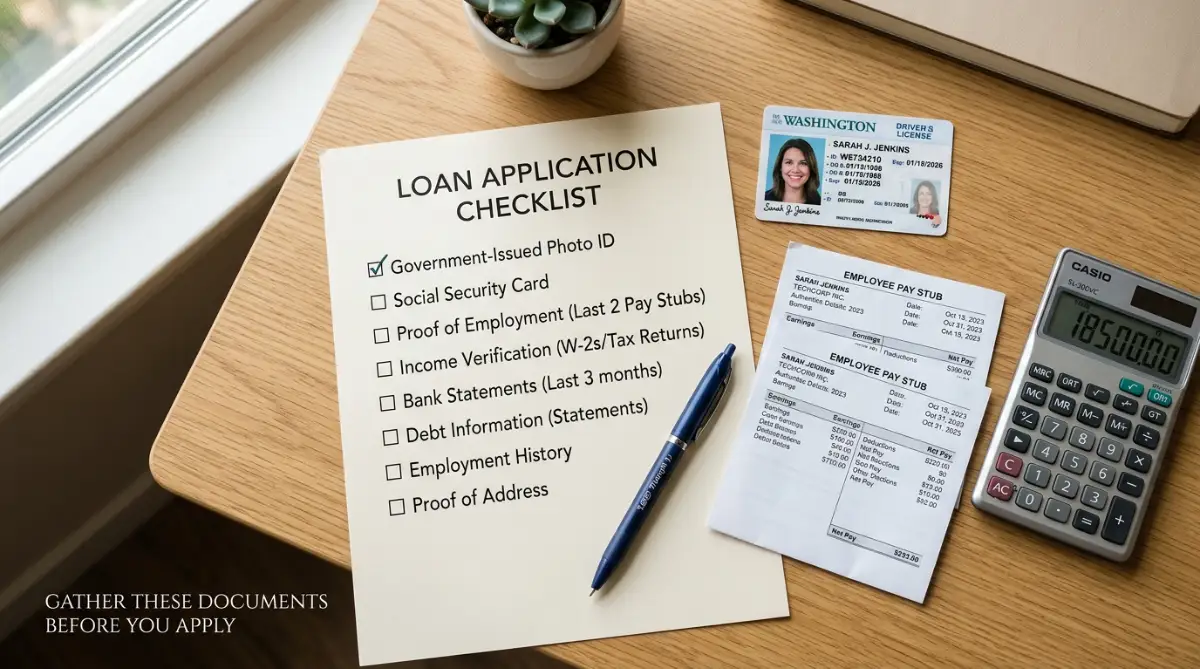
Step Three: Gather Every Document Before You Start the Application
This is the step most people skip, and it's the one that causes the most delays.
Having your paperwork ready before you apply can cut your approval time from days down to hours.
Here's a simple list to pull together in advance:
- Government-issued photo ID, such as a driver's license or passport.
- Proof of income, like recent pay stubs, tax returns, or bank statements if you're self-employed.
- Proof of address, such as a utility bill or lease agreement.
- Social Security number or taxpayer ID, required for identity verification.
- A list of your current debts, including balances and minimum monthly payments.
Picture this step like packing for a flight the night before instead of the morning of. Everything in one place means no last-minute scrambling.
Check Prequalification Before You Submit a Full Application
If you prefer watching a visual breakdown before diving into paperwork, check out this quick video tutorial. It walks you through the exact loan application steps so you know what to expect from start to finish.
Here's a detail that saves people a lot of stress. Most lenders let you check your likely rate through a soft credit pull, which does not affect your score at all.
This is different from the full application, which triggers a hard credit pull once you formally apply. Use the soft-pull option first, every time it's available. The difference between hard and soft credit pulls is worth understanding fully before you submit anything formal.
A simple way to think about it: prequalification is like trying on shoes in the store. Applying is like actually buying them. You want to know they fit before you commit.
Here is a mistake I personally learned the hard way: always use prequalification tools before submitting a real application. I once applied directly to three different places in a single day and watched my credit score drop overnight. Save yourself the headache and test the waters with soft checks first so your credit stays safe.
Here's how this plays out in practice. Maria, a teacher in Arizona, wanted a $6,000 loan to cover a home repair. Instead of applying blind, she used prequalification tools on four different lender websites first.
Two of them showed rates she didn't love. One showed a rate she was happy with. She moved forward with a single formal application instead of four, protecting her score the entire time.
Why Doing These Three Things First Changes Everything
Each one of these steps builds directly on the last. Knowing your numbers tells you which lenders will even consider you. Knowing your exact loan amount keeps you from over-borrowing or under-borrowing. Having your documents ready turns a multi-day process into something you can often finish in one sitting.
This isn't about being perfect. It's about removing the guesswork that causes most applications to stall out or get denied.
Clearing Up a Few Things Borrowers Often Get Wrong
A handful of beliefs trip people up before they even start their application. Let's clear them up.
"Prequalifying guarantees approval." It doesn't. Prequalification gives you an estimate based on a soft credit check, but the lender still verifies everything during the full application.
"Applying online is less safe than applying in person." Reputable online lenders use the same encryption standards as banks. The bigger risk is applying through an unfamiliar site that lacks clear contact information or physical verification, not the format itself.
"A cosigner is required if my income is low." A cosigner is optional in almost every case. It simply gives you a stronger application if your income or credit history is thin on its own.
"All lenders check the same things." Some weigh credit score heavily. Others weigh income or banking history more. This is exactly why comparing more than one lender matters, even when your numbers feel borderline.
"Once I submit, I can't change the loan amount." Many lenders allow adjustments before final funding, especially if you realize you requested slightly more or less than you actually need.
Borrowers who prepare this way consistently report smoother approvals and fewer surprises once they reach the offer stage. The difference between a frustrating application and a fast one almost always comes down to what happens before you click "Submit,"