The Silent Shock: How Interest Rates Took Me by Surprise
A couple of years back, I woke up, poured a mug of black coffee, and opened my brokerage app. What I saw made my stomach drop. My account was down by thousands of USD, and it kept sliding day after day. I was furious because I had put my savings into solid, blue-chip companies with clean track records. I could not understand why my balance was shrinking so fast.
It felt like walking up a downward escalator with a heavy backpack. Every time I thought the drop was over, another wave of red numbers hit my screen. For weeks, I blamed bad luck, company earnings, and market noise.
Then I figured out the real story. It was not the companies failing at all. It was the central bank quietly pushing interest rates higher in the background. That single move changed the value of every dollar, loan, stock, and bond in the country.
Most of us hear interest rate news and assume it only matters to Wall Street bankers. That is a dangerous mistake. Those rate changes reach directly into your savings account, your mortgage, and your retirement plans. I wrote this guide so you do not have to make the same painful mistakes I made. Let us break down how rate shifts actually work and how you can protect your hard-earned money without losing sleep.
⚡ Quick Takeaways: What You Need to Know
- The Seesaw Effect: When interest rates climb, bond prices and growth stock valuations tend to drop. When rates drop, asset prices generally shoot back up.
- Bonds Are Not 100% Risk-Free: Older bonds lose resale value when newer bonds come out with higher payout yields.
- Borrowing Costs Slow Growth: High rates make corporate debt expensive, eating away at company profits and home buyer demand.
- Cash Gets Rewarded: High-yield accounts and short-term Treasury bills offer strong, low-risk income during high-rate periods.
- Action Step: Pay off variable-rate debt first, build a ladder of short-term bonds, and own companies with strong cash flow.
The Seesaw Connection: How Interest Rates and Asset Values Interact
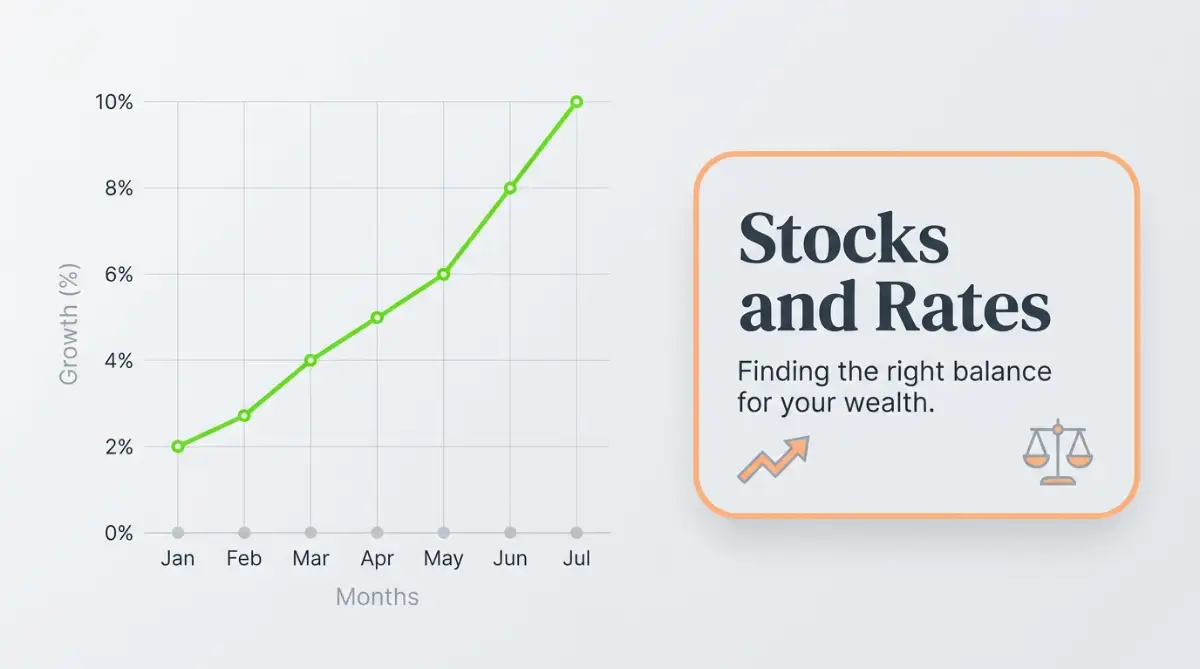
Think of interest rates like gravity on asset prices. When the central bank pushes interest rates up, that gravity gets stronger, pulling stock and bond values down toward earth. When they lower interest rates, gravity weakens, and prices float higher with ease. This happens because money naturally moves toward the easiest return. When a risk-free government note pays you 5% a year, taking risky bets on stocks becomes a lot less tempting.
This happens because money always seeks the easiest and safest way to grow. When central banks raise rates, they make safe options like government bonds and savings accounts look much more attractive.
This is why knowing how to define your personal risk tolerance is the first step before choosing between risky equities and safe cash. This simple question changes how millions of people and large institutions invest their money.
The Hidden Rules of the Bond Market
Bonds are essentially loans that you give to a government or a company. In return, they promise to pay you a fixed interest rate for a set period.
If you own a bond that pays three percent interest, you feel pretty good about it. But what happens if the central bank raises rates, and new bonds start paying five percent?
Suddenly, your three-percent bond looks very unattractive to other buyers. If you want to sell your bond before it matures, you will have to lower your price. This is why bond prices fall when interest rates rise.
This simple rule is something many new investors learn the hard way. They buy bonds thinking they are perfectly safe, only to watch the value drop when rates go up.
The Stock Market Reaction to Borrowing Costs
When interest rates rise, the cost of borrowing money goes up for everyone. This includes regular families buying homes and giant corporations building new factories.
If a company has to pay more interest on its loans, it has less profit left over. Lower profits usually mean lower stock prices.
Also, many fast-growing companies rely heavily on cheap loans to fund their expansion. When those loans become expensive, their growth slows down significantly.
Investors then become less willing to pay high prices for these shares. The stock market starts to cool down as people look for safer places to put their money. Even during these cooling cycles, beginners can still learn how to start investing in the stock market with little money by focusing on fractional shares of resilient companies.
How High Interest Rates Impact Different Asset Classes
Not all investments react the same way when rates begin to climb. Some assets struggle heavily, while others actually find a way to perform well.
Understanding these differences is the key to keeping your portfolio balanced and healthy. Let us look at how different types of assets behave in this environment.
Growth Stocks versus Value Stocks
Growth companies are businesses that promise massive profits far into the future. They often do not make much money right now, but they invest heavily to dominate their markets.
When interest rates are low, investors are happy to wait years for those future profits. But when rates are high, a dollar in the future is worth much less than a dollar today.
Value companies, on the other hand, are stable businesses that make steady profits right now. They often pay regular dividends to their shareholders.
These companies tend to hold up much better when rates rise. Investors appreciate the immediate cash flow they get from dividend payments.
Real Estate and the Mortgage Squeeze
Real estate is highly sensitive to interest rate changes because most people buy property using loans. When mortgage rates shoot up, the monthly cost of buying a home becomes much higher.
This keeps many potential buyers out of the housing market. As demand drops, home sellers are often forced to lower their asking prices to attract buyers.
Commercial real estate gets hit twice as hard. Most office towers and apartment complexes are not bought with 30-year fixed mortgages. Instead, developers use short-term loans that must be refinanced every 3 to 5 years. Imagine running an office park on a 3.5% loan, and suddenly the bank says your new rate is 7.5%. Your borrowing expense doubles overnight, your rental profits disappear, and the resale value of the property crashes. If direct real estate feels too risky during high rate periods, you can still learn how to invest in real estate without buying physical property using liquid alternatives like REITs.
Cash and High-Yield Savings Alternatives
For a long time, keeping cash in a bank account felt like a losing battle. The interest rates were so low that inflation slowly ate away at the purchasing power of every dollar.
When rates rise, this dynamic changes completely. High-yield savings accounts and certificates of deposit start offering decent returns.
For the first time in years, you can actually earn a return on your cash without taking any market risk. This makes holding cash a viable short-term strategy.
However, you must still be careful. If inflation is higher than the rate your bank pays, you are still losing a small amount of buying power.
Comparison of Assets in Different Rate Environments
To help you visualize this, let us compare how key assets perform in low versus high rate environments.
Expected Performance of a 10,000 USD Allocation Across Rate Environments
Your Step-by-Step Action Plan to Manage Rate Changes
You do not have to sit back and watch your investments suffer when rates fluctuate. There are several active steps you can take to protect your wealth and even grow it.
Step 1: Reduce Your Variable-Rate Debt First
Before you even think about buying new investments, look at what you owe. Any debt with a variable interest rate will become more expensive as rates rise.
Credit cards and personal lines of credit are the first things you should target. Paying down a loan that charges ten percent interest is the exact same as earning a guaranteed ten percent return on your money.
Step 2: Build a Bond Ladder for Safe Income
If you want to invest in bonds, do not put all your money into a single option. Instead, you can use a strategy called a bond ladder.
I once made the mistake of locking all my extra savings into a single long-term bond because the rate looked okay. A few months later, rates went up significantly, and I was stuck watching newer bonds pay much more while my money was trapped. Now, I always split my cash into bonds that mature at different times so I can regularly reinvest at higher rates.
This method ensures you always have cash coming due soon. If rates keep rising, you can use that cash to buy the new, higher-paying bonds.
If rates fall, you still have your longer-term bonds locked in at the older, higher rates. It gives you the best of both worlds.
Step 3: Focus on Cash-Rich Companies with Low Debt
When you look for stocks to buy during high-rate periods, check their balance sheets carefully. You want to find companies that have plenty of cash and very little debt.
These businesses do not need to borrow expensive money to keep operating. In fact, they can actually earn interest on their own cash reserves, turning a market headwind into a profit.
They also tend to have stable customer bases that buy their products regardless of the economy. These are often referred to as defensive stocks.
If you want to see a real-world breakdown of how interest rates affect everyday stock prices, this helpful video explains the connection in plain English and shows you what to watch out for next.
Step 4: Maximize Your Cash Yields
Do not leave your emergency savings in a traditional bank account that pays next to nothing. Take the time to shop around for a high-yield savings account.
Many online banks offer rates that are much higher than traditional brick-and-mortar banks. It takes only a few minutes to set up an account, and your money remains fully accessible.
You can also look into short-term treasury bills. These are backed by the government and often offer some of the safest yields available.
Why Central Banks Change Interest Rates in the First Place
To truly understand this system, we have to look at the people who control the dials. The central bank has the difficult job of keeping the economy stable.
They use interest rates as a tool to either speed up or slow down economic activity. Think of it like the gas pedal and the brake pedal in a car.
When the economy is struggling, the central bank steps on the gas pedal by lowering interest rates. This makes borrowing cheap, encouraging businesses to hire and people to spend.
Fighting the Monster of Inflation
However, if the economy grows too fast, it can cause inflation. This means the prices of everyday goods like groceries and gas start rising quickly.
When inflation runs hot, the central bank steps on the economic brakes by raising interest rates. They deliberately make loans expensive so consumers stop buying big-ticket items and companies pause their hiring sprees. It sounds harsh, but it is the only proven tool they have to bring daily living costs down. Their main challenge is slowing down inflation without slamming the economy into an outright recession. As an investor, your job is simply to watch which pedal they are pressing.
Reading the Signals from Central Bank Meetings
The leaders of the central bank meet regularly to decide what to do with interest rates. Financial markets watch these meetings with extreme focus.
You do not need to read every economic report they release. Just pay attention to their general tone and future outlook.
If they suggest that inflation is still too high, you can expect rates to stay high or rise further. If they worry about a slowing economy, rates may soon start to fall.
Common Myths About Interest Rates and Investing
There are several major misconceptions that cause investors to make poor decisions. Let us clear up these myths so you can invest with absolute confidence.
Myth 1: Rising Rates Always Ruin the Stock Market
Many people assume that a rate hike is an automatic signal to sell all their stocks. This is simply not true.
While rising rates can cause short-term market drops, the market often adapts over time. Historically, stocks have still managed to grow during periods of rising rates, provided the economy remains strong.
The key is simply to hold the right types of stocks. High-quality companies with strong pricing power can pass their higher costs onto customers and continue to thrive.
Myth 2: Cash is Always King When Rates Are High
It is true that high-yield savings accounts become much more attractive when rates go up. However, cash should rarely be your entire investment strategy.
Over the long term, inflation can still erode the real value of your cash. To build true wealth, you still need assets that grow faster than inflation, such as stocks or real estate.
Use cash as a safe haven for your emergency funds and short-term goals. Keep your long-term money invested in assets that have historical growth potential. The simplest way to keep your long-term wealth growing without stressing over market timing is to set up automatic investments for consistent savings every month.
Myth 3: You Should Avoid Bonds Completely
When rates are rising, bond prices do fall, leading some investors to avoid them entirely. But this ignores the regular interest income bonds provide.
If you hold a bond until it matures, you will receive your full principal back, assuming the issuer does not default. The temporary drop in market price only matters if you sell the bond early.
Also, once rates peak, locking in high-yield bonds can provide excellent income for years to come. Bonds remain an essential tool for managing overall portfolio risk.
Keeping a Balanced Mindset for Long-Term Success
The most important thing to remember is that interest rate cycles are completely normal. They have been going up and down for decades, and they will continue to do so.
Trying to time the market perfectly based on every minor rate change is a recipe for stress. Instead, focus on building a diversified portfolio that can handle any environment. Many long-term wealth builders compare index funds vs mutual funds to build a low-cost, balanced core that absorbs market swings.
By holding a mix of stocks, bonds, and cash, you ensure that some part of your portfolio is always working well. This balance is what allows you to sleep peacefully at night.
Review your financial goals regularly and make small adjustments when necessary. With patience and a clear understanding of the big picture, you can handle any interest rate cycle with complete ease.
Mastering the High-Rate Era: Expert Tactics for Long-Term Wealth
When interest rates begin to move, average investors often panic and make sudden changes. However, seasoned wealth builders look at these shifts as unique opportunities to adjust their portfolios for steady, long-term success.
To stay ahead of the curve, you must look beyond the basic savings accounts and traditional stocks. You need to understand how professional managers shield their capital and find hidden growth areas when the market shifts.
By applying these advanced strategies, you can build a portfolio that thrives in any financial environment. Let us look at how you can implement these professional methods starting today.
Understanding Duration Management in Bonds
When rates rise, not all bonds suffer the same fate. The secret to managing this lies in understanding a concept called bond duration.
Duration measures how sensitive a bond's price is to changes in interest rates. Bonds with long terms to maturity are highly sensitive, meaning their prices drop heavily when rates go up.
To protect your fixed-income portfolio, you should focus on short-duration bonds during rate hike cycles. These assets are much more stable and let you reinvest your money at higher yields sooner.
You can read more about how interest rate changes affect bond prices on the Federal Reserve educational guides to get a deeper grasp of bond mechanics. This knowledge will help you build a much stronger defensive base for your wealth.
Real Case Study: How I Fixed My Bond Disaster in 2022
The Blunder: In early 2021, I parked 15,000 USD into a 20-year Treasury bond fund yielding roughly 1.8%. I figured, "It is government-backed, so I cannot lose." Over the next 18 months, the central bank rapidly lifted rates to 5%. Because my fund owned ultra-long bonds, its resale price tanked by over 28%. My 15,000 USD was suddenly worth less than 11,000 USD on paper.
The Fix: I stopped waiting for long-term rates to fall. I moved my remaining capital into a T-Bill Ladder with 3-month, 6-month, and 12-month maturities. As each bill matured, I rolled the cash into new bonds paying over 5.2%. My portfolio value stabilized immediately, and the steady cash payouts helped recover my initial losses within two years.
Strategy Breakdown: Holding Cash vs. Buying Bonds at Peak Rates
- Holding High-Yield Cash:
- Upside: Zero market volatility, instant liquidity for emergencies, and dependable monthly payouts.
- Downside: Rates can drop overnight if central banks cut rates; inflation eats away purchasing power over time.
- Locking in 5-Year High-Yield Bonds:
- Upside: Guarantees high payout yields for half a decade even if interest rates crash next month.
- Downside: Your money is locked; selling early can trigger paper losses if rates push higher.
The Magic of Sector Rotation
During times of rising interest rates, different parts of the economy perform in highly predictable ways. Professional investors use a strategy called sector rotation to move their money into industries that benefit from higher rates.
For example, financial institutions like banks often see their profit margins improve because they can charge more for loans. Insurance companies also tend to perform well because they earn higher returns on the massive cash reserves they hold.
On the other hand, heavy manufacturing and utility companies often struggle because they carry large amounts of debt. By shifting your focus toward the financial and energy sectors, you can ride the wave of rising rates rather than fighting against it.
Here is a simple look at how different sectors handle rate increases. We will look at their typical performance when interest costs rise across the board.
Cash Flow Analysis: Finding the Safe Havens
When cheap money disappears from the market, cash flow becomes the most important metric for any company. You must look for businesses that generate real, actual cash today, rather than promising massive earnings in the distant future.
These companies can pay their bills, fund their own growth, and continue to distribute dividends to you without needing expensive loans. They are the true anchors of a resilient portfolio when borrowing costs are high.
Look at their balance sheets to ensure they do not have massive debts coming due soon. If a company has to refinance millions of USD in debt at double the old rate, its profits will quickly vanish.
The Strategic Power of Dividend Growth Stocks
Many investors make the mistake of chasing the highest-paying dividend stocks when rates rise. However, a high dividend yield can sometimes be a trap if the company is struggling to survive.
Instead, look for companies with a proven history of growing their dividends year after year. These businesses have highly stable cash flows and strong management teams that protect shareholder value.
As these companies raise their payouts, your personal yield on your initial investment continues to grow. This provides an excellent shield against the rising cost of living.
To learn more about analyzing safe yields and avoiding risky assets, you can review the SEC investor protection guides for helpful resources. Keeping your money safe from high-yield traps is a massive step toward long-term peace of mind.
Implementing a Dynamic Cash Reserve Strategy
Earning a high yield on your cash is great, but you must also keep that cash ready to use when great opportunities appear. When markets drop due to rising rates, excellent companies often sell at major discounts.
If all your money is locked up in long-term investments, you will not have the liquidity to buy these cheap shares. Keeping a portion of your wealth in high-yield savings accounts or short-term treasury bills gives you the perfect tool to strike when the time is right.
Think of your cash reserve not just as an emergency fund, but as an opportunity fund. When other investors panic and sell their high-quality shares, you can use your cash to buy them at bargain prices.
This proactive approach turns market volatility from a scary threat into a highly profitable shopping spree. It is the ultimate difference between an amateur investor and a long-term wealth builder.

Dangerous Pitfalls: The Blind Spots That Drain Your Portfolio
When interest rates begin to swing, many investors fall into common traps that can cause severe financial damage. These mistakes are usually driven by fear, confusion, or a simple lack of patience.
If you do not recognize these pitfalls early, you can easily wipe out years of hard-won progress in your portfolio. Let us explore these dangerous moves so you can avoid them entirely and keep your savings safe.
The Risk of Chasing High Yields Blindly
When safe government bonds start paying high interest, many investors get greedy and look for even higher returns. They see online platforms or secondary lenders offering massive interest rates and move their life savings there.
This is an incredibly dangerous game to play during a high-interest rate cycle. High rates put massive pressure on weaker businesses, making them far more likely to default on their debts.
If a platform promises you fifteen percent interest when the safe rate is five percent, they are taking massive risks with your money. If that business fails, you lose your entire initial investment, which can be devastating for your financial future. To protect your hard-earned money, make sure you know how to spot bad stock and financial advice on your feed before falling for unrealistic yield promises.
Always remember that there is no such thing as a free lunch in the financial world. If the yield looks too good to be true, it is because the risk of losing your money is incredibly high.
Letting Short-Term Panic Control Your Long-Term Plan
One of the most painful sights in investing is watching someone sell all their assets at the very bottom of a market drop. When interest rates rise, the stock market often experiences sharp, scary declines.
The constant negative news on television and social media can make you feel like the world is ending. Out of pure fear and the desire to protect what is left, many people hit the sell button. Learning how to overcome financial anxiety during market crashes is essential so you do not lock in permanent losses.
By doing this, you turn a temporary drop on paper into a permanent financial loss. You miss out completely on the eventual recovery that historically follows every single rate cycle.
Successful investing requires you to control your emotions and focus on the years ahead, not the daily news. If you bought high-quality assets, their long-term value remains intact despite temporary price drops.
Ignoring the Quiet Erosion of Inflation
Another major mistake is moving your entire portfolio into cash because safe savings accounts are finally paying decent returns. It feels incredibly comfortable to watch your savings balance grow with zero market risk.
However, this comfort can be a dangerous illusion if you ignore the impact of inflation. If your high-yield savings account pays four percent interest, but the cost of groceries and rent is rising by five percent, you are still losing wealth.
Your cash balance might be going up, but your actual purchasing power is steadily shrinking over time. This is why you must always maintain a healthy balance between safe cash and growing assets.
The table below highlights some of the critical behaviors you should adopt, compared to the common mistakes that hurt average portfolios.
Forgetting to Review Your Personal Debt Structure
Many people focus so much on their investment accounts that they completely forget about the debt side of their personal sheet. If you hold variable-rate loans, a rise in interest rates can quietly drain your monthly budget.
Your credit card interest rates will climb higher, and your personal lines of credit will become far more expensive. If you continue to carry these debts while hoping to earn a return in the market, you are working against yourself.
Paying off a loan that has a high interest rate is always a smart financial move. It is the absolute equivalent of earning a risk-free, tax-free return equal to that interest rate.
Always secure your home front by cleaning up expensive debt before you start taking risks with new investments. This simple priority shift can save you thousands of USD over the course of a single rate cycle.
Your Blueprint for Resilient Wealth Creation
Taking control of your financial future is all about building a system that can withstand any economic weather. Interest rates will continue to go up and down, but your strategy should remain steady and focused on long-term growth.
By understanding the rules of the game, you can turn these economic shifts into massive advantages for your portfolio. Let us look at a practical, simple checklist you can use to stay on track.
- Review Your Liabilities: Check all your personal loans and mortgages to ensure your interest rates are locked in at fixed levels.
- Boost Your Cash Cushion: Move your short-term savings into a high-yield account to earn a proper return on your cash.
- Shorten Your Bond Duration: Keep your fixed-income investments focused on short-term horizons to reduce price volatility.
- Filter for Quality: Look for companies with high cash reserves, steady profits, and zero immediate refinancing needs.
- Automate Your Investing: Use dollar-cost averaging to buy high-quality assets regularly, regardless of where rates are.
This simple list is your shield against market confusion. It keeps you focused on the things you can actually control, rather than worrying about the decisions of central banks.
Over time, this disciplined approach will set you apart from the crowd. You will build a strong financial foundation that serves you and your family for years to come.
My journey in the financial world taught me that the best investors are not those who predict the future perfectly. Instead, they are the ones who prepare their portfolios for any possible outcome. I spent years worrying about every single interest rate announcement, letting it ruin my sleep and stress my mind.
Once I stopped trying to guess the next move and focused on building a solid, diversified foundation, everything changed. My portfolio grew stronger, and my peace of mind returned. I want you to feel that same confidence and clarity with your own money today. Take that first step, check your accounts, and start building your resilient financial future right now.
Frequently Asked Questions (FAQ)
1. What happens to my mortgage when the central bank changes interest rates?
If you have a fixed-rate mortgage, your monthly payment will not change at all. If you hold an adjustable-rate mortgage (ARM) or a home equity line of credit, your rate will climb, meaning a larger portion of your monthly check will go toward paying interest rather than your principal balance.
2. Why do high interest rates hurt growth stocks more than value stocks?
Growth stocks base their valuation on projected profits 5 to 10 years into the future. When interest rates rise, the mathematical formula investors use to discount future profits reduces today's value of those future earnings. Value stocks, by contrast, generate dependable profits right now, making them much less vulnerable to that math problem.
3. Is keeping all my money in a high-yield savings account safe right now?
Your principal is secure up to government insurance limits (such as FDIC coverage in the US up to 250,000 USD per bank). However, holding 100% cash long term exposes you to inflation risk. If everyday living expenses increase at a rate higher than your savings yield, your true purchasing power declines every month.
4. What is a bond ladder and how does it protect my savings?
A bond ladder is a method where you split your money into multiple bonds that mature at different dates (such as 3 months, 6 months, 9 months, and 12 months). Every time one tranche matures, you receive your cash back and can reinvest it into newer bonds at current market rates, giving you continuous liquidity.
5. How do I know when the central bank is done raising rates?
Central banks signal rate pauses through their official policy statements and press conferences. They look for steady signs that inflation is dropping back toward their target (usually around 2%) and that the labor market is cooling down. Once those numbers align, they hold rates flat before considering eventual rate cuts.
📚 Explore More Investing & Wealth Guides:
- Stop Losing Money: Why You Need an Investment Exit Plan
- Understanding Digital Assets: A Simple Bitcoin and Ethereum Guide
- Building a Multi-Asset Crypto Portfolio for Long-Term Wealth
- How to Safely Buy Your First Bitcoin: Beginner Walkthrough
- How Decentralized Finance (DeFi) Operates in Modern Markets
- How to Track Digital Asset Trades and Avoid Tax Penalties
- What Are Smart Contracts? A Complete Beginner Breakdown
Disclaimer
This article is for informational and educational purposes only and should not be considered professional financial, investment, or legal advice. Investing involves risk, including the possible loss of principal. Always consult with a certified financial planner or advisor before making any major investment decisions to ensure they align with your personal situation and risk tolerance.