The Hidden Danger of Signing a Business Lease Unprepared
I still remember the knot in my stomach the morning I signed my very first office lease. I was twenty-six, bursting with excitement, and ready to take my small marketing agency out of my tiny living room into a real storefront. The property manager smiled, handed me a fifty-page contract packed with fine print, and pointed at the signature line.
I felt rushed and excited, so I skimmed through the pages and signed my name. That single signature turned into a massive financial headache. Six months later, I received a surprise repair bill for 4,200 USD because the building's central heating unit failed.
I had no idea my contract made me personally responsible for fixing a thirty-year-old system. It wiped out my entire working savings and nearly put me out of business before my second year.
That painful wake-up call taught me a hard truth: commercial contracts are written to protect property owners, not you. Residential laws do not step in to save you when you run a business. Every single line in that paperwork is a financial commitment.
If you are getting ready to rent a shop, warehouse, or office space, do not repeat my mistakes. Let us walk through the exact steps you need to take to protect your business, keep your cash safe, and negotiate a contract that works in your favor.
Quick Summary: What Every Business Owner Needs to Know
- Commercial Leases Lack Safety Nets: Unlike residential rentals, the law expects you to protect yourself. Everything in the contract is open for negotiation.
- Watch Out for Extra Hidden Costs: Base rent is only a fraction of your real bill. Look closely at Common Area Maintenance (CAM) and annual rent jump rates.
- Measure What You Actually Use: Ensure you know the difference between usable square footage and rentable square footage before agreeing on pricing.
- Always Cap Your Repair Exposure: Never accept full responsibility for major building items like roofs, foundations, or aging air systems.
How to Break Down Your Business Rental Agreement
Before you put pen to paper, remember that commercial renting plays by completely different rules than renting an apartment. Consumer protection laws do not apply here. The legal system expects you to be a savvy operator, which is why understanding contract law and your legal rights is so critical before entering any binding deal. Landlords build high margins into their initial drafts, waiting to see if you will push back. We need to inspect every line together so your revenue stays in your pocket.
Understanding the Three Main Types of Commercial Leases
Not all agreements use the same payment structure, and this can change your monthly costs. You must identify which type of contract is sitting on your desk before doing any math. The three most common structures are Gross, Modified Gross, and Net contracts.
A Full Service Gross lease is the most simple option for a tenant. In this setup, you pay one flat monthly rate to the landlord. The landlord takes care of all building costs, insurance, taxes, and daily utilities from that single payment.
A Modified Gross lease is a hybrid option where you share some costs. You will pay a base rent plus a portion of the building expenses. This is common in multi-tenant office buildings where bills are split among everyone.
Then we have Net leases, which are the most common in retail and industrial buildings. In these setups, you pay a lower base rent but cover other property expenses directly. The most common version is the Triple Net lease, often written as NNN.
Under an NNN contract, you pay base rent plus your share of property taxes, building insurance, and common area upkeep. This can make your monthly bills highly unpredictable.
Let us look at a simple comparison table to see how these structures handle common building costs:
(Note: All costs in the table above are usually calculated in USD per square foot annually.)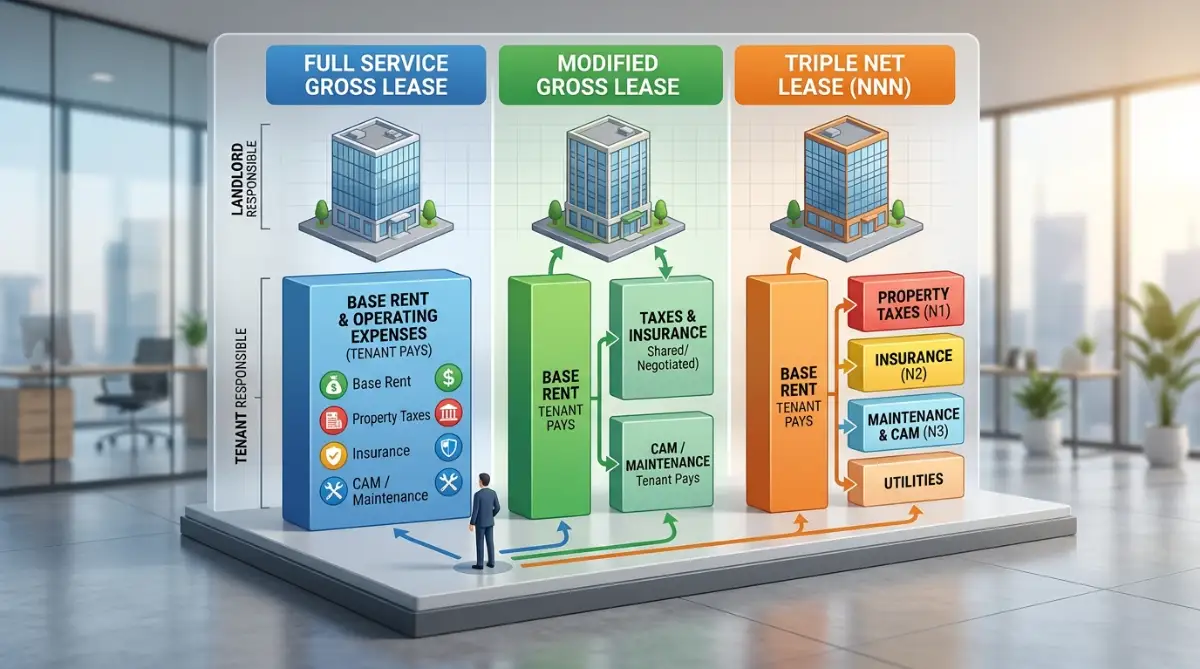
Commercial Lease Structure Breakdown (Based on 2,500 Sq Ft Space)
Deconstructing the Actual Cost: Base Rent vs. Extra Fees
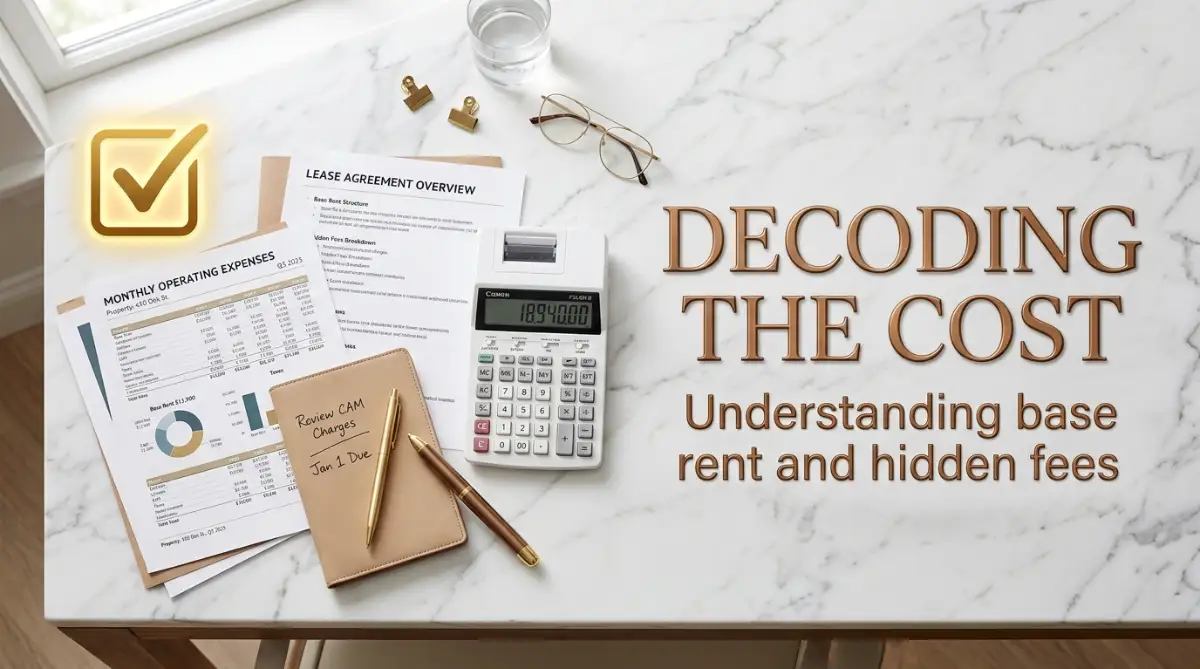
The first number you see in the contract is almost never the total amount you will pay. Many landlords show a low base rent to make the space look attractive. You must look deeper to find the extra costs that will hit your bank account.
These extra costs are often grouped under Common Area Maintenance, also known as CAM fees. CAM covers things like hallway lighting, parking lot cleaning, snow removal, and security guards. Landlords estimate these costs at the start of the year and charge you a monthly fee.
At the end of the year, the landlord compares the actual costs to what you paid. If the actual costs were higher, you will receive a bill for the difference. This can be a massive shock if you did not prepare your budget for it.
Why You Must Watch the Video Guide Below Before Signing
Before we look at the next clauses, take a moment to watch this visual breakdown of lease traps.
The Hidden Trap of Rent Escalation Clauses
Your rent will rarely stay the same for the entire length of your contract. Most landlords build rent increases directly into the text using escalation clauses. These increases usually happen once every twelve months.
Some contracts use a fixed percentage increase, such as three percent per year. Other contracts tie the increase to the Consumer Price Index, which measures inflation. Tieing rent to inflation can be highly risky because your costs could spike during high inflation years.
You should always try to negotiate a cap on these annual increases. A cap ensures your rent cannot grow beyond a certain percentage, no matter how high inflation goes. This helps you plan your business finances with certainty for years to come.
My own early mistake was agreeing to an uncapped inflation clause that cost me dearly. I did not read the fine print, and my rent jumped by eight percent in a single year. I had to cut my own salary just to keep up with the new monthly payments.
Usable Space vs. Rentable Space: What Are You Paying For?
One of the most confusing parts of a commercial contract is how space is measured. You will see two different terms: usable square footage and rentable square footage. Usable space is the actual physical area where you place your desks, inventory, and employees.
Rentable space includes your usable space plus a share of the building's common areas. These common areas include lobbies, shared bathrooms, elevators, and utility closets. Landlords use a formula called the load factor to calculate this difference.
For example, if a building has a load factor of fifteen percent, your rentable space is fifteen percent larger than your actual usable space. You pay rent based on the rentable space, not the usable space. You must measure the space yourself to ensure you are not paying for empty air.
Let us look at a practical example of how this affects your monthly budget:
As you can see, you are paying an extra 500 USD every month for space you cannot actually use for work. You must factor this difference into your business plan before agreeing to the terms.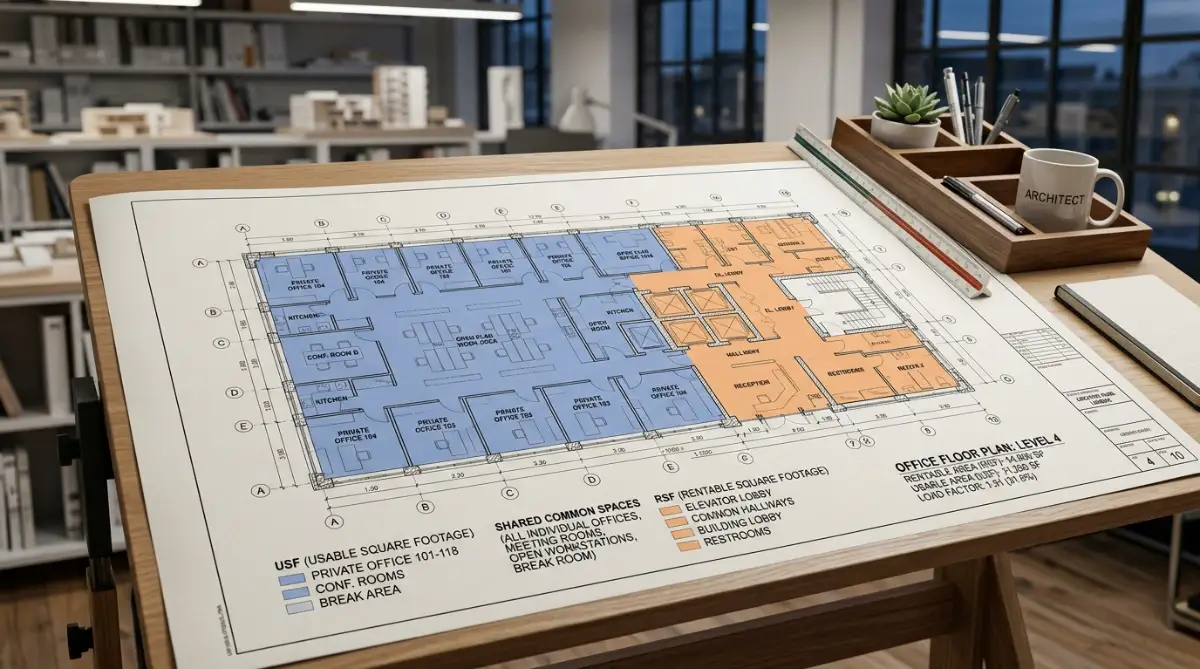
The Assignment and Subletting Clause: Your Exit Strategy
A commercial lease is a major multi-year commitment, often locking you down for five to ten years. Things change fast in business. You might outgrow your storefront in two years, or you might need to downsize to save money. If you do not have a strong assignment and subletting clause, you are personally on the hook for every cent of the remaining term. Always make sure your contract gives you the right to pass the space to another business owner, and confirm the landlord cannot drag their feet or refuse reasonable sublease requests.
Maintenance and Repair Responsibilities: Who Pays for What?
In a typical home rental, the landlord fixes everything from a broken light bulb to a leaking roof. In a commercial setting, these rules are turned completely upside down. You might be responsible for fixing things you do not even own.
You must read the maintenance clause carefully to see where your duties stop. Usually, tenants are responsible for everything inside the four walls of their space. This includes light fixtures, carpet wear, interior paint, and minor plumbing.
The landlord should remain responsible for the foundation, the exterior walls, and the main roof. The most dangerous item to watch out for is the heating, ventilation, and air conditioning system, known as the HVAC. Replacing a commercial HVAC system can cost tens of thousands of USD.
You should negotiate to have the HVAC system inspected and serviced before you move in. Try to limit your repair costs for major systems to a small annual cap. If the system fails completely, the landlord should cover the replacement cost.
The Power of the Cure Period: Protecting Your Business from Default
If you miss a rent payment or break a rule, the landlord can declare you in default. In a worst-case scenario, they can lock you out of your business within days. To prevent this, you must look for a term called the cure period.
A cure period is a set amount of time you have to fix a lease violation before the landlord can take legal action. For financial defaults, like late rent, you should negotiate a cure period of at least five business days. For non-financial defaults, like a broken window, you should have at least fifteen days.
This buffer time protects your business from sudden closure due to simple administrative errors. Never sign a contract that allows the landlord to evict you without written notice and a fair chance to fix the issue.
How Security Deposits Are Handled in Business Contracts
Commercial security deposits are much larger than residential ones, often equaling several months of rent. Landlords hold this money to cover potential damages or unpaid bills when you leave. However, the rules for returning this deposit are much more loose.
You must ensure the text clearly states when and how your deposit will be returned after the contract ends. It should specify a deadline, such as thirty days after you hand over the keys. You should also ask for a "burn-down" clause if you are signing a long-term agreement.
A burn-down clause reduces the security deposit amount over time if you make your payments on time. For example, your deposit might drop from three months of rent to one month after two years of good history. This frees up valuable cash that you can reinvest back into your business operations.
Guarantees and Personal Liability: What Are You Risking?
Setting up an LLC or corporation gives you a sense of safety, but landlords will almost always ask for a personal guarantee before giving you the keys. Signing an unlimited personal guarantee puts your house, bank accounts, and family assets on the line if your shop runs into financial trouble. You should always push for a "good guy" guarantee or a capped guarantee. This ensures your personal financial liability stops once you hand back the keys with the space in good working order.
💡 Recommended Guides on Protecting Your Personal Wealth & Family:
- Power of Attorney Guide: What Is a Power of Attorney? Complete Guide to Protecting Your Family
- Estate Planning: What Happens If You Die Without a Will and How to Protect Your Assets
- Court Cost Reduction: Protect Your Wealth: Best Ways to Reduce Probate Court Costs
Understanding the Holdover Clause: What Happens When Your Lease Ends?
Many business owners do not think about what happens on the very last day of their agreement. If you stay in the space even one day past your end date, you enter "holdover" status. Landlords charge massive penalties for holding over without a new agreement.
A typical holdover penalty can be one hundred and fifty percent to two hundred percent of your normal rent. This rate is charged daily, meaning a few extra days can cost you thousands of USD. You must check this clause and try to lower the penalty to a reasonable rate.
Ideally, you should have the option to transition to a month-to-month agreement at a slightly higher rate while negotiating a renewal. This prevents you from being forced out or fined during a transition period.
Resolving Lease Disputes Safely
Even with a great contract, disagreements can happen between you and your landlord. When they do, you need clear ways to resolve rental arguments outside of court without spending a fortune on legal fees. You must look for a dispute resolution clause in the document.
This clause usually outlines whether you will use mediation, arbitration, or traditional court systems. Mediation is a friendly process where a neutral person helps you reach an agreement. Arbitration is more formal, where a private judge makes a final, binding decision.
Both of these options are usually much faster and cheaper than going to court. You should request that both parties split the costs of mediation or arbitration equally. This keeps the process fair and prevents the landlord from using expensive legal fees to pressure you.
The Importance of the Estoppel Certificate
During your tenancy, the landlord might decide to sell the building or get a new loan. When this happens, they will ask you to sign a document called an estoppel certificate. Many tenants sign this document without reading it, which is a major mistake.
An estoppel certificate is a legally binding statement confirming the current status of your lease. It lists your current rent, security deposit, and whether the landlord owes you any money or repairs. Once you sign it, you cannot claim otherwise in the future.
If your landlord promised to fix the roof but has not done it yet, you must list that on the certificate. If you do not, you lose your right to demand that repair from the new owner. Treat every estoppel certificate with the same care as the original lease document.
Summary of Key Terms You Must Double-Check
Before we wrap up this guide, let us review a quick checklist of terms you should look for. You should verify each of these items in writing before signing your name.
- Base Rent Amount: Confirm the starting rate matches your verbal agreement.
- Escalation Schedule: Know exactly when and by how much your rent will rise.
- Additional Expenses: Understand your share of property taxes, insurance, and CAM fees.
- Usable vs. Rentable Space: Ensure you are comfortable with the load factor and square footage.
- Repair Duties: Confirm you are not paying to fix major structural building systems.
- Exit Options: Ensure you have subletting rights and a reasonable cure period.
Taking the time to verify these points will save you from sleepless nights and financial ruin. Your business deserves a solid foundation, and that starts with a fair and clear lease contract.
Expert Tactics for Structuring a Winning Commercial Agreement
Before you sit down to negotiate, you must realize that landlords expect you to counter their first offer. They build extra profit margins into their initial drafts, waiting for you to ask for changes. If you do not ask, you are leaving your money on the table.
We want to focus on advanced tactics that can save you tens of thousands of USD over the life of your contract. These are the secrets that experienced business owners use to protect their cash flow and assets. Let us look at how you can use these tools to your advantage.
Negotiating Your Tenant Improvement Allowance
A Tenant Improvement Allowance is money the landlord gives you to renovate and prepare the space for your business. You must decide whether you want a turn-key build-out or a standard allowance. Under a turn-key setup, the landlord manages the entire construction process using their own contractors.
This saves you time, but you lose control over the quality of the materials used in your shop. If you choose a standard allowance, the landlord pays you a set amount of USD per square foot of space. You hire your own contractors and manage the design directly to match your exact brand needs.
However, you are responsible for any costs that go over the agreed allowance amount. You must negotiate a clear timeline for when the landlord will release these funds to your bank account. Let us look at Sarah, a bookstore owner who negotiated a fifty thousand USD allowance.
Because of construction delays beyond her control, the total cost reached sixty-five thousand USD. Since she did not negotiate a clause to share unexpected cost overruns, she had to pay the extra fifteen thousand USD out of her own pocket. This mistake could have been avoided with a simple cost-sharing clause in the agreement.
(Note: Always specify all build-out values in USD within your contract to avoid currency confusion.)
Myth vs. Fact: What Landlords Do Not Tell You
- Myth: "The advertised base rent is the total amount you will pay each month."
- Fact: In many commercial properties, CAM charges, building insurance, and property tax adjustments add twenty to forty percent on top of the base rate.
- Myth: "If the air conditioning breaks down, the building owner will replace it."
- Fact: Unless your contract clearly sets an annual repair ceiling, you could be billed over 12,000 USD for a complete unit replacement.
- Myth: "A personal guarantee only covers the months you occupied the building."
- Fact: An unlimited guarantee makes you personally responsible for all remaining years on the contract if your company closes down.
Real-Life Case Study: The 18,000 USD HVAC Surprise
In 2023, a boutique fitness studio rented a 3,000-square-foot commercial unit in Denver. The owner signed a standard NNN agreement assuming the landlord would maintain the mechanical systems. Eight months later, two rooftop compressor units broke down during a heatwave. The landlord presented an invoice for 18,000 USD, pointing to a single sentence in the contract that assigned all equipment maintenance and replacement to the tenant.
The Lesson: Always require a third-party HVAC inspection report before signing, and negotiate a clause stating that the landlord covers full system replacements while your annual maintenance liability is capped at no more than 1,000 USD per year.
Securing an Exclusive Use Protection Clause
Imagine opening a specialty bakery, only to have the landlord lease the space next door to a massive national donut chain. This happens all the time to business owners who do not secure an exclusive use clause. This clause prevents the landlord from renting any other space in the shopping center to your direct competitors.
You must define your business activities clearly to make this clause work. If you simply write "restaurant" as your business type, the landlord could still lease space to a bakery. Instead, specify your main products, like "baked goods, pastries, and specialty desserts", to protect your market share.
We must also discuss the penalties if the landlord breaks this promise. The agreement should allow you to pay reduced rent or end your contract early if a competitor moves in. This gives you real leverage and forces the landlord to respect your exclusive space rights.
📌 Recommended Reading: How to Lock Down Your Brand & Business Assets:
- Trademark Basics: How to Register a Trademark: A Simple Legal Guide for Beginners
- Asset Protection: Trademark vs. Patent vs. Copyright: How to Secure Your Business Assets
- Online Security: Stop Digital Theft: Easy Ways to Secure Your Online Intellectual Property
The Hidden Power of Operating Expense Audits
Most triple net agreements force you to pay a share of the landlord's annual operating costs. But how do you know if the landlord is actually spending that money on the building? You must write an audit clause directly into the agreement to protect your business.
An audit clause gives you the right to hire an independent accountant to review the landlord's financial books. You should look for inflated management fees, double-billed expenses, or personal luxury items hidden in the upkeep costs. If the audit reveals a mistake of more than three percent, the landlord should pay for the audit costs.
Without this right, you are blindly paying whatever invoice the landlord sends your way. You can find detailed resources on commercial expense standards through professional groups like the Building Owners and Managers Association standards. They help define what constitutes fair and standard building expenses.
Demystifying SNDA: Your Shield Against Bank Foreclosures
A major risk that business owners overlook is what happens if the landlord goes bankrupt. If the bank forecloses on the property, they can legally cancel your lease and kick you out. To prevent this, you must demand a Subordination, Non-Disturbance, and Attornment agreement, known as an SNDA.
An SNDA is a three-way agreement between you, your landlord, and the landlord's lender. The key part is the "non-disturbance" clause, which protects your tenancy. It states that as long as you pay your rent on time, the bank will respect your lease even if they take over the building.
This means a bank cannot evict you to bring in a higher-paying tenant if the landlord defaults. We always advise our clients to make sure this document is signed by all three parties. It is a simple step that provides massive security for your business future.
Securing the Right of First Refusal to Buy or Expand
What happens if your business grows and you need to expand your physical space? Or what if the landlord decides to sell the entire property? You can protect yourself by adding a Right of First Refusal clause.
This clause states that if the landlord receives an offer to sell or lease adjacent space, they must offer it to you first. You have the right to match that offer before they can close a deal with anyone else. This keeps you in control of your expansion plans without moving to a new location.
Without this protection, you might find your business surrounded by competitors or squeezed into a small space. We have seen many retail brands lose their prime spots because the building was sold without their knowledge. You can read more about standard property transaction rules on the Small Business Administration resource portal to protect your location.
The Safety Net of the Kick-Out Clause
When starting a new location, you can never be absolutely certain about your future sales. A kick-out clause is an advanced negotiation tool that protects your downside risk. It allows you to terminate the contract early if your business does not hit a certain sales target.
For example, you can write that if your gross sales do not reach one hundred thousand USD by the second year, you can walk away. You might have to pay a small penalty to the landlord, but it is much better than being stuck with years of rent payments. This clause is highly common in retail spaces where foot traffic can change rapidly.
Landlords will fight against this clause because they want guaranteed rental income. However, you can offer them a slightly higher base rent in exchange for this safety net. It is all about balancing your risk and protecting your startup capital.
Redefining Force Majeure for Business Protection
A Force Majeure clause outlines what happens to your lease if a major disaster occurs. This includes events like floods, fires, hurricanes, or unexpected government closures. Many business owners skip this page, assuming it is just standard legal boilerplate.
You must ensure this clause states that your rent is paused or reduced if you cannot access your space due to a disaster. If the building is closed for more than ninety days, you should have the right to cancel the agreement completely. This prevents you from paying rent on a space you cannot physically use.
Using a Tenant Advisor for Long-Term Success
Many small business owners try to handle these negotiations entirely on their own. They believe they are saving money by not hiring a professional commercial real estate broker. In reality, a tenant representative can save you thousands of USD at no cost to you.
The landlord pays the broker commission fees, meaning their services are free for the tenant. A good broker knows the local market rates and can spot hidden fees in the contract instantly. They can help you secure free rent periods, tenant allowances, and favorable renewal terms.
Working with an expert gives you the leverage you need to stand up to experienced landlords. We highly suggest finding a broker who only represents tenants, not landlords. This avoids any conflict of interest and ensures they are fighting solely for your business.
⚖️ Pro Tip: Preparing for Professional Legal Help:
- Attorney Meeting Prep: Meeting a Lawyer for the First Time: What to Expect and How to Prepare
Understanding the Relocation Clause
Let us look at another advanced concept called the relocation clause. Some agreements allow the landlord to move your business to a different space in the building. They usually promise to pay for your moving costs, but a sudden move can destroy your foot traffic and brand visibility.
You should always try to remove this relocation clause during your negotiations. If the landlord refuses, ensure they must move you to a space of equal size, quality, and visibility. They must also cover all your lost business revenue during the moving period to keep you whole.
The Right to Audit Your Landlord’s CAM Invoices
Many tenants pay their annual CAM reconciliation bills without asking any questions. This is a massive mistake because landlords make errors on these bills all the time. You should always ask for detailed invoices to see where your money is going.
If you find that you were charged for repairs on a different building, demand a refund immediately. You can reference legal contract rules on the Cornell Law School Legal Information Institute to understand your rights regarding contract breaches. Keeping your landlord honest will save you thousands of USD over time.

The Dangerous Blunders That Can Destroy Your Business
Signing a commercial lease is one of the most high-stakes financial decisions you will ever make. To truly protect your small business from hidden legal disasters, you must know what pitfalls exist before signing.
The emotional toll of watching your dream disappear because of a hidden clause is devastating. You work late nights, sacrifice family time, and pour your soul into your business. To see it all taken away by a cold legal document is a pain we want to help you avoid.
One of the most common blunders is signing the contract under your personal name instead of your business entity. If you are still in the setup phase, focus on legally forming a business entity like an LLC before putting your name on a commercial lease. This establishes a clean wall of protection between your business liabilities and your family's future. If your LLC or corporation is not listed as the official tenant, you are personally liable for every dollar of the lease. This means if your business fails, the landlord can sue you directly and take your personal assets.
Another trap is relying on the verbal promises of a friendly landlord or leasing agent. They might tell you that they will fix the air conditioner or repaint the walls before you move in. If those promises are not written down in the final contract, they do not legally exist.
Once the papers are signed, a landlord can simply ignore their verbal agreements with no legal consequences. You cannot go to court and say "but they promised me" because the contract overrides all verbal statements. Write down every single promise, repair, and agreement in the document itself.
Failing to check local zoning laws before signing is another silent business killer. You might find the perfect retail space for your new pet grooming salon. But if the local city zoning laws do not allow pet services in that zone, you cannot open.
You will still be legally obligated to pay rent for a space you cannot use for your business. Always make the contract contingent upon securing all necessary city permits and zoning approvals. This gives you an easy exit path if the city rejects your business license applications.
Many owners also make the mistake of ignoring the default and remedies section of the lease. They assume they will always pay rent on time, so they do not read what happens if they fall behind. A harsh default clause can allow the landlord to lock you out after just one late payment.
They can seize your equipment, inventory, and office furniture to cover the unpaid rent. You must negotiate a reasonable grace period and written notice before any default action is taken. This small buffer can save your business during a sudden cash flow crunch.
Finally, we must warn you about agreeing to a restoration clause without reading the fine print. A restoration clause requires you to return the space to its exact original condition when you move out. This means you might have to spend thousands of USD tearing down walls and removing fixtures you installed.
Try to negotiate this clause so you only have to return the space in "broom-clean" condition. This saves you from a massive bill at the very end of your lease term when you are trying to move. Protect your exit as carefully as you protect your entry into the property.
Frequently Asked Questions About Commercial Leases
1. How is commercial rent calculated per square foot?
Commercial rent is usually quoted as an annual dollar rate per square foot. For example, if a space is 2,000 square feet and the rate is 24 USD per square foot, your annual base rent is 48,000 USD, which equals 4,000 USD per month. In a Triple Net lease, you must add property taxes, insurance, and CAM fees to this base amount.
2. Can I walk away from a commercial lease if my business loses money?
No. You cannot simply walk away without serious financial consequences. If you break the contract early, the landlord can sue your business and come after you personally if you signed a personal guarantee. To protect yourself, always ask for a kick-out clause or the right to sublease the space.
3. What is the difference between usable space and rentable space?
Usable space is the actual square footage inside your doors where you work and place equipment. Rentable space includes your usable area plus a share of common spaces like restrooms, lobbies, and hallways. You pay rent based on the higher rentable square footage figure.
4. Who pays for a tenant broker when looking for commercial space?
The landlord pays the broker fees and commissions in almost all commercial real estate transactions. Using an experienced tenant broker provides you with market data, negotiation power, and contract review assistance without any direct fee to your business.
5. What is a standard cure period in a business contract?
A standard cure period gives you time to fix a lease problem before facing legal action or eviction. You should aim for at least five to ten business days for financial defaults like a late rent payment, and thirty days for non-financial issues like sign approvals or repair notices.
📚 Explore More Practical Legal Resources:
- Accident Documentation: How to Protect Your Rights with Proper Accident Documentation
- Family Law Checklists: The Ultimate Document Checklist for a Stress-Free and Simple Divorce
Your Action Plan for a Safe Lease Negotiation
Now that you know the hidden traps, you can approach your next lease with total confidence. Taking the time to understand these terms puts the power back in your hands. You do not have to accept whatever the landlord hands you.
We want you to use this knowledge as a tool to build a secure future for your brand. By being proactive and careful, you are protecting your employees, your customers, and your family. Your business space should be a launchpad for your dreams, not a source of constant stress.
Let us look at a simple action plan you can start using today:
- Review Your Entity: Make sure your LLC or Corporation is active and ready to sign the contract.
- Calculate Your True Cost: Estimate your monthly CAM charges and add them to your base rent.
- Ask for Exclusivity: Protect your business from nearby competitors by requesting an exclusive use clause.
- Inspect the HVAC: Require a professional inspection and repair of the heating and cooling systems before moving in.
- Get a Tenant Broker: Find a local professional who only represents tenants to guide your negotiation.
When I look back at my first business mistake, I realize it was a blessing in disguise. It forced me to learn the rules of commercial real estate and become a smarter business owner. Today, I want you to feel empowered when you sit down at the negotiation table. You have worked too hard to let a bad contract take away your achievements. Take a deep breath, review your terms with care, and build the future you deserve.
Disclaimer:
The information provided in this article is for educational and informational purposes only and does not constitute formal legal advice. Commercial real estate laws vary by state and region. We recommend learning how to pick the best attorney and avoid costly mistakes before signing any complex property contract.