
The Hidden Cost of Being Unprepared for the Unexpected
Three years ago, I found myself standing in a freezing hospital hallway at 2:00 AM, numb with fear while my mother was in the emergency room. When the head surgeon walked out with a clipboard and asked if I could legally authorize her emergency surgery, I froze. I looked at him and said, "Of course, I am her son."
He shook his head and replied with three words that broke my heart: "That is not enough."
Without a signed piece of legal paper, hospital rules tied my hands completely. My mother was unconscious, bills were piling up fast, and the bank froze her accounts that same week because no one had written legal authority to touch anything. I spent three months feeling completely helpless, burning through my savings on emergency legal fees just to pay her utility bills and keep her heat running.
Most of us assume our marriage certificate or family ties will protect us when life takes a sudden turn. In reality, hospitals and financial institutions look strictly at legal authorization, not bloodlines. In this guide, I will show you exactly what I learned the hard way about setting up a proper Power of Attorney so you can shield your loved ones from the exact nightmare I went through.
⚡ Key Takeaways at a Glance
- Marriage and bloodlines do not grant automatic access: Banks and doctors require signed legal paperwork before allowing anyone to touch accounts or make medical decisions.
- Durable vs. Regular makes all the difference: A standard authorization cancels itself the moment you lose consciousness, whereas a "Durable" document stays valid when you need it most.
- Split money from medicine: Always keep your Financial Power of Attorney and Medical Power of Attorney as separate legal forms to prevent delays.
- Avoid the springing trap: Creating immediate powers for someone you trust 100% prevents weeks of waiting for doctor certifications during an emergency.
- Act while you are completely healthy: Once cognitive decline begins, you lose the legal capacity to sign, forcing your family into expensive court battles.

Understanding the Magic Behind a Simple Sheet of Paper
The good news is that preventing this chaos is actually very simple once you understand the rules. You just need to set up the right permissions before an emergency actually happens. Let us break down exactly how you can protect your family starting today.
To keep things simple, think of a Power of Attorney as handing over the spare keys to your car. You still own the car, and you can still drive it whenever you want. However, if you ever get too sick to drive, you have given someone else the official permission to drive it for you.
In the legal world, the person making the document is called the "Principal." You are the principal because it is your life, your money, and your health on the line. You are the boss who gets to set the rules.
The person you give the keys to is called the "Agent" or the "Attorney-in-Fact." Do not let the word attorney confuse you. This person does not need to be a lawyer at all.
Your agent can be your spouse, your adult child, your best friend, or a trusted neighbor. Their only job is to follow your instructions and make decisions in your best interest. You have total control over how much power you give them.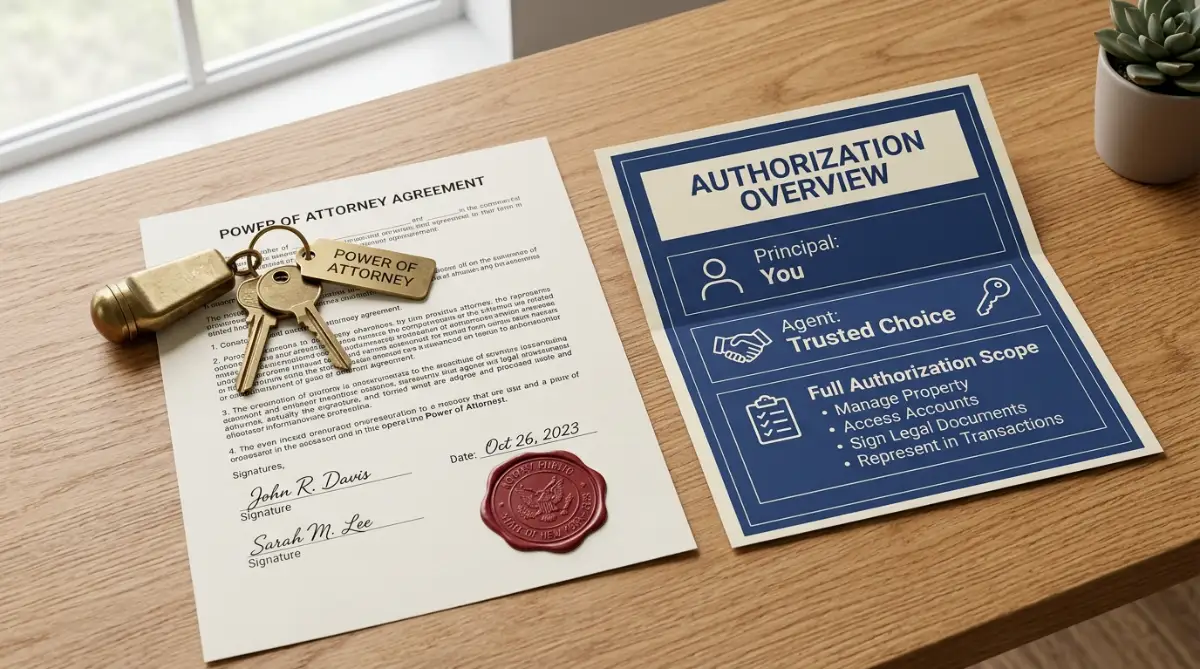
Exploring the Different Types of Authority
Not all legal documents are created equal, and one size definitely does not fit all. You can customize your paperwork to match your exact needs and comfort level. Let us look at the most common options available to you.
Think of a General Power of Attorney as handing over the master key to your whole life. With this document, your agent can access your checking accounts, sell your car, sign property contracts, and manage your taxes. It gives someone massive control, which works well if you travel overseas for work and need a dependable relative to run your day-to-day life. But you should only hand over this level of authority to someone whose honesty you trust without a single doubt.
The second option is a Limited or Special Power of Attorney. This is the exact opposite of the general version. Instead of a master key, you are giving your agent a key that only opens one specific door for a short amount of time.
For example, imagine you are buying a house, but you have to travel for work on closing day. You can sign a limited document that only allows your brother to sign the real estate papers for that specific house. Once the house is bought, his power completely vanishes.
The Difference Between Regular and Durable Documents
This next detail is where many families make a massive mistake. A regular power of attorney automatically cancels itself if you become mentally incapacitated. If you get into an accident and slip into a coma, a regular document becomes completely worthless.
To fix this problem, you need something called a "Durable" Power of Attorney. The word durable simply means the document stays strong and active even if your mind is no longer functioning. This is the exact document that saves families from the hospital nightmares I mentioned earlier.
If you want someone to manage your affairs when you are seriously ill, it absolutely must say it is durable. Without that specific legal wording, the bank will reject the document just when your family needs it the most. Always double-check your paperwork to ensure this word is clearly written.
Watch This Quick Explainer on How to Set Up Your Documents:
Separating Your Health from Your Wealth
Another smart strategy is to separate your medical decisions from your financial decisions. You might have a brother who is amazing with numbers and taxes. However, that same brother might be terrible at making emotional choices in a hospital room.
Because of this, you can create two totally different documents. A Financial Power of Attorney handles your money, bills, properties, and business choices. A Medical Power of Attorney handles your doctors, treatments, and end-of-life care.
You can name the exact same person for both jobs if you want to. But you also have the freedom to pick two different people who excel in different areas. Having the right person in the right role makes everything run much smoother.
When dealing with medical paperwork, it is often paired with a Living Will. A Living Will tells your agent exactly what kind of treatments you want or do not want. This prevents your agent from having to guess what you would prefer during a terrifying medical crisis.
How to Choose the Perfect Agent for Your Life
Picking the right agent is the most important part of this entire process. You are handing over a lot of control, so you need someone who is completely reliable. Do not just pick your oldest child simply because of tradition.
You need to ask yourself a few hard questions before making your choice. Is this person organized with their own money? Do they handle stress well, or do they panic during emergencies?
You also want someone who lives relatively close to you if possible. While digital banking makes handling money from afar easy, medical emergencies often require someone to be there in person. A local agent can rush to the hospital and speak directly with your doctors.
It is also highly recommended to name a backup agent. Life is unpredictable, and your first choice might become sick or unavailable when you need them. Having a secondary person listed keeps your safety net intact no matter what happens.
Some people try to name two agents to act at the exact same time. This is called acting "jointly." While it sounds nice to have two kids share the responsibility, it usually causes massive delays. If they disagree on a medical treatment, nothing gets done, and the entire system freezes.
My Pro Tip for you: I completely ruined my first attempt at setting this up by overcomplicating things and naming three people to act together. I quickly learned that requiring three signatures just to pay a phone bill was a logistical nightmare. Keep your primary agent to just one trusted person, and save the others as backups.
The True Cost of Skipping This Important Step
Many people avoid doing this paperwork because they do not want to spend the money. But you need to look at the big picture. Let us examine what happens if you ignore this and suddenly become unable to make decisions.
Your family will be forced to go to court and ask a judge to grant them "Conservatorship" or "Guardianship." This is a long, highly public, and very expensive legal battle (learn how to reduce probate and court costs before emergencies happen). A judge who does not know you will decide who gets to control your life.
Your family will have to pay expensive filing fees and hire lawyers just to get permission to manage your bank account. This process can take many months to complete. During those months, your bills go unpaid, and your assets are frozen tight.
As you can clearly see, spending a little bit of money today saves your family thousands of dollars later. It is essentially an insurance policy for your personal choices. It keeps the government out of your private family matters.
📊 Real Financial Comparison: Planning Ahead vs. Court Intervention
The Simple Steps to Making It Legal
Making your paperwork legally binding is actually a very straightforward process. You do not always need to hire an expensive law firm to get this done, though knowing how to pick the best attorney is helpful if your estate has complex assets. Many standard forms are available directly from your local government websites.
First, you need to find a template that is specific to your exact location. Laws change depending on where you live, so a generic form might not hold up in your local bank. Make sure the document specifically mentions your local laws and regulations.
Next, you will need to sit down and fill out the details clearly. Spell out exactly what your agent is allowed to do. If you want them to be able to sell your car but not your house, write that down plainly.
The most important step is signing the document correctly. Almost everywhere requires this document to be signed in front of a Notary Public. A notary is a certified official who verifies your identity and makes sure you are signing willingly.
Many places also require you to have one or two witnesses watch you sign. These witnesses usually cannot be the people you are naming as your agents. They must be independent adults who can confirm you were in your right mind during the signing.
Once it is signed and stamped, the document is officially active. You do not need to file it with a court unless it involves selling real estate. Keep the original copy in a fireproof safe at home.
Distributing the Documents to the Right Places
Creating the document is only half the battle. If nobody knows the document exists, it cannot help you in an emergency. You must distribute copies to the right people immediately.
Give a physical and a digital copy directly to your chosen agent. Sit down and explain to them where you keep your banking passwords, insurance papers, and property deeds. They cannot manage your affairs if they do not know where your accounts are held.
Take a copy of your medical documents to your primary care doctor. Ask them to scan it directly into your permanent health records. This ensures that any hospital in their network can see your preferences immediately.
You should also take a copy of your financial documents to your local bank branch. Some big banks have their own specific internal forms they want you to fill out alongside your standard document. Doing this while you are healthy prevents the bank from blocking your agent later on.
Breaking Down Common Myths and Misunderstandings
There are many rumors about how these legal tools actually work. Let us clear up the confusion so you can move forward with confidence.
Many people falsely believe that signing this document means giving up their own rights. That is entirely incorrect. You are just sharing authority, not losing it. You can still pay your own bills and make your own medical choices as long as you are mentally capable.
Another common myth is that marriage automatically gives you financial control over your spouse. While you might share a joint checking account, you do not automatically own their individual retirement accounts. If your spouse has a company in their name only, you cannot legally run it without written permission, which is why business owners must protect their small business from hidden legal disasters.
Some parents assume they can keep making decisions for their children forever. The reality is that once your child turns eighteen, they are legally an independent adult. If your college-aged child gets into an accident, doctors cannot legally share their medical details with you without a signed healthcare proxy.
How and When to Make Changes to Your Plan
Your life is going to change, and your paperwork needs to change right along with it. A document you signed ten years ago might not make sense for your life today. It is highly recommended to review your choices every three to five years.
You should definitely update your forms after any major life event. If you get married, get divorced, or have a child, you need to look at your paperwork. If the person you named as your agent moves away or passes away, you must draft a new document immediately.
Canceling an old document is called "revoking" it. To do this, you simply write a formal letter stating that you are canceling the previous powers. You must sign this letter, ideally in front of a notary, and send a copy to your old agent.
Make sure you also notify your banks and your doctors about the cancellation. If you do not tell the bank you canceled it, they might still let your old agent access your money. Always destroy the old physical copies to prevent any accidental confusion in the future.
Taking control of your future does not have to be scary or overwhelming. By understanding these simple tools, you are giving your family the greatest gift possible. You are giving them a clear map to follow during the darkest and most confusing days of their lives.
Start having these important conversations with your loved ones tonight. Decide who you trust the most, and take the basic steps to put it all in writing. The peace of mind you will feel afterward is absolutely priceless.
📌 Case Study: How One Word Saved Sarah's Home
The Situation: In 2024, Mark (54) suffered a severe stroke. He and his wife, Sarah, shared a home, but the primary checking account and mortgage deed were solely in Mark's name.
The Problem: The bank immediately froze Mark's individual account to prevent fraud. Sarah could not draw funds to pay their 2,400 USD monthly mortgage.
The Resolution: Two years earlier, Mark had executed a Durable Financial Power of Attorney naming Sarah as his agent. Because the document clearly contained the word "Durable," the bank verified her authority within 48 hours, keeping the mortgage current and avoiding court guardianship fees.
💡 Myth vs. Fact Quick Check
- Myth: "My spouse automatically gets access to my individual retirement and bank accounts if I am hospitalized."
- Fact: Banks strictly follow account titling laws. Without joint ownership or a signed Financial Power of Attorney, individual accounts are frozen instantly.
- Myth: "A Power of Attorney allows my daughter to handle my funeral and distribute my belongings after I pass."
- Fact: The legal authority of any Power of Attorney ends the second you pass away. After death, your Last Will and Testament or Trust takes full control.
Next-Level Strategies for Total Legal Security
Setting up your paperwork is a huge first step, but just having the paper is not always enough. You want to make sure your documents actually work flawlessly in the real world. Let us look at some advanced strategies that professionals use to protect their clients.
One of the biggest hurdles families face is dealing with large national banks. Banks are terrified of fraud, so they often push back against outside legal forms. I have seen perfectly legal paperwork get rejected simply because the bank manager did not recognize the template.
To avoid this nightmare, you need to be proactive while you are still healthy. Take your signed documents directly to your local branch and ask to speak with the branch manager. You should ask them to add your agent to their specific internal computer system right now.
Many financial institutions have their own specific internal forms they want you to fill out. If you sign their internal forms alongside your state documents, you remove all the friction. This guarantees your agent can access funds without arguing with a customer service representative for three hours.
Here is a quick look at the hidden costs of fighting bank rejections versus planning ahead.
The Dangerous Trap of "Springing" Documents
A lot of people pick a "springing" document because it feels safer. On paper, it means your agent gets zero control until a doctor officially signs off that you cannot think for yourself. In reality, this causes painful delays. Try getting two busy doctors to quickly review your medical records, write formal legal letters, and send them to your bank while your mortgage payment is bouncing. If you truly trust your chosen agent, make the document active immediately. If you worry they might misuse your money while you are healthy, you simply picked the wrong person.
Mastering the Out-of-State Confusion
People move constantly, and lots of folks split their time between different regions during the winter. A major issue pops up when a hospital in Florida looks at paperwork drafted in Ohio. Laws vary widely depending on where you are standing at that exact moment.
If you spend a lot of time traveling, you need to carry digital copies of everything on your smartphone. I always recommend emailing the signed PDFs to yourself so you can pull them up anywhere in the world. You never want to wait for someone to mail a physical paper across the country during an emergency.
If you permanently move to a new state, it is highly recommended to sign new documents immediately. While your old forms might technically still be legal, local banks are used to seeing their own local formats. Getting new paperwork prevents unnecessary delays when time is of the essence.
You can easily learn more about managing someone else's money through trusted government resources to better prepare your agent. Providing them with educational resources makes their job much less stressful.
Having the Awkward Family Conversation
This is the part everyone hates doing, but it changes everything. You absolutely must sit down and talk to your family about the choices you made. Surprising your children with these decisions during a medical emergency is incredibly unfair to them.
You need to clearly explain why you picked one person over another. Tell your oldest child that you picked their younger sibling because the younger one lives five minutes away from the hospital. Making it about logistics rather than favoritism stops arguments before they even start.
Make sure your chosen agent knows exactly where you keep your most important items. They need to know where your safe is, who your accountant is, and what your digital passwords are. An agent with a signed piece of paper but no passwords is like a mechanic with a wrench but no car to fix.

The Heartbreaking Pitfalls That Destroy Families
Even with the best intentions, families constantly fall into the same predictable traps. Fixing these errors later is almost always messy and extremely expensive. Let us walk through the biggest mistakes so you can keep your family out of the courtroom.
Picking an Agent Out of Pure Guilt
When I first organized my paperwork, I almost picked my oldest brother simply because he was the eldest. That would have been a terrible mistake. He is a wonderful person, but he gets flustered looking at spreadsheets and hates hospital environments. Treat this choice like a job interview, not a family popularity contest. If your eldest child struggles with personal debt, do not hand them your life savings. Pick the person who stays calm under pressure, answers their phone promptly, and knows how to ask hard questions.
The Safe Deposit Box Trap
I see this specific disaster happen all the time. Someone does everything right, signs all their paperwork, and then proudly locks the only copy inside a bank safe deposit box. They think they are being incredibly responsible by keeping it secure.
The problem is that the bank will not let anyone open that box unless their name is on the account. If you fall into a coma, your agent goes to the bank to get the paper that proves they are your agent. The bank manager asks to see the paper first, which is locked inside the box they are not allowed to open.
It is a complete catch-22 that locks your family out entirely. Your family will have to hire a lawyer and get a court order just to drill the lock on the box. Always keep the original copies in a fireproof safe at home, and make sure your agent knows exactly where the key is.
The Waiting Game Disaster
People love to procrastinate when it comes to legal paperwork. They think they will just sign everything when they get a little older or when they start feeling sick. This mindset completely misunderstands how the law actually works.
To sign this paperwork, you must have the mental capacity to understand exactly what you are doing. If you wait until early signs of dementia appear, a notary will refuse to stamp your document. The law strictly protects vulnerable people from signing away their rights when their minds are clouded.
Once that mental clarity is gone, the window to sign the paper closes forever. You cannot go back in time. It is highly recommended to read up on understanding cognitive decline symptoms so you know why acting early is your only real protection. Your family will be forced into the expensive court guardianship process we discussed earlier.
You have to buy the parachute long before you jump out of the airplane. Waiting until the emergency has already started means it is simply too late to protect yourself.
Believing the Power Survives Death
This is a massive misconception that gets families in huge trouble with the IRS and the courts. Many people think this document gives their agent the right to pay for their funeral or distribute their inheritance. They assume the agent just keeps managing things after they pass away.
The absolute second your heart stops beating, this document becomes entirely worthless. All the legal authority you granted instantly vanishes into thin air. You cannot use this form to empty a bank account after the owner has passed away.
Once you are gone, your Last Will and Testament takes over completely to determine asset distribution. The person named in your Will steps forward, and the probate process officially begins. Trying to use a power of attorney at a bank after someone dies is actually considered fraud, so make sure your agent understands when their job finishes.
❓ Frequently Asked Questions About Power of Attorney
1. What is the main difference between a regular and a durable Power of Attorney?
A regular Power of Attorney ends automatically if you become mentally incapacitated or slip into a coma. A Durable Power of Attorney includes specific wording that keeps the document active and legally valid even if you lose the ability to make decisions for yourself.
2. Can my agent use my money for their personal expenses?
No. Your agent has a strict fiduciary duty under the law. This means they are legally required to manage your money solely for your benefit, pay your bills, and act in your best financial interest. Using your funds for their own benefit is considered fraud.
3. Do I need a lawyer to create a valid Power of Attorney?
You do not always need a lawyer for standard family situations. You can use verified state-specific legal forms provided by state agencies or legal template platforms. However, you must follow your state's signing rules, which almost always require a Notary Public and independent witnesses.
4. Can I revoke or cancel my Power of Attorney at any time?
Yes. As long as you are mentally competent, you can cancel your document at any moment. You just need to write and sign a formal Revocation Document, give a copy to your former agent, and deliver written notice to your banks and doctors.
5. Does a Power of Attorney give someone the right to change my Will?
No. An agent cannot alter, rewrite, or create a Last Will and Testament on your behalf. Their authority applies only to managing your property, finances, and healthcare choices during your lifetime.
📚 Related Essential Legal & Business Guides
📄 Contracts & Property Law:
- Understanding Contract Law: How to Protect Your Rights and Agreements
- How to Read a Commercial Lease Agreement Without a Lawyer
- Simple Ways to Resolve Rental Arguments Outside of Court
💼 Business Formation:
🛡️ Intellectual Property:
- Trademark vs. Patent vs. Copyright: How to Secure Your Business Assets
- How to Register a Trademark: A Simple Legal Guide for Beginners
- Stop Digital Theft: Easy Ways to Secure Your Online Intellectual Property
⚖️ Family & Personal Rights:
- The Ultimate Document Checklist for a Stress-Free and Simple Divorce
- How to Protect Your Rights with Proper Accident Documentation
Your Action Plan for Complete Peace of Mind
Getting your affairs in order might feel like a heavy task, but it is actually one of the most freeing things you can do. You are taking complete control over the unknown parts of life. By setting up these documents, you are building a massive brick wall around your family's future.
You no longer have to worry about judges making choices for you. You do not have to stress about your spouse being locked out of the checking account during an emergency. Everything is mapped out perfectly, and your loved ones know exactly what to do.
Think of this as the ultimate act of love for your family. You are removing all the guesswork, all the expensive lawyer fees, and all the sibling arguments. You are giving them a clear instruction manual for your life.
My Personal Thoughts on Taking Action
I still remember the incredible relief I felt the day I finally brought my signed paperwork back home. I sat at my kitchen table, looked at the neat stack of documents, and realized a huge weight had disappeared from my shoulders. I knew that no matter what happened to me tomorrow, my family would not have to fight the hospital or the bank. I did not just protect my money; I protected my family's emotional well-being. Please, do not wait for a tragic wake-up call to get this sorted out. If you need complex planning, learn what to expect when meeting a lawyer for the first time, get your forms sorted out today, and give yourself the gift of sleeping soundly tonight.
Disclaimer:
The information provided in this blog post is for educational and informational purposes only and should not be construed as formal legal or financial advice. Laws vary significantly by location and individual circumstances. You should always consult with a qualified attorney or certified financial planner in your specific area before making any legal decisions or signing legally binding documents.